Folio №01 · vs Claude · 2026-10-11
General chat AI, coding agents and overseas writing tools

Writing Novels with Claude vs Maliang Writer: Who Handles Story So Far and Settings in a Long Serial

Claude writes well and Projects holds settings, but over dozens of chapters you pick the context, update settings and compare edits. Price and regions compared.

❦ · Verdict · ❦
Bottom line

The short answer

Claude suits discussing plot, drafting passages and revising, and Projects keeps settings and instructions together. In a long serial, which earlier text goes with each chapter, where to edit when a setting changes and what this version changed are all for the author to arrange. Maliang turns characters, settings and foreshadowing into cards, organizes story archives after each chapter is written, and shows AI changes right in the editor, where you can keep or restore each one.
Who should pick Maliang WriterAuthors writing a Chinese serial of several hundred thousand characters who want the new chapters and settings AI writes to go straight into the table of contents and cards, and who don’t want to maintain a pile of setting files themselves.
Who should pick ClaudeAuthors who mainly use AI to talk through plot or write short stories and single-chapter passages, already have a Claude subscription and live in a region on the official supported list; authors who are comfortable on the command line and willing to build their own folder structure can also look at Claude Code.
Scenario

A concrete writing scenario

An author writing a xianxia serial creates a Project in Claude: the knowledge base holds the worldbuilding, short biographies of the main characters and the outlines of the first twenty chapters, the project instructions set out the style and forms of address, and each chapter gets a new conversation. The first twenty chapters go smoothly. By chapter sixty, the protagonist has advanced two cultivation realms, two supporting characters have switched sides, and the jade pendant planted in chapter twelve has not been paid off. Now, before each chapter, he has to decide which earlier chapters to paste this time, which setting in the knowledge base needs a new version, and exactly which sentences differ between the last draft and this one. None of it is hard, but it has to be done for every chapter, and he has to remember it all himself. Maliang takes this part over.

❦ · Matrix · ❦
Comparison table

12 dimensions compared one by one

On narrow screens, scroll sideways to see all columns.

Maliang Writer vs Claude: key dimensions compared
DimensionMaliang WriterClaudeNotes
Product form✅ Web editor plus AI chat, ready to use in the browser with nothing to install✅ Claude.ai on the web; desktop apps for macOS and Windows (Linux version in beta); iOS and Android
How the manuscript is organized✅ Volumes, chapters and chapter outlines are separate; characters, settings, foreshadowing and storylines are individual cards; the master outline is stored separately; style samples and the like are documents⚠️ Projects: each project has conversation history, a knowledge base (uploaded documents) and project instructions; no official material found on novel-specific chapter or character management
What story-so-far comes with a new chapter✅ The writer agent brings in the preceding text, relevant characters and style samples this chapter needs according to the chapter outline✅ On paid tiers, new models have a 1M-token context per conversation; when project knowledge nears the limit, retrieval turns on automatically and capacity expands by up to about 10×
Tracking character states and foreshadowing✅ After a chapter is written and this stretch of writing ends, story archives are organized: character states, relationships, locations, foreshadowing; anything that conflicts with existing settings is listed as pending confirmation; can be turned off⚠️ Memory is saved by topic and can be viewed, edited and deleted, with separate memory for each project; no official material found on tracking character states chapter by chapter
How to see what AI changed✅ Red for deletions and green for additions in the editor; keep or restore each change, or keep all or restore all⚠️ Artifacts can be edited through conversation or directly; no official material found on word-by-word comparison of additions and deletions
When you’re not satisfied✅ Undo the current round, branch from before the round, or edit and resend; the branch shares the same manuscript as the original conversation⚠️ No official material found on undoing a whole round in Claude.ai; Claude Code creates a checkpoint automatically with every prompt and you can roll back with /rewind
Old settings once you reach a new volume✅ Characters, places and foreshadowing that only appeared in earlier volumes are moved into the archive; AI no longer consults them when writing new chapters, but they can still be looked up when needed; when a character returns, they go back into regular use⚠️ No official material found
Genre reference✅ When starting a book, consult the character setups and pacing of popular books in the same genre (breakdowns of characters and structure of more than 1,500 popular serials in the public book library), learning methods rather than copying⚠️ No official material found (you can upload your own reference material to the project knowledge base)
Chapter-ending check✅ Each chapter comes with a chapter-ending check, benchmarked against more than 2,000 popular web novels and about 56,000 chapter endings⚠️ No official material found
Models✅ A choice of several models, see the in-product list for specifics; the model that writes the body text can be chosen separately✅ Free can use Sonnet and Haiku; Pro and above can use Opus, Sonnet and Haiku
Price✅ Free sign-up to try; credits are deducted by usage, and each round’s cost is shown under the reply✅ Free $0; Pro $20/month ($17/month billed annually); Max from $100/month (checked against the official pricing page in 2026-10)
Regions✅ A Chinese-language web product for Chinese-language authors❌ The official supported-region list does not include Mainland China, Hong Kong or Macau, covering Claude.ai, Claude Code and the API

✅ Confirmed in official material or in the product   ⚠️ Partly supported, or not stated in official material   ❌ Officially not supported · Competitor information comes from their public material.

How Maliang Writer approaches it

How Maliang Writer handles these problems

№01 Maliang Writer

Characters and settings are cards, not one document that keeps growing

In the left sidebar, characters, settings, foreshadowing and storylines are individual cards, the master outline is stored separately, and style samples and book-opening material are documents. Say in chat “give the protagonist a sect”, and AI edits that card, with the change appearing straight in the sidebar; whatever you edit yourself in the editor, AI can see in the next round.

№02 Maliang Writer

After a chapter, the archive records what happened in it

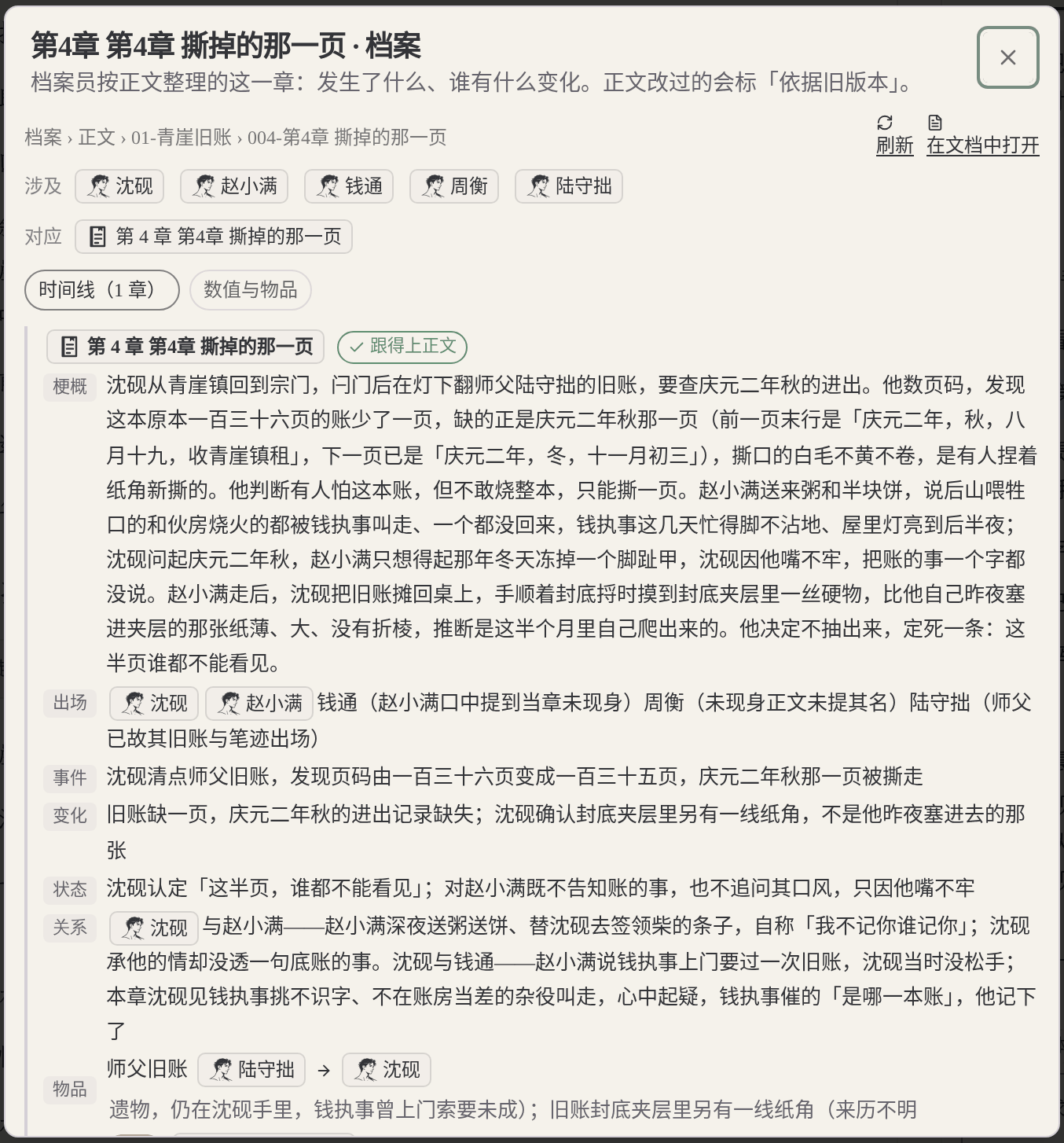
After a chapter is written and this stretch of writing ends, the background organizes this chapter’s story archive: character states, relationship changes, locations, and where foreshadowing is planted and advanced. Anything that conflicts with existing settings is listed as “pending confirmation”, and you decide whether to change the setting to match the text, change the text, or ignore it. If you don’t want it, you can turn it off above the chat box.

№03 Maliang Writer

What AI changed is visible at a glance in the editor

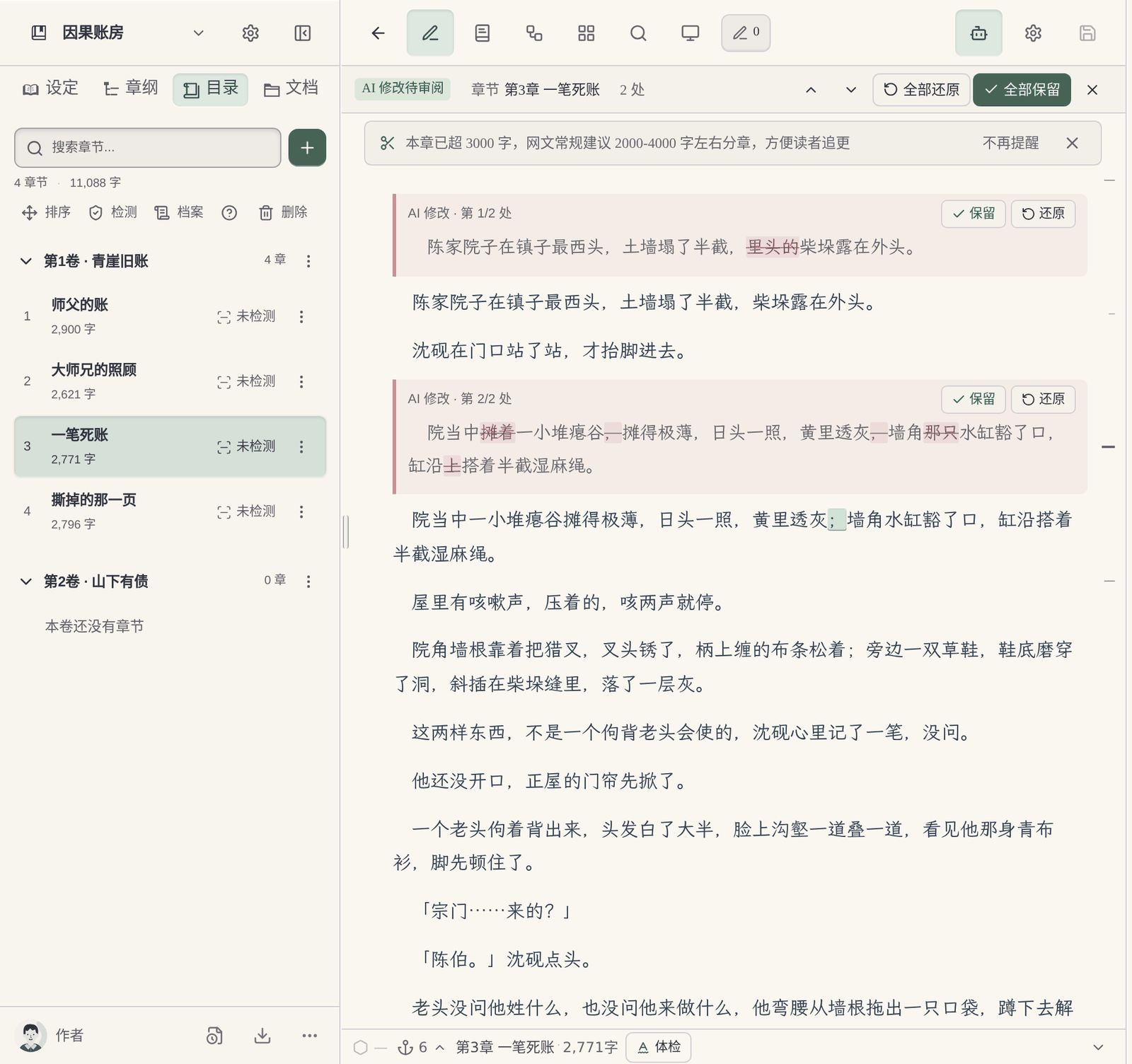
When AI edits the body text or a document, changes are marked right on the original: deletions are struck through and additions are green, and you can keep or restore each one. If you are unhappy with a whole round, you can undo the current round, change one sentence and resend, or branch from before this round (the branch shares the same manuscript as the original conversation).

  1. The body text goes to the writer agent, drawing on the book’s earlier text and style samples: Say “keep writing the next chapter” and the body text goes to a dedicated writer agent, which brings in the preceding text, relevant characters and style samples this chapter needs according to the chapter outline. Each chapter comes with a chapter-ending check, benchmarked against more than 2,000 popular web novels and about 56,000 chapter endings. The model that writes the body text can be chosen separately from the chat model.
  2. Reaching a new volume, old settings fold away automatically: When you reach a new volume, characters, places and foreshadowing that only appeared in earlier volumes are moved into the archive; AI no longer consults them when writing new chapters, but they can still be looked up when needed, and go back into regular use when an old character returns. Late in a long serial, the material AI looks at by default doesn’t keep piling up.
What you fill in yourself

What the author has to do when writing a long novel directly with Claude

  1. You pick which earlier text goes with each chapter: Claude’s paid tiers have a large context and Projects can expand capacity, but which chapters and characters a given chapter should draw on is still for the author to arrange in the conversation. Maliang’s writer agent gathers material from the chapter outline automatically, and you only need to confirm the outline.
  2. When settings change, you go back and edit the knowledge base: After the protagonist levels up or a supporting character switches sides, no official material describes automatic chapter-by-chapter upkeep of character biographies, so the author usually has to remember which file in the knowledge base to edit. Maliang organizes the archive after a chapter is written and lists anything that doesn’t match for you to confirm.
  3. Draft versions and change comparison are yours to keep: Artifacts can be edited directly, but official material does not describe a word-by-word comparison of additions and deletions. To know what this draft changed from the last, you usually have to save the old draft and compare.
  4. The table of contents for volumes, chapters and characters is yours to build: Projects is a general-purpose workspace with no novel-specific table of contents for volumes and chapters and no character cards. After several dozen chapters, where chapters go, in what order, and which character appears in which chapter has to be sorted out by the author.
Where they are strong

What Claude does well

Claude is strong at understanding and writing Chinese, and suits discussing character motivation, rewriting paragraphs and offering several plot options. Projects keeps conversations, the knowledge base and project instructions together, and on paid tiers project knowledge can be expanded; Memory can be viewed and edited, and incognito chats are supported. Claude Code can read and write a whole folder and make batch edits across files, and some authors use it for continuity checks on long novels. If you are in an officially supported region and write short fiction or mainly discuss ideas, Claude is already very good on its own.

Every product suits some scenarios; the advice here covers only one: serialized long-form fiction in Chinese.

Real interface

Maliang Writer's real interface

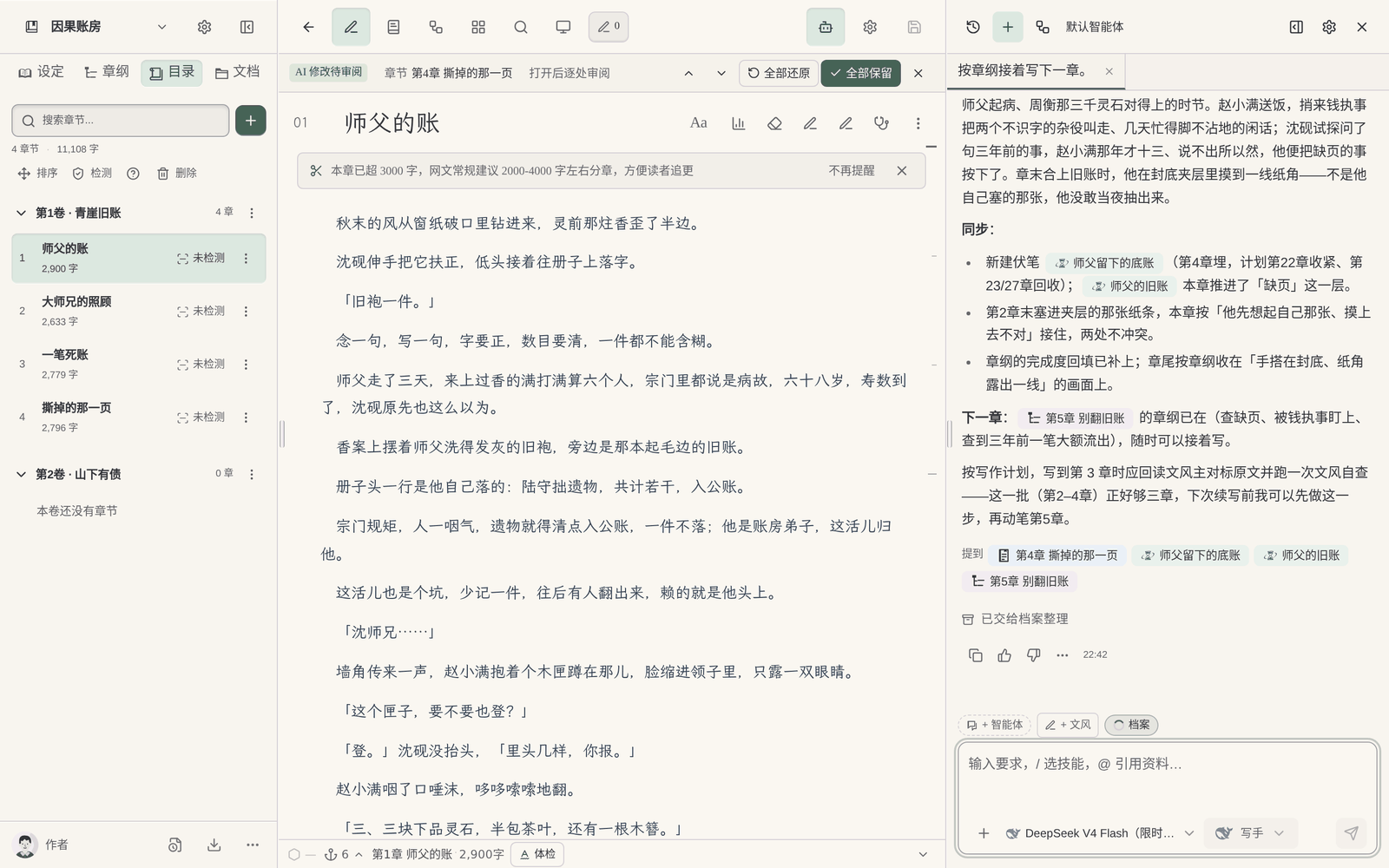
Asking Maliang in chat to keep writing, with a new chapter appearing in the left-hand table of contents and the text
The author says “keep writing” in chat, and the new chapter appears in the left-hand table of contents and the text.
Maliang’s archive for this chapter: character states, relationships, locations, foreshadowing
The author opens this chapter’s archive to check character states, relationships and foreshadowing.
Red deletions and green additions for AI changes in the Maliang editor, each of which can be kept or restored
The author goes through AI’s changes one by one in the editor and decides whether to keep or restore each.
❦ · Evidence · ❦
Data and sources

Sources and check dates

Try four real writing tasks before you decide

For this page, record in particular what earlier-chapter and character material has to be provided again before the next chapter starts, and, after switching to a new conversation, how you confirm it is still working from the current manuscript of this book. Rely on actual experience.

Below is a same-task trial checklist, not a finished comparison experiment. You can use the original teaching material “Jiehuo City” or a manuscript you have the right to handle; record the preparation, the output and the author’s edits for each tool.

Start a new book

Give both tools the same protagonist, core rules and reading preferences; compare the opening directions first, then organize the master outline, the first volume outline and the outlines for the first three chapters.

Check: Can it tell the roles of the three outline levels apart? Can the author confirm a plan before it continues? Were settings that hadn't been settled yet quietly written in as fact?

Use the same book-opening kit

Continue an existing twenty chapters

Use the same old manuscript you have the right to handle, specify how the last chapter ends and the goal of the next chapter; try writing one scene first, without changing the previous twenty chapters.

Check: What material did you prepare? Did character positions, items and open threads carry over? How are candidate drafts told apart from adopted ones?

See the import-and-continue task checklist

Change a setting that has already appeared

Pick a real rule that affects earlier chapters; first ask it to list the affected chapters and the evidence, then let the author choose the scope of the change.

Check: Does it say which parts it did not check? Can you review the changes first? Did it wrongly edit text outside the task or write an unadopted plan into the material?

See how to change a setting

Take your work and material with you

Actually try keeping the text, the order of volumes and chapters, character profiles and world rules, and check whether the output is suitable for further editing; list what cannot be taken along.

Check: Are the format and order recognizable? What material is inside the platform account, what is in local files, and what is in the export? Do not infer usability from a marketing page alone.

Copy the task and result record card

Record the models, plans or account conditions you actually used, and the time spent preparing materials and editing the text. Leave blank anything you have not tried or cannot confirm; do not let a feature name or a single generation stand in for the full experience.

How to choose

Choose by your situation

FAQ

FAQ

Is Claude good for writing novels?

Claude is strong at understanding and writing Chinese, and suits discussing plot, drafting passages and revising. In a long novel, you decide which earlier text goes with each chapter, which material to update when a setting changes, and how to save and compare versions. Maliang turns these into cards, story archives and revision comparison in the editor.

Can Claude write a long novel?

Yes. On paid tiers new models have a 1M-token context, and Projects can hold setting files. The hard part of a long novel is that settings change with the plot: characters level up, switch sides, foreshadowing gets paid off, and the author has to update all of it. Maliang organizes story archives after a chapter is written and lists anything that doesn’t match as pending confirmation.

Is Claude Projects good for writing novels?

It works well for holding worldbuilding, character biographies and writing requirements, which all conversations in the project share. It is a general-purpose workspace with no volume-and-chapter table of contents and no character cards; once there are many chapters, the author has to sort out chapter order, character states and foreshadowing progress.

Can Claude Code write novels?

Yes. Some authors online use Claude Code to manage a whole book’s folder, writing rules in CLAUDE.md and recording settings in tracking files. It suits authors who are comfortable on the command line and willing to build their own folder structure; for details and public practice, see the “Maliang Writer vs Claude Code” comparison page.

Does writing a novel with Claude cost money?

Claude has a free tier (Sonnet and Haiku available, up to 5 Projects); Pro starts at $20/month, and Claude Code is offered only on Pro and above (checked against the official pricing page in 2026-10). Maliang is free to sign up and try, and then deducts credits by usage.

Can I use Claude to write novels in China?

Anthropic’s official supported-region list does not include Mainland China, Hong Kong or Macau, and states that this restriction covers Claude.ai, Claude Code and the API. Maliang is a web product for Chinese-language authors.

Can I use Claude models in Maliang?

Maliang offers a choice of several models, and the chat model and the body-text model can be chosen separately; see the in-product model list for specifics.

Will Maliang get settings wrong?

AI can still write content that conflicts with settings. Maliang’s approach: after a chapter is written it organizes the archive and lists anything that conflicts with existing settings as pending confirmation, and you decide whether to change the setting, change the text or ignore it. It does not promise there will be no contradictions at all.

I’ve already written part of my book in Claude. How do I move it to Maliang?

Put the body text into Maliang’s table of contents chapter by chapter, then send the character biographies and worldbuilding to the AI in Maliang and have it organize them into character cards and setting cards; once you’ve checked them, keep writing. Older chapters can have their archives organized as needed, and the credit cost is estimated beforehand.

❦ · Continued · ❦
Related comparisons

Related comparisons

Can Claude Code Write Novels? How Public Practice Works and How It Differs from Maliang Writer

vs Claude Code · updated 2026-10-11

Claude Code can write novels, and it is very capable: it reads and writes a whole book’s folder, checks continuity across files and makes batch edits. In public practice, authors design the folders, write CLAUDE.md, maintain a setting ledger and work in a terminal or editor plugin, which suits authors who are comfortable on the command line. Maliang builds the table of contents, character cards, story archives and revision comparison into a web editor, and the author starts writing from the chat.

Read the comparison →

Writing Novels with ChatGPT vs Maliang Writer: How Projects and a Novel Editor Divide the Work in a Long Serial

vs ChatGPT · updated 2026-10-11

ChatGPT suits brainstorming, drafting passages and polishing sentences. Projects keeps story files and instructions together, and Memory remembers preferences. In a long serial, how chapters are ordered, where to edit when a setting changes and what this draft changed are still for the author to arrange. Maliang puts volumes and chapters, character cards, story archives and revision comparison in one editor.

Read the comparison →

Can Gemini’s 1M Context Write a Long Novel? How It Compares with Maliang Writer for Long Fiction

vs Gemini · updated 2026-10-11

Gemini’s long context can take in a large amount of earlier text at once, Gems and Notebooks keep material fixed, and Canvas edits drafts directly and lets you page through earlier and later versions, which suits reading through, summarizing and rewriting whole passages. In a long serial, which setting is the latest, where a character is now and which sentence this draft changed are still for the author to manage. Maliang turns these into cards, story archives and revision comparison in the editor.

Read the comparison →
Get started

Try one chapter of the book you're writing

After signing up, create a book or import existing chapters, tell the AI which chapter to continue, then look at what it wrote, what it changed and what it recorded in the archive, and decide whether to move your long novel over.