Folio №05 · vs Novelcrafter · 2026-10-11
General chat AI, coding agents and overseas writing tools

Does Novelcrafter Work in Chinese? Novelcrafter vs Maliang Writer for Long Fiction

Novelcrafter is an author-driven writing tool with a Codex, Progressions and Grid / Matrix / Outline views; you bring your own AI. Compared with Maliang, with prices.

❦ · Verdict · ❦
Bottom line

The short answer

Novelcrafter gives control to the author: the setting library is brought in automatically when entries are mentioned, Progressions manage how settings change over time, the Matrix view tracks character appearances, and you choose and connect your own model. The price is that you connect the AI service yourself and maintain the setting library and prompts yourself. Maliang has models built in, organizes story archives after each chapter is written, lets you review AI changes one by one in the editor, and provides genre reference for Chinese web novels.
Who should pick Maliang WriterAuthors writing Chinese web novels who don’t want to connect an AI service and tune prompts themselves and want settings organized automatically as chapters are written.
Who should pick NovelcrafterAuthors who like fine-grained control, are willing to bring their own API or use a local model, write English-language fiction and need the Matrix view for planning.
Scenario

A concrete writing scenario

A Chinese author writing a long mystery likes Novelcrafter’s Matrix view and wants to use it to manage three interwoven timelines. Before getting started he has several things to do: sign up with an AI provider and add credit, and enter the API key; create characters and places one by one in the Codex; add Progressions for two characters who change identity midway; and check that the chosen model’s Chinese output is what he expects. Once these are set up, Novelcrafter runs by his rules. Maliang’s approach is to do the steps of connecting a model, building the archive and recording changes first, so the author can start writing from the chat.

❦ · Matrix · ❦
Comparison table

10 dimensions compared one by one

On narrow screens, scroll sideways to see all columns.

Maliang Writer vs Novelcrafter: key dimensions compared
DimensionMaliang WriterNovelcrafterNotes
Where the AI comes from✅ Built in, with a choice of several models, see the in-product list for specifics; credits are deducted by usage✅ The official site does not provide a model; you connect OpenAI, Anthropic, Google, OpenRouter and others, or a local model (LM Studio, Ollama)Each approach has its trade-offs: built in is convenient, bringing your own is controllable
Setting library✅ Characters, settings, foreshadowing and storylines are cards; AI can read and write them as you ask✅ The Codex stores characters, places and settings, brings them into the AI context automatically when mentioned, and can be shared across books in a series
Settings changing with the plot✅ After a chapter is written, story archives are organized (character states, relationships, locations, foreshadowing), and anything that doesn’t match is listed as pending confirmation; when you reach a new volume, old settings are moved into the archive✅ Progressions: add content to a Codex entry that is visible only after a certain point in time; the author has to add it
Planning views✅ Planning canvas and storylines (existing features retained)✅ Plan has three views: Grid, Matrix (tracks character and location appearances and subplots by entry) and Outline
Versions and undo✅ Undo the current round, branch from before the round, or edit and resend✅ Revision History covers body text, summaries, the Codex and more, a scene gets a revision every 3 minutes, and Ctrl/Cmd+Z is supported
Revision comparison✅ AI changes appear on the original in the editor as red deletions and green additions, each of which can be kept or restored⚠️ Restoring is a direct replacement; no official material found on a side-by-side diff
Talking to the book✅ In chat you can @ chapters, chapter outlines, settings, characters and documents, and use / to pick a writing method✅ Workshop Chat can talk with the novel, and new ones can only be created on the Artisan and Specialist tiers; it reads about the latest 25 messages
Chinese✅ A Chinese-language product for Chinese web-novel authors⚠️ Officially says generation works as long as the model supports the language and it is written left to right; Chinese is not mentioned specifically
Genre reference✅ When starting a book, consult the character and structure breakdowns of more than 1,500 popular serials in the public book library; chapter endings are benchmarked against about 56,000 popular chapter endings⚠️ No official material found on genre reference for Chinese web novels
Price✅ Free sign-up to try; credits are deducted by usage✅ Scribe $4 (no AI), Hobbyist $8, Artisan $14, Specialist $20 per month; 21-day trial, no free tier; AI costs are paid separately to the provider (checked 2026-10)

✅ Confirmed in official material or in the product   ⚠️ Partly supported, or not stated in official material   ❌ Officially not supported · Competitor information comes from their public material.

How Maliang Writer approaches it

How Maliang Writer handles these problems

№01 Maliang Writer

No need to connect an AI service yourself

Models are built in, with a choice of several, and chat and body text can be chosen separately; see the in-product list for specifics. The credits each round costs are shown under the reply, and it pauses when credits run out.

№02 Maliang Writer

Setting changes are organized in the background

Progressions have to be added by the author; after a chapter is written and this stretch of writing ends, Maliang organizes the archive, recording character states, relationships, locations and foreshadowing, and lists anything that doesn’t match as pending confirmation. It can be turned off.

№03 Maliang Writer

What AI changed is visible on the original

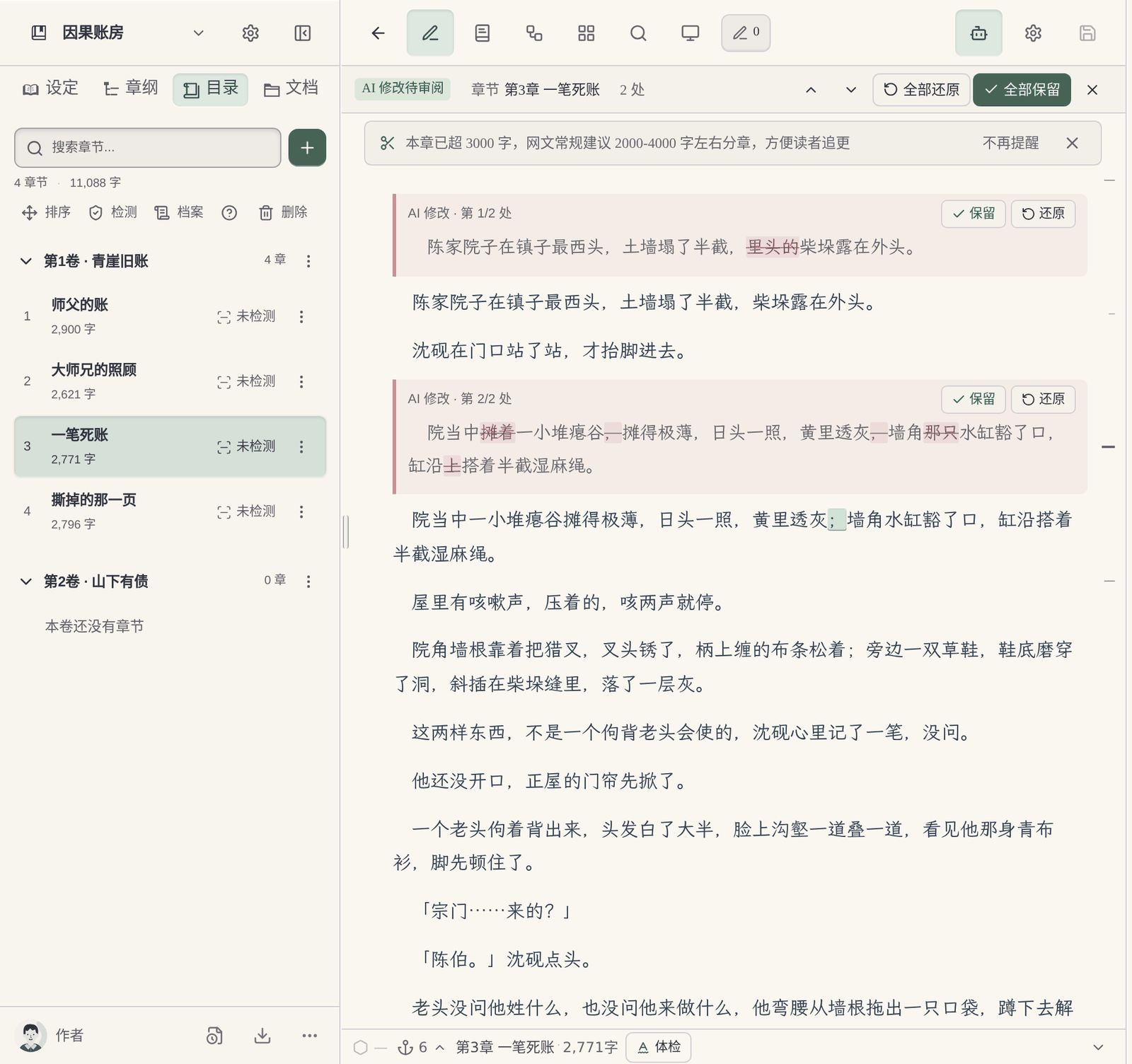
Changes are marked in the editor as red deletions and green additions, and you can keep or restore each one, or keep all or restore all.

  1. Genre and chapter-ending benchmarks for Chinese web novels: When starting a book, it consults the character and structure breakdowns of more than 1,500 popular serials; each chapter comes with a chapter-ending check, benchmarked against more than 2,000 popular web novels and about 56,000 chapter endings.
  2. Combine writing methods in chat: Type / to pick a writing method (such as chapter diagnosis or AI-flavor removal) and @ to specify chapters and characters; one message can combine several.
What you fill in yourself

What the author has to do when writing a long novel directly with Novelcrafter

  1. You connect and pay for the AI service yourself: The official wording is “we currently do not offer any AI model ourselves”. The author has to choose a provider and manage API keys and quotas, with costs charged separately.
  2. Setting changes are yours to write into Progressions: Progressions keep AI from writing settings that haven’t happened yet, but the author has to add one for every change to a character.
  3. You verify how it works in Chinese yourself: The official site only states that left-to-right languages are supported and it depends on the model, and does not discuss Chinese specifically; the author has to tune prompts for the pacing and chapter endings of Chinese web novels.
  4. Revision comparison is yours to read: Restoring from Revision History is a direct replacement, and official material does not describe a side-by-side diff.
Where they are strong

What Novelcrafter does well

Novelcrafter is the standard-bearer of “author-driven” tools: the Codex is brought in automatically when entries are mentioned and can be shared across a series, Progressions handle settings changing over time, the Matrix view is very useful for tracking character appearances and subplots, prompts can be customized with variables, any provider or local model can be used, and API keys are stored only locally in the browser. The official site states that it does not train models on creative content, and the team describes itself as “Built by writers, for writers”. English-language authors who like fine-grained control will feel at home.

Every product suits some scenarios; the advice here covers only one: serialized long-form fiction in Chinese.

Real interface

Maliang Writer's real interface

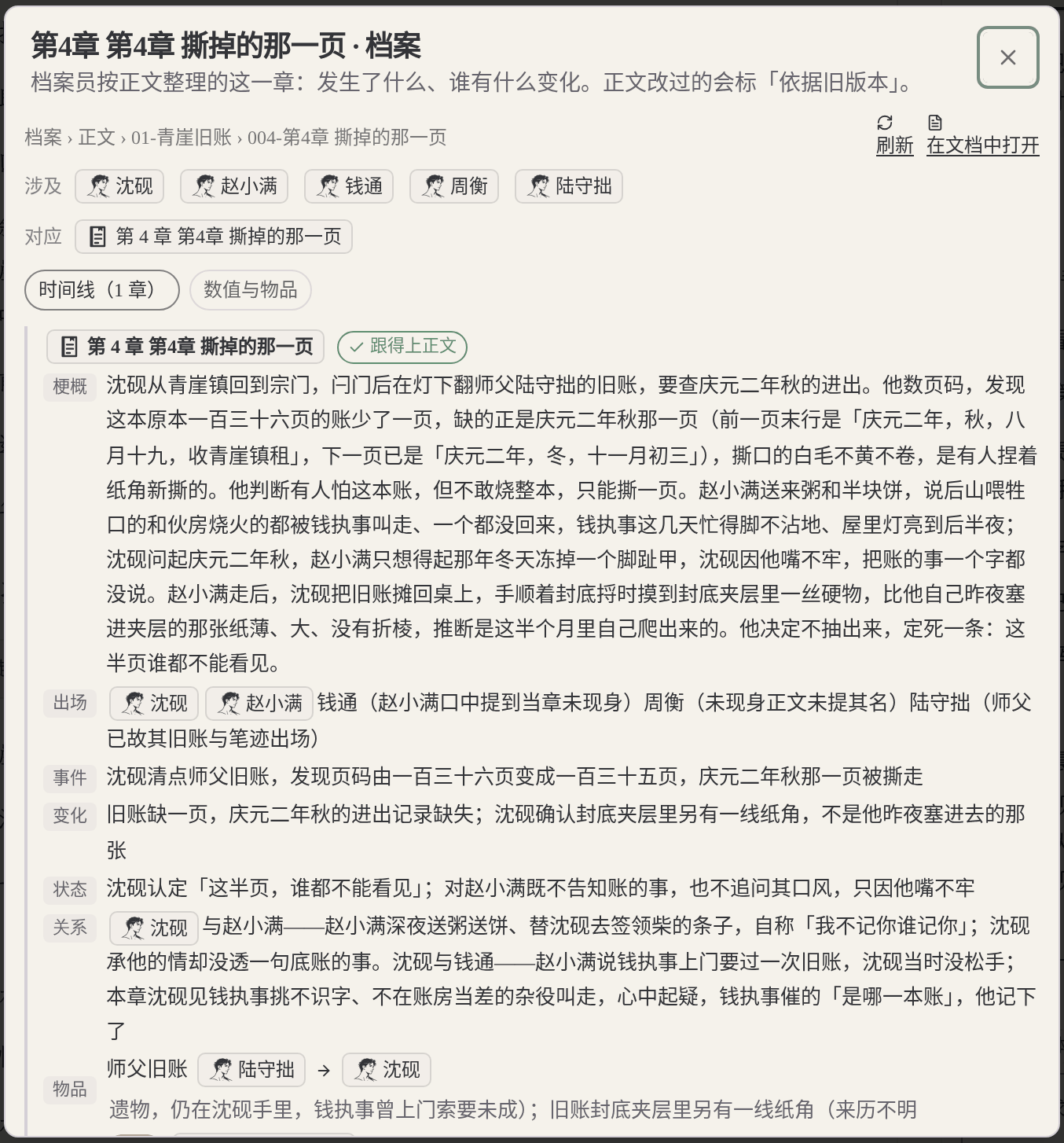
Maliang’s archive for this chapter: character states, relationships, locations, foreshadowing
The author checks this chapter’s archive.
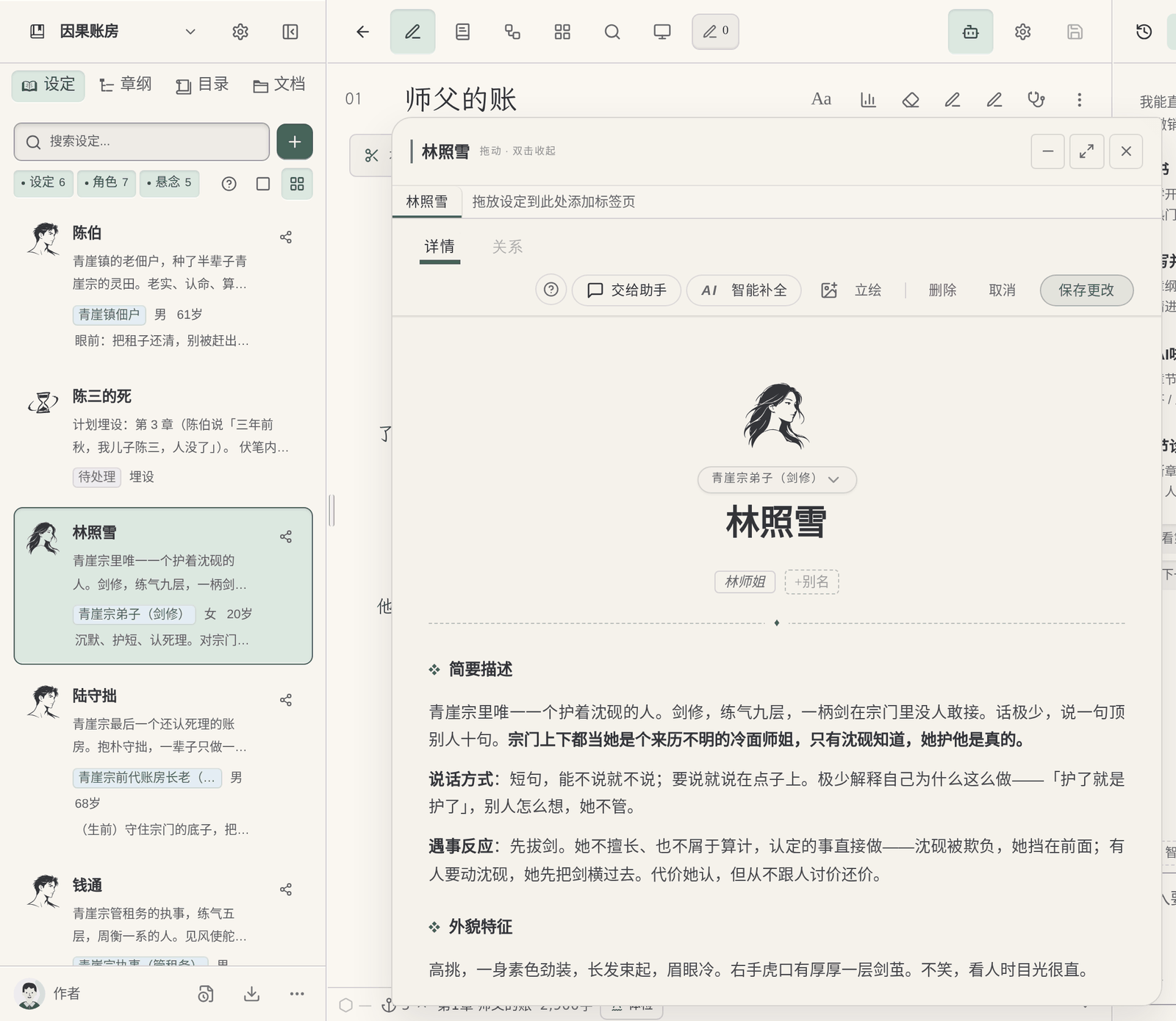
Maliang’s floating character card
The author opens a character card to check settings.
Red deletions and green additions for AI changes in the Maliang editor
The author reviews AI’s revisions one by one.
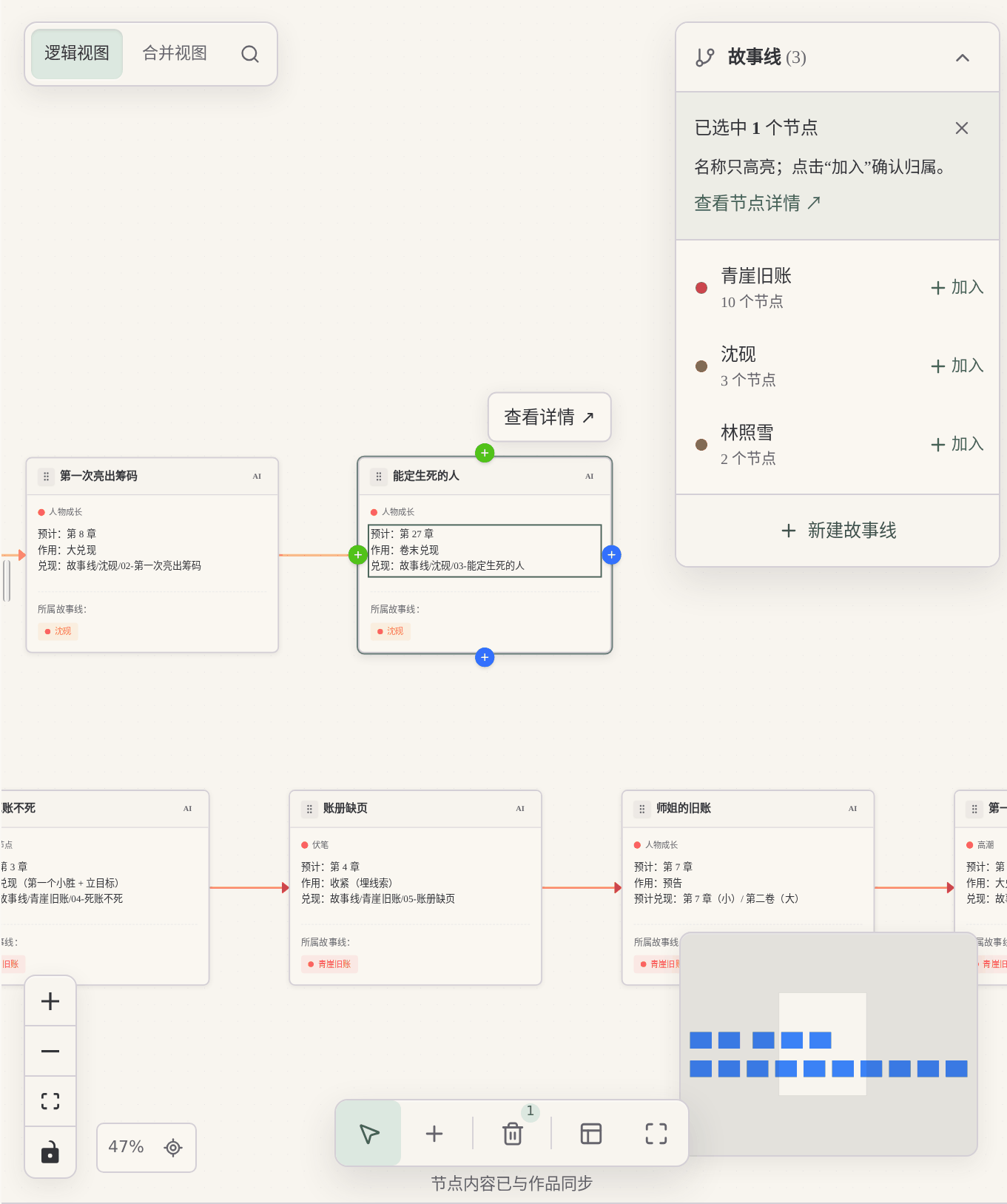
Maliang’s planning canvas and storylines
The author lays out the storylines on the planning canvas.
❦ · Evidence · ❦
Data and sources

Sources and check dates

Try four real writing tasks before you decide

When trying Novelcrafter and Maliang Writer, start with the same original material and record the whole process: preparing materials, editing the text and taking the work with you when you leave the tool. Actual use decides the result; no side is assumed to win.

Below is a same-task trial checklist, not a finished comparison experiment. You can use the original teaching material “Jiehuo City” or a manuscript you have the right to handle; record the preparation, the output and the author’s edits for each tool.

Start a new book

Give both tools the same protagonist, core rules and reading preferences; compare the opening directions first, then organize the master outline, the first volume outline and the outlines for the first three chapters.

Check: Can it tell the roles of the three outline levels apart? Can the author confirm a plan before it continues? Were settings that hadn't been settled yet quietly written in as fact?

Use the same book-opening kit

Continue an existing twenty chapters

Use the same old manuscript you have the right to handle, specify how the last chapter ends and the goal of the next chapter; try writing one scene first, without changing the previous twenty chapters.

Check: What material did you prepare? Did character positions, items and open threads carry over? How are candidate drafts told apart from adopted ones?

See the import-and-continue task checklist

Change a setting that has already appeared

Pick a real rule that affects earlier chapters; first ask it to list the affected chapters and the evidence, then let the author choose the scope of the change.

Check: Does it say which parts it did not check? Can you review the changes first? Did it wrongly edit text outside the task or write an unadopted plan into the material?

See how to change a setting

Take your work and material with you

Actually try keeping the text, the order of volumes and chapters, character profiles and world rules, and check whether the output is suitable for further editing; list what cannot be taken along.

Check: Are the format and order recognizable? What material is inside the platform account, what is in local files, and what is in the export? Do not infer usability from a marketing page alone.

Copy the task and result record card

Record the models, plans or account conditions you actually used, and the time spent preparing materials and editing the text. Leave blank anything you have not tried or cannot confirm; do not let a feature name or a single generation stand in for the full experience.

How to choose

Choose by your situation

FAQ

FAQ

Does Novelcrafter support Chinese?

The official FAQ says generation works as long as the model you use supports the language and it is written left to right, and does not mention Chinese specifically. How well it works in Chinese depends mainly on the model you connect and your prompts.

Do I have to buy AI separately for Novelcrafter?

Yes. The official wording is “we currently do not offer any AI model ourselves”; you connect providers such as OpenAI, Anthropic, Google and OpenRouter, or a local model, and AI costs are paid separately to the provider.

How much does Novelcrafter cost?

Scribe is $4/month (no AI), Hobbyist $8, Artisan $14 and Specialist $20; annual billing gives “2 Months off”, there is a 21-day full-feature trial and no free tier (checked 2026-10; the page says pricing is localized by region).

Are Novelcrafter’s Codex and Codex CLI the same thing?

No. Novelcrafter’s Codex is its setting library; Codex CLI is OpenAI’s terminal coding agent. For writing novels with Codex CLI, see the “Maliang Writer vs Codex CLI” comparison page.

How are Novelcrafter’s Progressions different from Maliang’s story archives?

With Progressions the author manually adds content to a setting that takes effect from a certain point in time; in Maliang, after a chapter is written the background organizes character states, relationships, locations and foreshadowing, lists anything that doesn’t match as pending confirmation, and the author confirms.

Can Novelcrafter be used offline?

At present you must be online; the official site says the architecture has been prepared for offline use but gives no timeline. Maliang is also a web product and needs an internet connection.

Does Novelcrafter have a phone app?

The official site says it can be installed as a Web App in the browser, and no native mobile app is described; the same-named “Novel Crafter” on the App Store is another company’s product.

Can I customize prompts in Maliang?

Maliang combines instructions with / to pick writing methods and @ to reference chapters and characters, and you can also state requirements in plain text; it does not offer prompt templates with variables like Novelcrafter’s.

❦ · Continued · ❦
Related comparisons

Related comparisons

How Good Is Sudowrite for Chinese Writing? Sudowrite vs Maliang Writer for Long Fiction

vs Sudowrite · updated 2026-10-11

Sudowrite is designed around a complete workflow for English-language fiction: the Story Bible runs from a brain dump all the way to prose, the Muse model is built for fiction, and there is a planning canvas and a mobile app. Chinese authors writing web-novel serials should note the officially mentioned “some output falls back to English”, and setting changes after a chapter is written are also mostly for the author to maintain. Maliang is built for long Chinese fiction: cards, story archives, revision comparison in the editor and genre reference for Chinese web novels.

Read the comparison →

Can Codex Write Novels? Writing Long Fiction with Codex CLI and How It Differs from Maliang Writer

vs Codex CLI · updated 2026-10-11

Codex CLI is open source and runs in a local terminal; it reads and writes a whole project and runs scripts, with system-level isolation and approvals. Writing a novel with it, the author builds the folders, writes AGENTS.md, maintains a ledger and uses Git for versions, and views changes as a text diff in the terminal. Maliang builds these into a web editor: a volume-and-chapter table of contents, character cards, story archives and revision comparison you review one by one.

Read the comparison →

How to Manage Novel Settings: Folders + Markdown, or Character Cards and Story Archives?

vs Folder + Markdown approach · updated 2026-10-11

Folders plus Markdown are flexible and transparent, with the files in your own hands, which suits authors who like to define their own formats; the drawback is that once there are many files, which file is the latest and which other places need syncing after one edit are all yours to remember. Character cards plus story archives fix each character and setting as a card and organize states automatically after a chapter is written, which suits authors who don’t want to maintain files. Maliang has both: characters and settings are cards, the master outline is stored separately, and style samples and book-opening material are documents.

Read the comparison →
Get started

Try one chapter of the book you're writing

After signing up, create a book or import existing chapters, tell the AI which chapter to continue, then look at what it wrote, what it changed and what it recorded in the archive, and decide whether to move your long novel over.