In Chinese, on the web, write as soon as you open it
A Chinese interface, usable as soon as you open the browser; the manuscript and settings are saved online, so you can log in on another computer and keep writing.
Manus is a general AI agent for research and writing. See how it compares with Maliang Writer, a Chinese web tool built for serial novels.
Manus is a general AI agent that plans and carries out multi-step tasks such as research, writing and building websites; its official story-generation page says that with a persistent file system and long-term memory it can write a complete long novel and stay consistent across chapters, and a project can hold knowledge files and instructions. For Chinese web novels, volume-and-chapter management, ledger updates and the after-chapter routine are worth verifying during a trial; whether it can currently be used in Mainland China is not clearly stated in official material. Maliang Writer is a Chinese web tool that does only long novels: volumes, chapters, characters, settings and foreshadowing are there out of the box, story archives are organized after each chapter is written, and characters who have left the story are put away when you reach a new volume.
Imagine an author who wants to write a Chinese web novel with Manus: first researching the genre, then writing an outline and the first few chapters. Before starting a long serial, a few things are worth confirming in a trial: new tasks inherit the project’s configuration, but is the character sheet in the project up to date with the story so far? After the character sheet is updated, can a task already in progress read it (the official site says updates take effect only for new tasks)? How are chapters organized by volume? Can it be used reliably in your region? If you want the tool to arrange these directly, compare with Maliang’s approach below.
On narrow screens, scroll sideways to see all columns.
| Dimension | Maliang Writer | Manus | Notes |
|---|---|---|---|
| Product positioning | ✅ A writing tool for long Chinese novels | ✅ A general AI agent; on 2026-09-01 it officially announced it had resumed independent operation | |
| Product form | ✅ Used directly on the web, nothing to install | ✅ Web, desktop and mobile, plus an API | |
| Availability in Mainland China | ✅ Chinese interface, accessed directly in the browser | ⚠️ The official site once announced account and data-handling measures for a transition period; whether it can currently be used in Mainland China is not clearly stated in official material, so confirm it | |
| Structure of a book | ✅ Volumes, chapters, chapter outlines, characters, settings, foreshadowing, storylines and documents are there out of the box | ⚠️ Organized by task and project; no official material found on volume-and-chapter management for Chinese web novels, so confirm during a trial | |
| Long-term material | ✅ Characters, settings and foreshadowing are cards, and AI reads them as needed when writing new chapters | ✅ Project instructions and material are applied automatically to new tasks; the official site says file updates take effect only for tasks created afterwards; the story-generation page says it has a persistent file system and long-term memory | |
| Organizing after each chapter | ✅ After a chapter is written and this round ends, story archives are organized; anything that doesn’t match is listed as “pending confirmation”; can be turned off | ⚠️ No official material found on organizing character states and foreshadowing chapter by chapter, so confirm during a trial | |
| Reaching a new volume | ✅ Characters, places and foreshadowing that only appeared in earlier volumes are moved into the archive, and can still be looked up when needed | ⚠️ No official material found | |
| How to review AI revisions | ✅ Red deletions and green additions on the original in the novel editor, each kept or restored; undo the current round, branch, or edit and resend | ⚠️ No official material found on reviewing novel body text one change at a time, so confirm during a trial | |
| Price | ✅ Free sign-up to try; credits are deducted by usage | ✅ Free tier with 300 credits a day; Pro from $20/month (from 4,000 credits a month) (official Help Center, checked 2026-10-11) |
✅ Confirmed in official material or in the product ⚠️ Partly supported, or not stated in official material ❌ Officially not supported · Competitor information comes from their public material.
A Chinese interface, usable as soon as you open the browser; the manuscript and settings are saved online, so you can log in on another computer and keep writing.
Volumes, chapters, chapter outlines, characters, settings, foreshadowing, storylines and documents are already sorted into categories, with the table of contents and cards on the left.
After a chapter is written and this round ends, the archivist organizes this chapter’s character states, relationships, locations, items and foreshadowing; anything that doesn’t match is listed as “pending confirmation”. You can turn it off if you don’t need it.
Manus is a general agent: it can research, write, build websites and reports; the official story-generation page says that with a persistent file system and long-term memory it can write a complete long novel, remember character details and stay consistent across chapters. It has web, desktop and mobile versions, offers an API, and applies project instructions and material automatically to new tasks. On 2026-09-01 it officially announced it had resumed independent operation. People who need multi-step tasks such as research, reports and building sites can consider Manus.
Every product suits some scenarios; the advice here covers only one: serialized long-form fiction in Chinese.
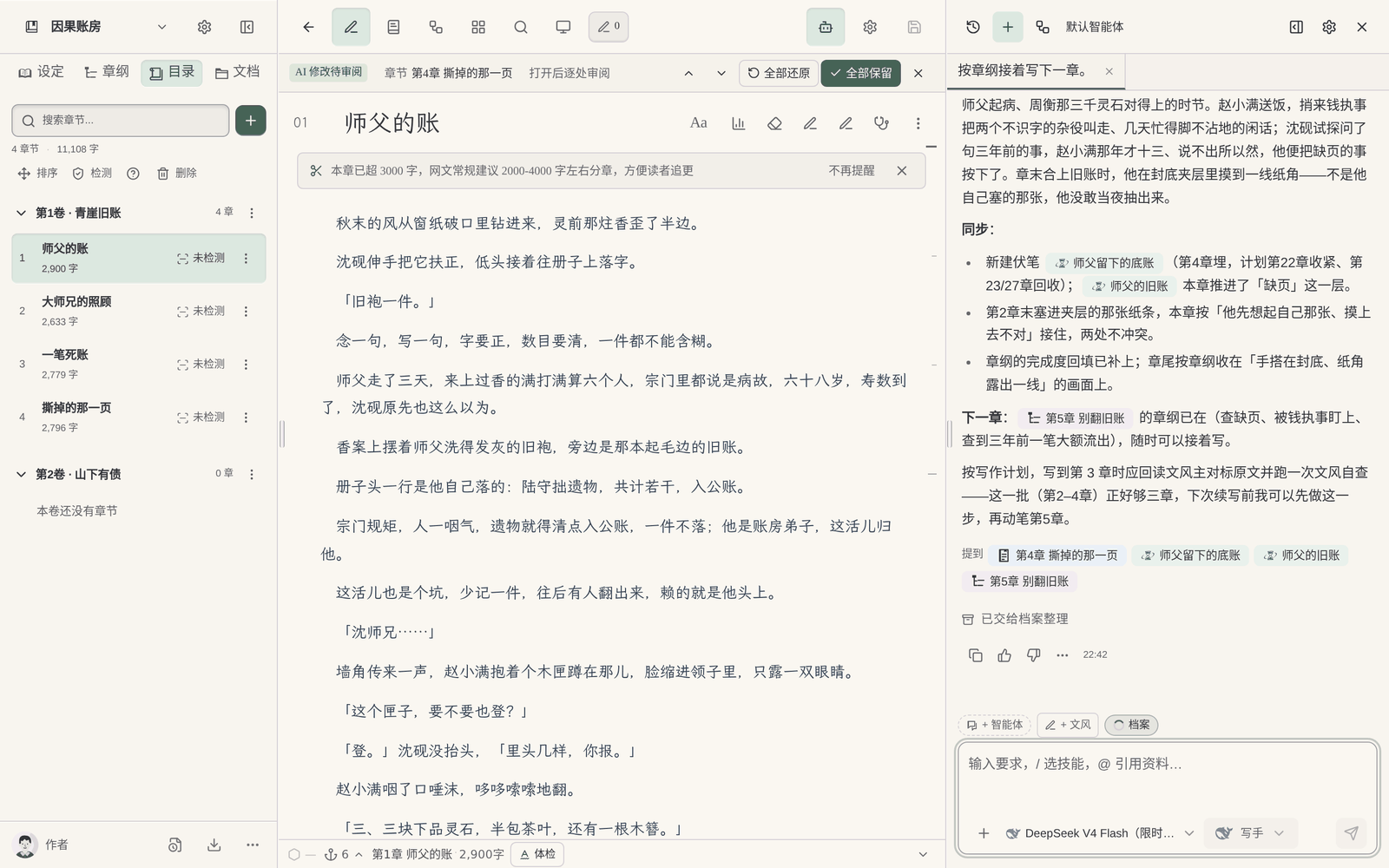
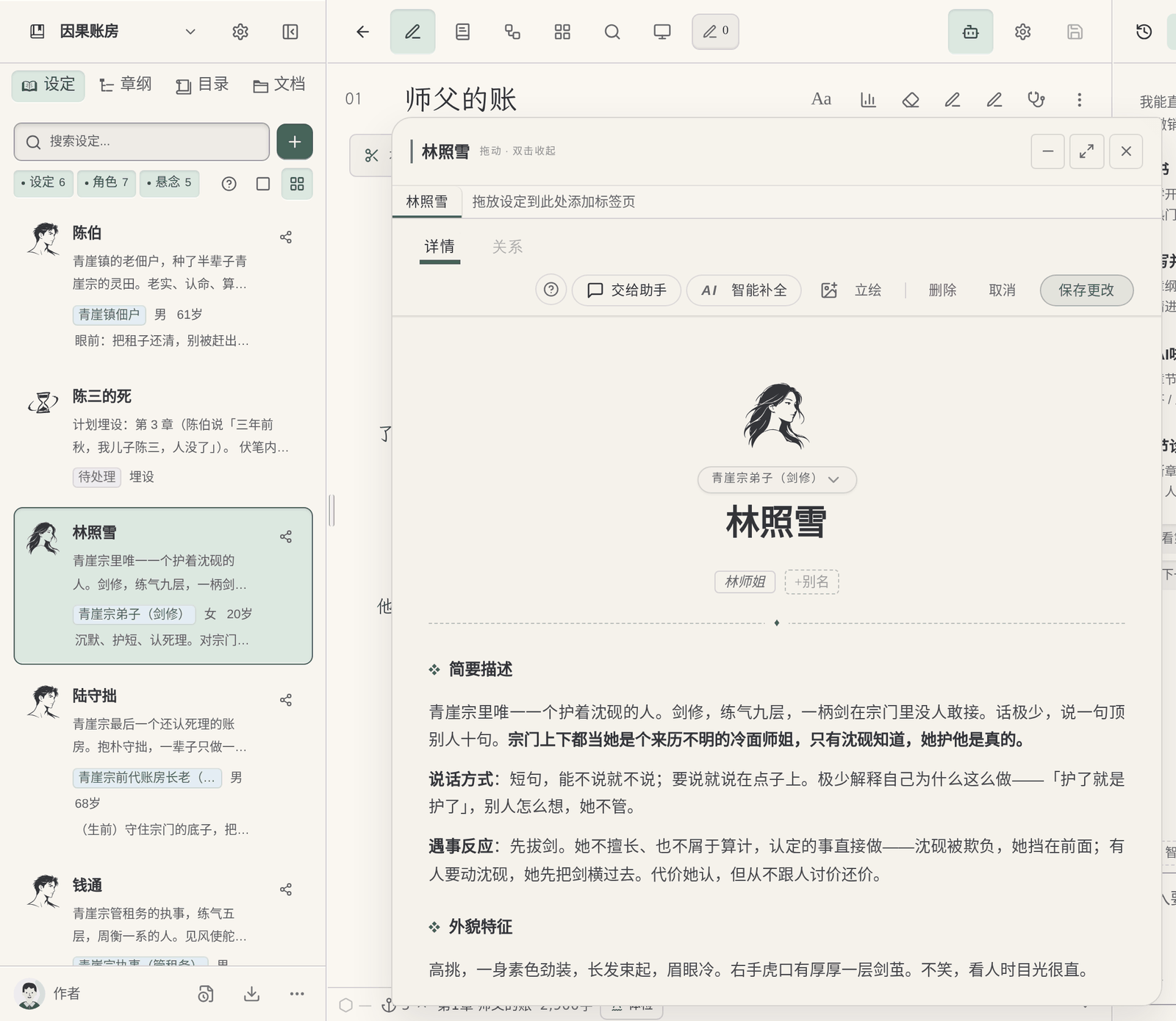
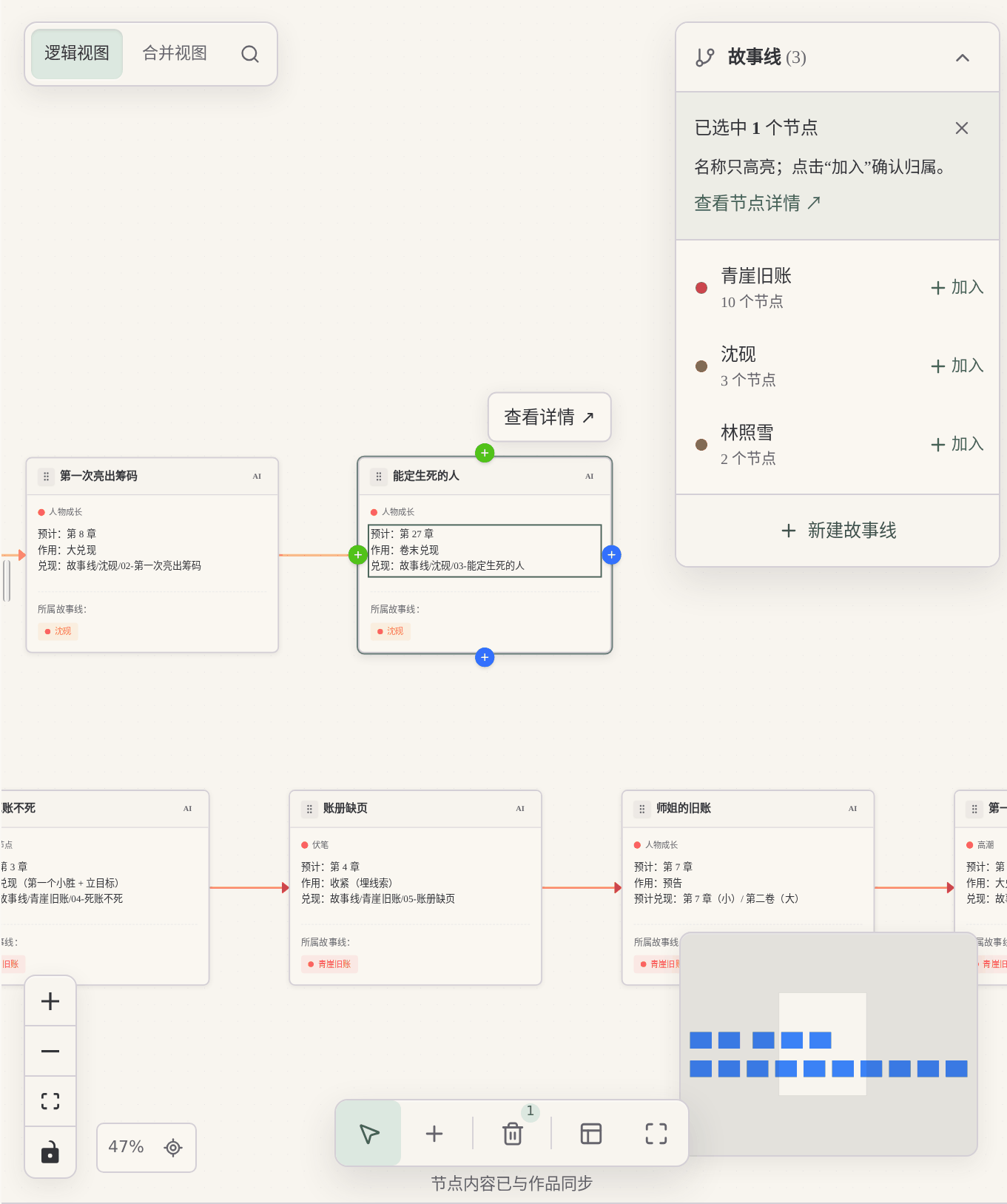
For this page, record in particular whether chapters, character material and later edits connect smoothly after you move from a general task into a novel project; which material the author has to organize, and which steps can be reused directly.
Below is a same-task trial checklist, not a finished comparison experiment. You can use the original teaching material “Jiehuo City” or a manuscript you have the right to handle; record the preparation, the output and the author’s edits for each tool.
Give both tools the same protagonist, core rules and reading preferences; compare the opening directions first, then organize the master outline, the first volume outline and the outlines for the first three chapters.
Check: Can it tell the roles of the three outline levels apart? Can the author confirm a plan before it continues? Were settings that hadn't been settled yet quietly written in as fact?
Use the same book-opening kitUse the same old manuscript you have the right to handle, specify how the last chapter ends and the goal of the next chapter; try writing one scene first, without changing the previous twenty chapters.
Check: What material did you prepare? Did character positions, items and open threads carry over? How are candidate drafts told apart from adopted ones?
See the import-and-continue task checklistPick a real rule that affects earlier chapters; first ask it to list the affected chapters and the evidence, then let the author choose the scope of the change.
Check: Does it say which parts it did not check? Can you review the changes first? Did it wrongly edit text outside the task or write an unadopted plan into the material?
See how to change a settingActually try keeping the text, the order of volumes and chapters, character profiles and world rules, and check whether the output is suitable for further editing; list what cannot be taken along.
Check: Are the format and order recognizable? What material is inside the platform account, what is in local files, and what is in the export? Do not infer usability from a marketing page alone.
Copy the task and result record cardRecord the models, plans or account conditions you actually used, and the time spent preparing materials and editing the text. Leave blank anything you have not tried or cannot confirm; do not let a feature name or a single generation stand in for the full experience.
Yes. The official story-generation page says that with a persistent file system and long-term memory it can write a complete long novel and stay consistent across chapters. For Chinese web novels, volume-and-chapter management and ledger updates are worth verifying during a trial.
The official Manus blog announced on 2026-09-01 that it had resumed independent operation, with the founding team continuing to lead.
As of 2026-10-11, whether it can currently be used in Mainland China is not clearly stated in official material; refer to the latest official information. Maliang Writer is a Chinese web tool that works as soon as you open it in a browser.
There is a free tier with 300 credits a day; Pro starts at $20/month (official Help Center, checked 2026-10-11).
Manus is a general agent that handles multi-step tasks such as research, writing and building websites; Maliang does only long Chinese novels, and volumes and chapters, character cards, story archives and putting away old settings when you reach a new volume are all prepared for serials.
Free sign-up to try, then credits are deducted by usage, with each round’s cost shown under the reply.
ChatGPT suits brainstorming, drafting passages and polishing sentences. Projects keeps story files and instructions together, and Memory remembers preferences. In a long serial, how chapters are ordered, where to edit when a setting changes and what this draft changed are still for the author to arrange. Maliang puts volumes and chapters, character cards, story archives and revision comparison in one editor.
Read the comparison →Claude Code can write novels, and it is very capable: it reads and writes a whole book’s folder, checks continuity across files and makes batch edits. In public practice, authors design the folders, write CLAUDE.md, maintain a setting ledger and work in a terminal or editor plugin, which suits authors who are comfortable on the command line. Maliang builds the table of contents, character cards, story archives and revision comparison into a web editor, and the author starts writing from the chat.
Read the comparison →After signing up, create a book or import existing chapters, tell the AI which chapter to continue, then look at what it wrote, what it changed and what it recorded in the archive, and decide whether to move your long novel over.