
50 AI Novel Writing FAQs: Copyright, Quality, and Efficiency Explained in One Guide
Answers to the 50 most common questions about AI novel writing: Who owns the copyright to an AI-written novel? Can platforms detect it? Will every story read the same? How many characters a day can you boost your daily updates to? Covering four core areas—copyright ownership, content quality, writing efficiency, and tool selection—read this through before diving in so you can avoid common pitfalls as a beginner.
In this article 12 sections
Is Writing a Novel with AI Actually Reliable?
It's 2026, and AI-assisted writing has gone from a "toy" to a real productivity tool for plenty of web novel authors. Still, plenty of questions remain: Who owns the copyright? Does the quality hold up? Will the story start breaking continuity halfway through?
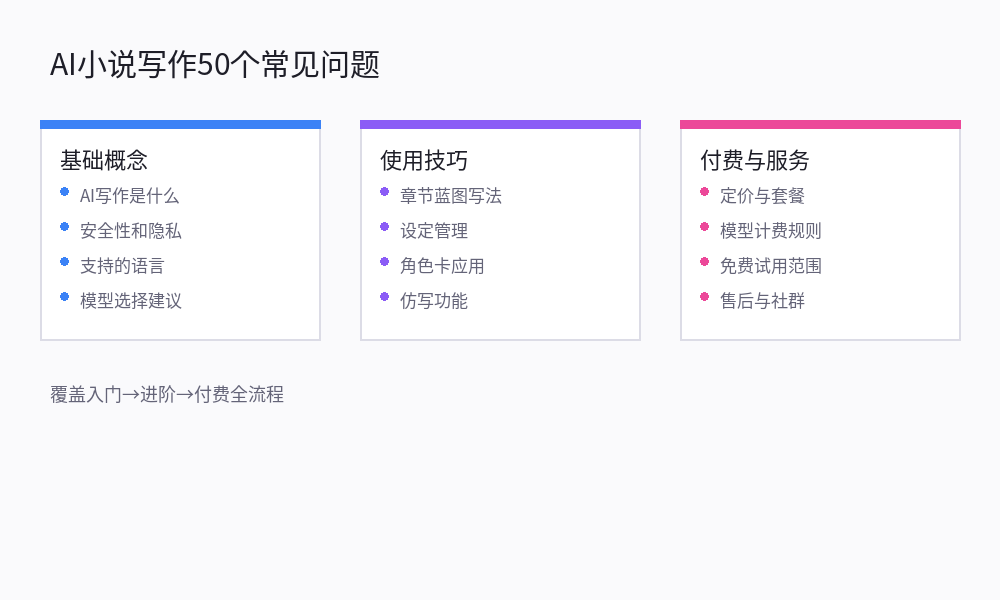
This article collects the 50 questions we get asked most often in the Maliang Writer community. No fluff—straight to the practical answers.
The Basics
Q1: Can AI really write a complete novel?
Yes, but don't expect it to write one from start to finish on its own. AI excels at efficiently generating chapter text in bulk once your outline and story bible are in place. Among Maliang Writer users, some have already completed serialized novels of over 800,000 characters with AI assistance. The key is that the human handles the "soul" (plot direction, payoff design) while the AI handles the "muscle" (drafting the prose).
Q2: Who owns the copyright to what AI writes?
The mainstream view in legal circles in China and abroad right now is this: if a human makes a substantial intellectual contribution to the creative process (such as worldbuilding, outlining, reviewing, and revising), copyright in the finished work belongs to the human author. Copyright ownership for content generated purely at random by AI without human intervention remains disputed. Our advice: keep records of your creative process (outlines, revision history) to prove your contribution.
Q3: Can an AI-written novel be published on Fanqie or Qidian?
Yes. Multiple platforms currently have no explicit rules prohibiting AI-assisted writing. But there's a bottom line: the content quality has to hold up. If the AI output is obviously padded, highly repetitive, or illogical, editors will still reject it during review. After generating chapters with Maliang Writer's multi-agent system, we recommend reading through at least once to polish the text by hand.
Q4: What's the difference between AI writing and "content spinning"?
The fundamental difference is originality. AI generates brand-new narrative content from your worldbuilding, character relationships, and plot outline—it isn't rewriting existing text. It's much like hiring a ghostwriter to write from your outline, except the writer is an AI.
Q5: Will readers notice I'm using AI?
It depends on how you use it. If the whole chapter reads like stiff translationese—with clichés like "his eyes betrayed a deep sense of worry" everywhere—readers will spot it immediately. But if you customize the style, polish by hand, and weave in your own memorable lines and standout scenes, readers won't be able to tell the difference. In our tests, after Maliang Writer's style learning plus light manual tweaking, the GPTZero AI detection rate dropped below 15%.
Quality and Efficiency
Q6: How many characters can AI help me write in a day?
It depends on the model and how fast you review. In terms of raw generation speed, with Maliang Writer's 7 agents working together, a 2,000-character chapter takes about 30-60 seconds. In theory, that's 60,000-100,000 characters a day. Actual output depends on how quickly you review and revise, so we recommend keeping daily output around 10,000-30,000 characters to maintain quality.
Q7: How good is AI's prose?
Above average. Chinese web novel text generated with Claude 4.6 or Gemini 2.5 generally matches the prose fluency of a mid-tier title on Fanqie. But if you want "god-tier" prose, you still need your own ear for language and manual polish. AI is strong on efficiency and consistency, and weak on creative spark and flashes of brilliance.
Q8: How do I keep the AI from creating continuity errors (contradicting itself)?
This is the biggest pitfall in long-form fiction. Maliang Writer solves it with a knowledge graph: after each chapter is generated, the system automatically extracts character states, item locations, revealed information, and more, and retrieves that data before generating the next chapter. In tests on novels over 300,000 characters, story-bible inconsistencies dropped by about 72%.
Q9: Is AI-generated content very repetitive?
Without guardrails, yes—you'll run into repetitive, circular filler. There are three fixes: first, explicitly forbid repeating earlier plot points in your prompt; second, use Maliang Writer's repetition detection feature; third, keep your knowledge graph updated so the AI knows "this trope was already used in the last chapter."
Q10: Can AI write good fight scenes?
Yes, with proper guidance. Spell out the pacing of the fight in your chapter blueprint (initial probing → spotting a weakness → turning the tables → conclusion), and the AI can produce solid action scenes. Without any guidance, AI tends to fall back on a flat "one punch from you, one strike from me" play-by-play.
Choosing Tools
Q11: What's the difference between Maliang Writer and using ChatGPT directly?
In a nutshell: ChatGPT is a generalist; Maliang Writer is a specialist. ChatGPT has no novel knowledge graph, no multi-agent collaboration, no three-level outline management, and no story-bible tracking—and it starts forgetting once the context passes 20,000 characters. Maliang Writer builds all of that in. Think of ChatGPT as a Swiss Army knife and Maliang Writer as a full set of professional chef's knives.
Q12: How much content can free users write with AI?
Maliang Writer's free tier includes a basic daily AI generation quota. For light use (3,000-5,000 characters a day), the free plan is generally enough. Heavy daily-updating authors should consider a membership for a much larger quota and access to stronger models.
Q13: Which AI models are supported?
Maliang Writer currently supports 6 mainstream models: Claude 4.6, GPT o3, Gemini 2.5 Pro, DeepSeek R1, Qwen 2.5 Max, and GLM-4. Each model has a slightly different writing style; see the AI Model Selection Guide for a detailed comparison.
Q14: Do I need to bring my own API key?
No. Maliang Writer provides built-in AI model access across the platform—all you need to do is sign up for an account. Of course, advanced users can also connect their own API key for more flexible control.
Q15: Can I use it on my phone?
The web app works in mobile browsers, and basic tasks work fine. However, since novel writing involves heavy text editing, we recommend using a desktop or laptop for a better experience.
Writing Techniques
Q16: What genre should a beginner start with?
We recommend starting with urban fiction or romance. The worldbuilding in these genres is relatively straightforward (no cultivation systems or magic rules to design) and character relationships are closer to everyday life, making them easier for the AI to grasp and yielding higher-quality output. Once you're comfortable with the workflow, you can tackle complex genres like xuanhuan (Eastern fantasy) and sci-fi. For details, see AI Writing: A Beginner's Guide.
Q17: How do I get AI to write satisfying "payoff" moments?
AI can't invent payoffs on its own—you need to mark them clearly in your chapter blueprint. For example: "The climax of this chapter is the protagonist defeating his opponent in a single move when everyone expects him to lose, delivering a massive face-slap to the entire crowd." With concrete emotional beats like that, the AI's output improves dramatically.
Q18: How long should an outline be?
We recommend the three-level outline system: a master outline of 500-1,000 characters summarizing the overall arc of the book, a volume outline of 300-500 characters per volume, and a chapter blueprint of 100-200 characters per chapter. Make the outline too vague and the AI will wing it; make it too detailed and you'll box in the AI's creativity.
Q19: How do I handle passages the AI writes poorly?
Two approaches: first, hit "regenerate" to try a fresh take—Maliang Writer lets you save previous versions to compare and choose from; second, edit manually at the paragraph level, rewriting any unnatural phrasing in your own voice. We recommend the second approach, because that's how you infuse the work with your personal style.
Q20: Can I get the AI to imitate a specific author's style?
Yes. Maliang Writer's bestseller style-imitation feature is built specifically for this: import a reference text you like, and the system analyzes its narrative pacing, diction, descriptive density, and other traits, then mirrors that style during generation.
Technology and Security
Q21: Is my novel data safe?
Maliang Writer uses HTTPS encryption across all data transfers, and user data is stored in isolated environments. Your novel content is never used to train AI models and is never visible to other users.
Q22: What if AI generation gets interrupted?
Don't panic. Maliang Writer has session memory and breakpoint resumption—even if your connection drops or the AI service has a temporary hiccup, your progress won't be lost. Reopen the project and pick up right where you left off. For details, see Session Memory and Smart Retry.
Q23: How much compute or cost does it take to generate a chapter?
It depends on the model you choose. With Claude 4.6, for example, generating a 2,000-character chapter costs roughly $0.02 in API usage. Platform memberships already include a generous quota, so everyday writing generally requires no extra payment.
Q24: Will the AI leak my ideas?
No. Large language model inference is stateless—what you send isn't "remembered" by the AI or used to answer other users. Every call is independent.
Q25: Where is knowledge graph data stored?
It's stored in Maliang Writer's cloud database, isolated on a per-novel basis. When you delete a novel, its corresponding knowledge graph data is deleted along with it.
Long-Form Writing
Q26: Can AI handle a novel of over 1 million characters?
Yes, provided you take an engineered approach. Maliang Writer's architecture is purpose-built for million-character novels: the three-level outline steers overall direction, the knowledge graph tracks canon settings, and multiple agents maintain consistency. Users on the platform have already completed a 1.2-million-character xuanhuan serial.
Q27: Will the AI still remember earlier plot points later in the book?
A single AI call has a limited context window (even the latest models only offer around 200,000 tokens). However, Maliang Writer combines its knowledge graph with smart summaries so that whenever the AI generates text, it always has access to key information from across the entire book—not just the most recent chapters.
Q28: How do I handle transitions between volumes?
In your volume outline, explicitly list "unresolved threads from the previous volume" and "core conflicts to resolve in this volume." When generating the opening chapter of a new volume, the AI references both the ending summary of the previous volume and the opening setup of the new volume outline.
Q29: How do I avoid "running out of steam" after 300,000 characters?
This is really an outlining problem. If your master outline amounts to nothing more than "the protagonist gets stronger and fights the boss," you really will run out of material by 300,000 characters. We recommend mapping out at least 5-8 major turning points during the master outline stage, with each turning point anchoring a new volume.
Q30: Can AI help me write the ending?
Yes, though it's best for you to take the lead on the ending. Put the core elements of the finale into the blueprint—how the final showdown plays out, where each character ends up, and which foreshadowed threads need to pay off—and let the AI execute the prose.
Monetization and Publishing
Q31: Can an AI-assisted novel get a platform contract?
Yes. Across multiple platforms, there are currently no cases of a book being denied a contract for using AI assistance. It still comes down to quality: is the story engaging, and are updates consistent? With AI assistance, your daily update consistency can actually improve, potentially boosting your chances of getting signed.
Q32: Can I hit 10,000 characters a day in daily updates with AI?
Absolutely. With Maliang Writer's workflow of batch agent generation plus manual review, producing 10,000-30,000 characters a day is realistic. Many contracted authors who maxed out at 3,000 characters a day before using AI now consistently publish 10,000+ characters daily. For details, see Web Novel Monetization with AI.
Q33: What if readers complain about a heavy "AI feel"?
That's usually a sign of insufficient manual polishing. Focus on three areas: give characters distinct verbal tics in dialogue, use unconventional metaphors in descriptions (AI leans heavily on stock metaphors), and add chatty narrator asides during transitions. Fix those three things and the "AI feel" drops sharply.
Q34: What's the cost-benefit ratio of AI writing?
Take a web novel author publishing 300,000 characters a month: a Maliang Writer membership costs around 100 yuan per month, and the time saved can go toward launching a second book or raising the quality of your current one. If you're earning contract income, the return on investment is substantial.
Q35: Is there any risk in publishing across multiple platforms simultaneously?
The exact same rules apply as with traditional writing—pay close attention to each platform's exclusive vs. non-exclusive contract terms. AI-assisted writing introduces no extra legal risk here.
Advanced Techniques
Q36: How do I use AI to design a complex web of character relationships?
In Maliang Writer's character management module, create a detailed profile for each character and manually define their initial relationships. As chapters are generated, the AI automatically tracks and updates shifts in those relationships—for instance, if two characters go from enemies to allies, the knowledge graph logs that transition automatically.
Q37: How do I vary narrative pacing across chapters?
Use "pacing tags" in the chapter blueprint: for chapters tagged "high-intensity," the AI speeds up the narrative pace and ramps up conflict density; for chapters tagged "slice-of-life," it slows things down and adds everyday detail and dialogue.
Q38: Can I write two or more novels at the same time?
Yes. Data in Maliang Writer is completely isolated by novel, giving each book its own story bible, knowledge graph, and outline system. You can run three books simultaneously without any cross-contamination.
Q39: How do I manage foreshadowing that spans dozens of chapters?
Maliang Writer's storyline system is built specifically for this. You can create a "FORESHADOWING" storyline, marking both the chapter where it's planted and the chapter where it's meant to pay off. When you reach the payoff chapter, the AI automatically pulls that foreshadowing detail into its context.
Q40: Can AI write good romance scenes?
Yes, provided you give it rich enough "emotional prompts." If you just write "the two go on a date," the output will feel flat. If instead you specify "sweet, doting tone: the male lead confesses awkwardly, the female lead acts tough on the outside but melts on the inside, and both blush when they finally hold hands," the AI can deliver a genuinely charming scene. For more tips, see the Romance Novel AI Writing Guide.
Common Misconceptions
Q41: Will AI replace human authors?
Not anytime soon. What AI can replace is mechanical "grunt-work" drafting—not story concepts, emotional resonance, or personal voice. The future lies in human-AI collaboration: humans provide the soul and aesthetic judgment, while AI provides efficiency and consistency.
Q42: Is AI writing plagiarism?
No. Large language models generate brand-new text from probability distributions rather than copying and pasting from training data. Keep in mind, though, that if you explicitly prompt the AI to "imitate XX's 'XXX'" and borrow heavily from the original work's settings, you run a real risk of infringement.
Q43: Is AI suited to every kind of novel?
No. AI works very well for web novels and genre fiction (xuanhuan, romance, urban, mystery) because these genres follow relatively established narrative patterns. For literary fiction and experimental writing, however, AI still has a long way to go—anything built on breaking conventions is where AI struggles.
Q44: Will AI writing make every novel feel homogenized?
Not as long as you put real effort into custom worldbuilding and characterization. Give 100 authors the same AI with different worlds, characters, and outlines, and the resulting novels will be worlds apart. Homogenization doesn't come from AI—it comes from lazy creators.
Q45: Is a bigger model always better?
Not necessarily. For Chinese web novel writing, Claude 4.6 already delivers strong prose. Larger models don't automatically write better, and they cost more and run slower. Match the model to the task: use a cost-effective model for everyday chapters and save the most powerful model for pivotal chapters.
Looking Ahead
Q46: Where is AI writing technology headed next?
The big trend in 2026 is multimodality—AI that not only writes prose, but simultaneously generates illustrations, character portraits, and scene art. Maliang Writer is already experimenting with novel cover generation, and "finish a chapter, automatically get a matching illustration" may soon become reality.
Q47: Do traditional publishers accept AI-assisted work?
Attitudes are shifting. More and more editors acknowledge that a manuscript should be judged by "whether it's a good read," not "how it was written." Even so, we currently recommend not proactively mentioning AI assistance when querying or submitting (and there is no legal obligation to disclose it).
Q48: Where can I connect with other AI writers?
Maliang Writer runs an official user community where members regularly share AI writing tips and success stories. You can also find dedicated AI writing boards on Chinese web novel forums like Lkong (Long de Tiankong) and Ciweimao.
Q49: Do I need a technical background to get started with AI writing?
Not at all. Maliang Writer is built around a "zero technical barrier" philosophy—if you can type and write an outline, the platform handles all the AI and technical heavy lifting.
Q50: How would you sum up the core of AI novel writing in one sentence?
You're the director, and AI is the actor. The better the script, the better the performance.
Quick FAQ Index
Getting started: Q1-Q5, Q16, Q49
Quality: Q6-Q10, Q33
Tools: Q11-Q15
Long-form: Q26-Q30
Monetization: Q31-Q35
Advanced: Q36-Q40