
Best AI for Novels 2026: Claude, Gemini, GPT, DeepSeek
By genre and task, not rankings: official sources, same-prompt test, scoring sheet, costs including retries/edits, for daily, dialogue and long-form use.
In this article 10 sections
Which Model Should You Use to Write Novels with AI? Choose by Your Task First
For daily chapter updates, pick the model whose output you change least and whose total cost you can accept; for mysteries and ensemble casts, first look at cause and effect, characterization and information boundaries; for long-novel continuation, you must test with your own existing settings and chapters, and cannot treat the context window as a guarantee of memory. Claude, Gemini, GPT and DeepSeek can all be candidates, but a brand name is not a specific version, and the same version’s parameters, limits and fees are not necessarily the same on different platforms.
For your first selection, you don’t need to try ten models at once. Pick two versions you can use normally, use the same story material below to do an outline, dialogue and a revision with each, and then compare with the names covered. When results are close, prefer the more stable one with the lighter revision burden, rather than chasing a “best prose” with no samples behind it.
Scope of evidence on this page: this is a selection and self-testing guide, not a new round of model rankings. When it was revised on 2026-09-06, the old version’s scores, million-character cost estimates and statements such as “fully remembers the first 100 chapters” lacked sufficient evidence for readers to recompute, and are no longer presented as ranking conclusions. The stories and good and bad examples below are teaching material constructed to illustrate the checking method, not the output of any model. The official links are for checking products and evaluation methods, and do not prove that any model leads in fiction prose.
Narrow the Candidates First: Which Step Do You Get Stuck On Most?
| Writing task | What to compare first | What signals it is unsuitable | What to compare after it passes |
|---|---|---|---|
| Writing body text every day | Passages you can keep, repeated phrasing and stability within the same genre | The narrative voice has to be rewritten every chapter, or output is often cut off | Actual billing, wait for the first paragraph, revision time |
| Character dialogue and romance scenes | Whether each person speaks with a motive and distinctly | Everyone has the same voice, and narration explains the emotions | Pacing, subtext and your personal preference |
| Mystery, ensemble casts and foreshadowing | Who knows what, the order of evidence, the chain of cause and effect | Truth leaked early, characters using clues they haven’t obtained yet | Naturalness of expression, revision cost |
| Long-novel continuation | Whether key settings are used correctly when needed | Forgetting injuries, who owns an item, the time or character relationships | Input cost, context preparation and response time |
| Outline and revision | Whether suggestions are specific and fit the goal you gave | Only saying “add conflict” without giving events and costs | Differences between plans, feasibility and cost |
This table is an order of selection, not a vendor brand ranking. An author writing romance and one writing hard science fiction can get different results; the same author can also choose different models for planning, body text and checking, but should watch for breaks in narrative style after switching models.
Claude, Gemini, GPT, DeepSeek: Check the Version First, Then Compare
| Candidate model family | Check before use | Focus of the fiction test | Official information |
|---|---|---|---|
| Claude | Exact model ID, thinking settings, input and output limits | Dialogue motive, narrative voice, rewriting per revision notes | Model catalog, pricing |
| Gemini | Stable or preview version, the actual endpoint, context and output limits | Citing material across chapters, overlooked story details, tasks with image-and-text material | Model catalog, pricing |
| GPT | The specific version, reasoning settings, whether you use the chat product or the API | Outline causality, constraint following, revising on evidence | Model catalog, pricing |
| DeepSeek | The actual model version, thinking mode, caching and how output is billed | Chinese genre expression, character consistency, amount of body text revision | Models and pricing |
The “test focus” column is what this guide suggests checking, and does not assert that other models lack these abilities. When a platform shows only “advanced model” or “smart mode”, first record the tier you can see, and don’t label it with an underlying model ID on its behalf.
An official API list price is also not the same as a chat product subscription price, and certainly not the same as Maliang Writer’s credit price. Whether a version is offered in the product depends on the model selection interface of the current feature; having written an article about a model does not mean that version is connected. For Maliang’s prices and billing periods see Pricing and plans, and for the feature entry point see the multi-model settings guide.

Same-Prompt Test: Three Tasks from One Set of Story Material
Save the full same-prompt trial kit and blank record sheet. The material shares one source of prompts with this page; the file contains no pre-filled scores and does not require registration.
Below is original practice material from this guide, which you can use for personal model selection. You can also swap in a short passage of a work you have the right to use; don’t upload other people’s manuscripts without authorization or material containing private information. Use exactly the same settings, task and output length requirement for every candidate.
Fixed Story Setting
Story: The Ferry Crossing on a Rainy Night

Characters and facts:
1. Qi An is an umbrella repairer with an injured right wrist, and cannot lift heavy things with his right hand.
2. Lu Yao is the ferry’s bookkeeper, who remembers the sailings but cannot read.
3. An unopened letter is in the inner pocket of Qi An’s coat, and only Qi An knows it is there.
4. The bronze key has already been handed to the boatman and cannot return to Qi An’s hands without explanation.
5. The last ferry leaves the shore only after the big bell strikes the third time.
6. This scene uses only Qi An’s limited point of view; Lu Yao’s inner thoughts cannot be written directly.

Immediate goals:
Qi An wants to confirm before the boat leaves whether Lu Yao is lying, but doesn’t want to reveal that the letter exists.
Lu Yao wants Qi An to stay, but cannot resolve the conflict by confessing directly.

Direction of the ending:
The relationship between the two changes slightly, leaving a doubt that can be verified in the next chapter,
without revealing the content of the letter in this scene.
Task 1: Does the Outline Have Causality, or Is It Just Six Nice Headings?
Based on the fixed setting, write six consecutive plot points.
For each point write: who takes action, what the action costs, and what change it causes.
Keep the total length to 300–450 Chinese characters, whitespace not counted.
Do not add new characters or new props that could directly resolve the conflict.
Output the outline, not the body text.
Check whether each turn is led into by the previous step. If, with the character names covered, the six points could fit any story, it usually means the plan is not yet specific enough.
Task 2: Can the Dialogue Show Two People’s Different Purposes?
Based on the fixed setting, write a scene of 500–700 Chinese characters, whitespace not counted.
At least four exchanges of dialogue; weave dialogue with action, without listing character labels separately.
Keep Qi An’s limited point of view, and do not directly explain what Lu Yao is thinking.
Each of the two tries to change the other’s decision; do not end with a direct reconciliation.
Output only the body text.
Don’t just judge “is there a memorable line”. What is more worth marking is which line is probing, which action is evasive, and whether the situation changed after it was said.
Task 3: After Receiving Revision Notes, Does It Break Parts You Didn’t Ask It to Change?
For each model, use its full output from Task 2, and attach the same revision note:
Keep the existing facts, who owns which item, the order of time and the relationships between characters.
Remove the explanatory psychological summary, and let the final doubt be presented through an observable action.
Keep the original point of view, do not reveal the letter, do not add characters.
Output the full revised scene, then list no more than three revision notes separately.
This step evaluates the full workflow “from each model’s first draft to its own revision”, not a pure rewrite comparison with the same input. If you need to compare rewriting ability separately, pick one identical, frozen first draft and give it to all models, and don’t mix and average the results of the two experiments.
Small-sample method: run each model’s three tasks twice; two models give twelve task outputs in total. Use a fresh clean session each run; Task 3 continues from that run’s Task 2 draft. Keep every result and failure, not just the best one. Running the same prompts repeatedly is not twelve independent questions, and cannot represent all genres. After the first screening, recheck with several different chapters of your own.
How to Judge: Check Hard Constraints First, Then Read the Prose Blind
First note whether any of the six fixed facts were broken. Don’t let beautiful wording hide problems you can point to, such as “hurt right wrist but moves the box with the right hand” or “cannot read but reads the letter directly”.
The two passages below are good and bad teaching examples constructed to illustrate the checking method, not model benchmark scores:
Bad example: Qi An lifted the wooden box with his right hand and slapped the bronze key on the table. Lu Yao made out the writing on the letter in his inner pocket and finally understood why he had come.
It violates the injury limit, the ownership of the key and the information boundary at once, and also makes a character who “cannot read” able to read the letter.
Corrected example: Qi An nudged the wooden box toward his left foot and didn’t reach for it. Lu Yao asked about the sailing again, but he looked first toward the bell tower. The third strike had not yet sounded.
The second passage only shows how to avoid breaking known facts, and does not mean it is necessarily better as literature. Whether the conflict is enough and whether the language fits the genre still need your judgment.
Replace model names with A and B, read them interleaved, and keep specific sentences as the reason for each item:
| Check item | How to record |
|---|---|
| Facts and point of view | Mark each as pass, fail or can’t tell, with the original sentence |
| Causality and information gain | State what changed; a comment like “reads smoothly” is not enough |
| Character voice | Find one line only this character would say; if you can’t, record that honestly |
| Completeness after revision | Compare with the first draft and mark facts added, deleted or broken without being asked |
| Degree of adoption | Mark the passages actually kept and the revision time; don’t count output length as adoption |
| Stability | Record differences between the two runs, truncation, refusals and timeouts separately; one good result is not a conclusion about stability |
If you are not familiar with blind evaluation, you can first read OpenAI’s evaluation methodology: design evaluations around real tasks, avoid relying only on subjective impressions, and verify the evaluation itself. Referring to this method is not an endorsement by OpenAI of this page’s model selection results.
How Much Does Writing a Novel Cost? Count “Per Thousand Adopted Characters”, Not Just Per Generation
Record at least four things separately: actual input cost, output cost, billed retry cost, and manual revision time. Don’t convert between Chinese characters and tokens at a fixed ratio, and don’t add different currencies together directly.
Model cost per thousand adopted characters
= total actual model cost of the same set of tasks ÷ number of Chinese characters finally adopted × 1000

Also record: minutes of manual revision, seconds of waiting for the first paragraph, total completion time.
If the number of adopted characters is 0, record “no usable output”, not zero cost.
An arithmetic example only, not a quote or a measurement: if one first draft plus retries cost 2 yuan in total and 1,600 characters were finally adopted, the model cost is 1.25 yuan per thousand adopted characters. If you also spent half an hour revising, that half hour should go into your decision too. A cheaper single call does not necessarily mean a cheaper usable chapter.
When developers call an API themselves, they should also separate cache hits, cache-miss input and output according to the billing of the service used; for details see Claude pricing, Gemini pricing, GPT pricing and DeepSeek pricing. This guide does not convert channel quotes into a guarantee of “writing a million characters costs a fixed amount”.
Long-Novel Continuation: A Large Window and Reliable Memory Are Two Different Things
After short scenes pass, recheck with existing chapters. Put checkpoints at different positions, at the beginning, the middle and close to the current chapter, and check character identity, injuries, items, timeline and undisclosed information separately; make the continuation actually use these conditions, rather than only asking whether it can recite them.
When the material exceeds the actual input limit, record how you trimmed, summarized or chose the context. When comparing models, first do a controlled comparison with the same material as input; then treat the context management each platform provides as a separate workflow experiment. You can’t supply the full material to one and only a summary to another, and then attribute all the difference to the model itself.
The “Lost in the Middle” study discusses how the language models it tested use information at different positions in a long context differently. It is not a ranking of all 2026 models, and cannot replace retesting your current version. For writing, the prudent approach is to keep a setting sheet, recent events and characters’ information boundaries, and recheck after changing models.
When you need to organize long-form material, continue with the long-novel writing framework and the context assembly tutorial. This page discusses methods of use, and doesn’t ask you to rebuild your whole writing system just to choose a model.
How to Start in Maliang Without Switching the Model for the Whole Book First
First choose a representative existing chapter, keep the original draft and the settings, and then open the current feature’s model settings to confirm which versions are actually available. Compare only on this passage, and decide whether to expand after you are satisfied. When using different models for different writing tasks, keep the character voice, point of view and narration requirements uniform.
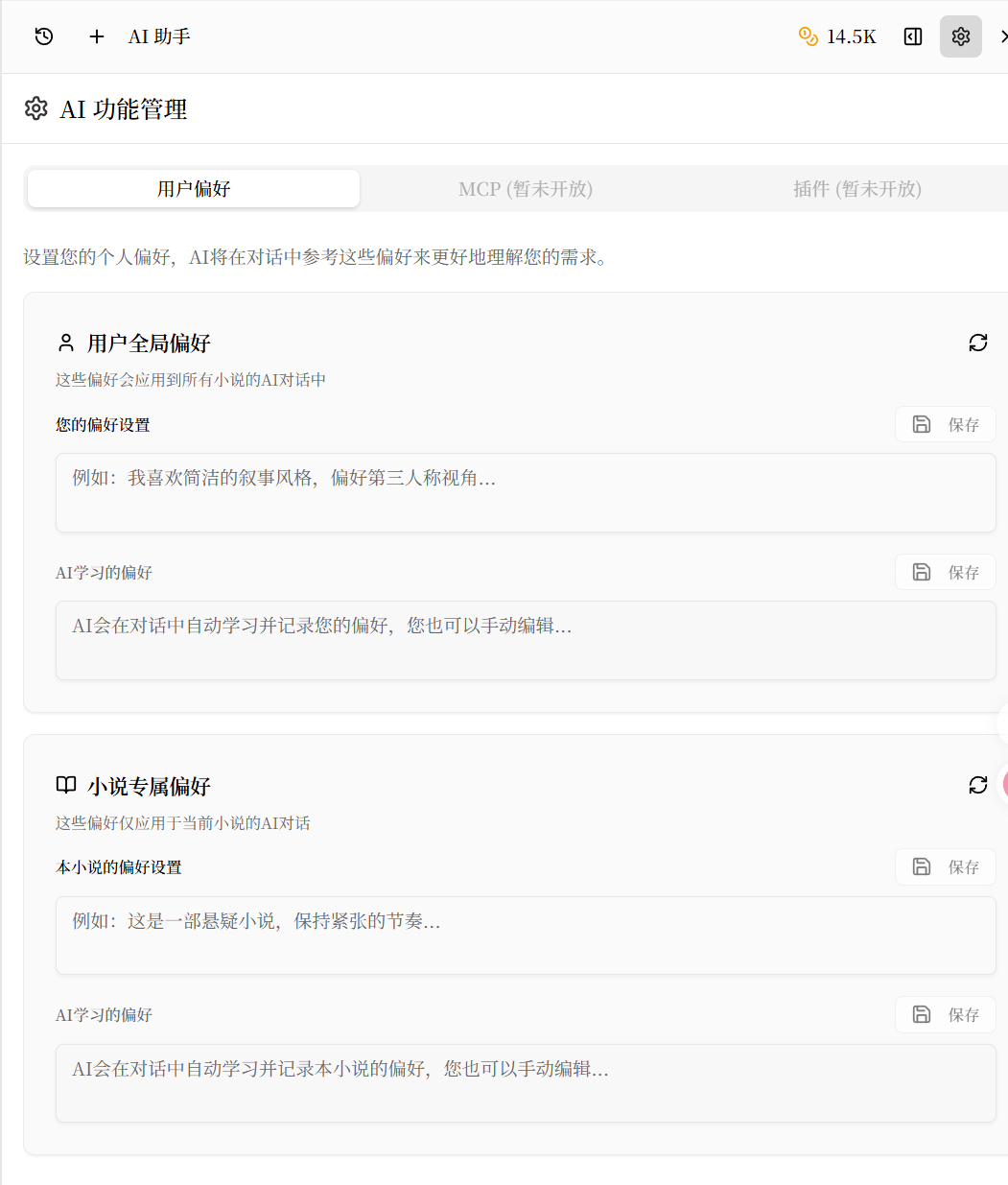
If you don’t have an outline yet, first use the novel outline templates to clarify characters’ goals, obstacles and chapter changes; if you haven’t started chapter one, continue with the AI novel writing beginner flow. When these materials aren’t well prepared, switching straight to a more expensive model won’t necessarily solve the problem. When comparing dialogue voice, see the guide to personal style and character voice; to handle blank lines and punctuation produced by copying, you can first use the free text formatter, but the formatted result cannot stand in for a prose score.
FAQ
Which AI is best for writing novels?
This page lacks sufficient evidence to name a single champion across genres and versions. The best candidate for you should, in your own same-prompt test, leave you with more adoptable content, disrupt established story details less, and meet your budget and waiting-time requirements. Do a small comparison first, then decide on your main model.
Does a larger context window guarantee a long novel has no continuity errors?
You can’t make that guarantee from the window specification alone. Input capacity, whether the material is complete, where information sits and whether it can be used correctly at generation time each need checking. Test with settings that affect the current plot, rather than just asking the model “do you remember”.
If I set the thinking effort to the maximum, will the body text certainly be better?
This page makes no such guarantee. First fix the parameters to set a baseline, then change the thinking setting separately and compare the actual output, wait and cost. Don’t change the model, prompt, material and reasoning settings all at once and still treat the result as a single-variable experiment.
Does this guide guarantee passing review, signing a contract or detection results?
No. Novel quality, platform rules and detection results are different questions; a model selection test also cannot prove a text was written by a human. Before submitting, check the target platform’s formal rules at the time.
About This Revision and Sources
2026-09-06: kept the original page address and first publication date, and turned it into a verifiable selection guide; provided original test prompts and good and bad teaching examples, and withdrew the old scores, absolute-memory claims and fixed million-character cost conclusions that lacked a basis for recomputation. No new paid model comparison was carried out this time.
The official sources are used respectively for checking model and price information and as references for evaluation methods; actual product support depends on the service used. The stories, tables and cost arithmetic in the text are teaching material of this guide. If you find a specific factual error, you can explain the page, the original sentence and the basis through content feedback.