
Three-Level Outline: Never Abandon a Long Novel Again
Build a three-level outline (master outline → volume outline → chapter blueprint) to set direction, control pacing and plan each chapter’s conflict and hook.
In this article 6 sections
Why Do Long Novels Get Abandoned?
The root cause of abandoned web novels is that the author loses their sense of direction while writing:
- Too much foreshadowing was planted early and can’t be paid off later
- Characters’ personalities become self-contradictory as they grow
- The antagonist was written off, and the plot lost its core tension
- Halfway through, you discover a fundamental flaw in the whole story structure
The core value of the three-level outline system is solving these problems before you start writing.
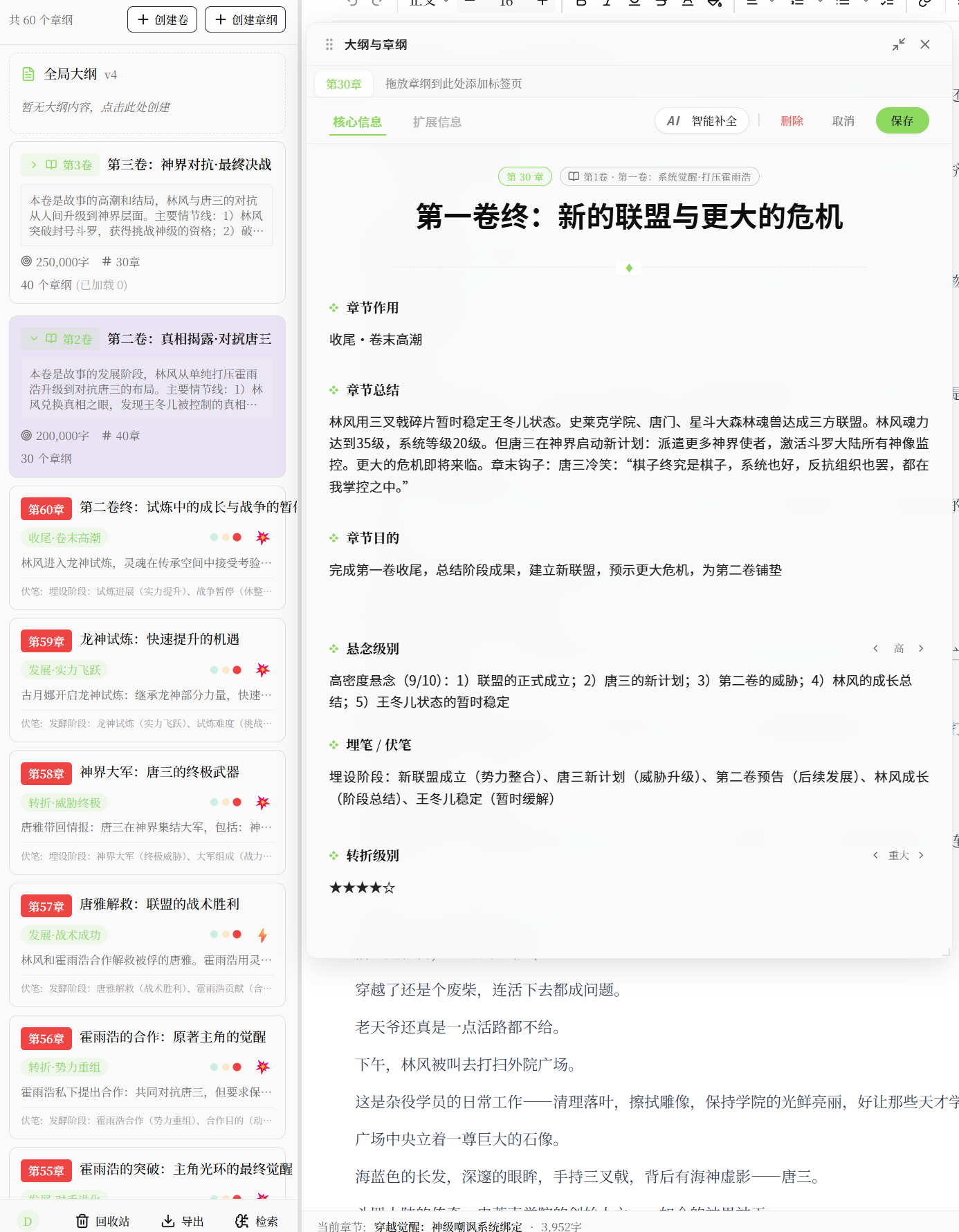
Level 1: The Master Outline (the Blueprint of the Whole Book)
The master outline is the “soul file” of the whole book, usually 1,000–3,000 characters, and contains:
Required items:
- Core conflict: what is the fundamental conflict between the protagonist and the final opponent?
- The protagonist’s growth arc: where does the protagonist start, and what kind of person do they become?
- Theme: what does this book want to express? (optional, but it helps keep the style consistent)
- Direction of the ending: the basic shape of the finale (no details needed, but the direction must be set)
Example (xuanhuan fantasy):
Core conflict: the mortal Zhang San against the immortal realm’s establishment — he is no genius, yet he has to break the “genius monopoly” on the cultivation order.
Growth arc: from a mocked good-for-nothing, to someone who surpasses geniuses through accumulated knowledge and strategy, and finally reshapes the rules of the cultivation world.
Ending: Zhang San becomes the new-generation Great Emperor, abolishes the talent-testing system, and gives ordinary people a chance to cultivate too.
With these three lines, every chapter of the book has a standard to be judged by: does the content of this chapter serve this story?
Level 2: The Volume Outline (Stage Milestones)
Each volume is about 30,000–80,000 characters, and the volume outline plans that volume’s:
- Core events: the 2–3 most important events of this volume
- Changes in the protagonist’s state: changes in realm, relationships and inner life
- Closing hook: what suspense is left at the end of this volume to draw readers into the next
A typical xuanhuan long-form structure (10 volumes in all):
Volume 1: The Good-for-Nothing Rises (realm: Qi Refining → Foundation Establishment)
Volume 2: Leaving the Nest (realm: Foundation Establishment → Golden Core, first meeting with the main-line villain)
Volume 3: The Noble Family Storm (realm: Golden Core → Nascent Soul, conflict with powerful factions)
...
Volume 9: Struggle in the Immortal Realm (realm: Mahayana stage, core conflict intensifies)
Volume 10: Seeking the Heavenly Dao (the final showdown, tying up threads, elevating the theme)
Level 3: The Chapter Blueprint
A chapter blueprint of 500–800 characters for each chapter, containing:
- Opening: the starting state of this chapter (location, time, characters present)
- Development: how the main events unfold (3–5 plot nodes)
- Turn (optional): an unexpected event or piece of information
- Ending: the closing state of this chapter + the hook for the next
With a chapter blueprint, the accuracy of AI’s body text improves greatly, because the direction is extremely clear.
Tips for Generating Outlines with AI
In Maliang Writer, you only need to provide the three core elements of the master outline, and AI can:
- Automatically derive a framework of 10 volume outlines
- Break down the chapter blueprints of the first 3 chapters from the volume outlines
- Generate the body text of chapter one from the chapter blueprint
The whole process takes about 10 minutes, turning “an idea” into “an actionable writing plan”.
Common Mistakes
Mistake 1: Making the outline too detailed
An outline is not a screenplay; too much detail costs you creative flexibility. Draw the skeleton, and fill in the flesh as you write.
Mistake 2: Writing a few chapters before making an outline
Writing first and planning later is the main cause of abandoned novels. Even a rough outline is better than none.
Mistake 3: Thinking the outline can’t be changed
An outline is a living file and can be adjusted at any time. The key is that every time you adjust it, you check the effect on the later chapters at the same time.