
AI Writing for Beginners: Your First Chapter in 10 Minutes
Beginner AI writing: sign up, create a book, generate an outline, and write chapter one, with screenshots—a 2,000-character chapter in 10 minutes.
In this article 9 sections
Don’t Let the Words “AI Writing” Scare You
Many people hear “AI writing” and assume the bar is high: do I need to know programming? Do I need to write prompts? Do I need to understand how large models work?
You need none of it.
If you can type in an online chat, you can write a novel with AI. This article takes you through writing a 2,000-character first chapter in 10 minutes. No exaggeration: really 10 minutes.
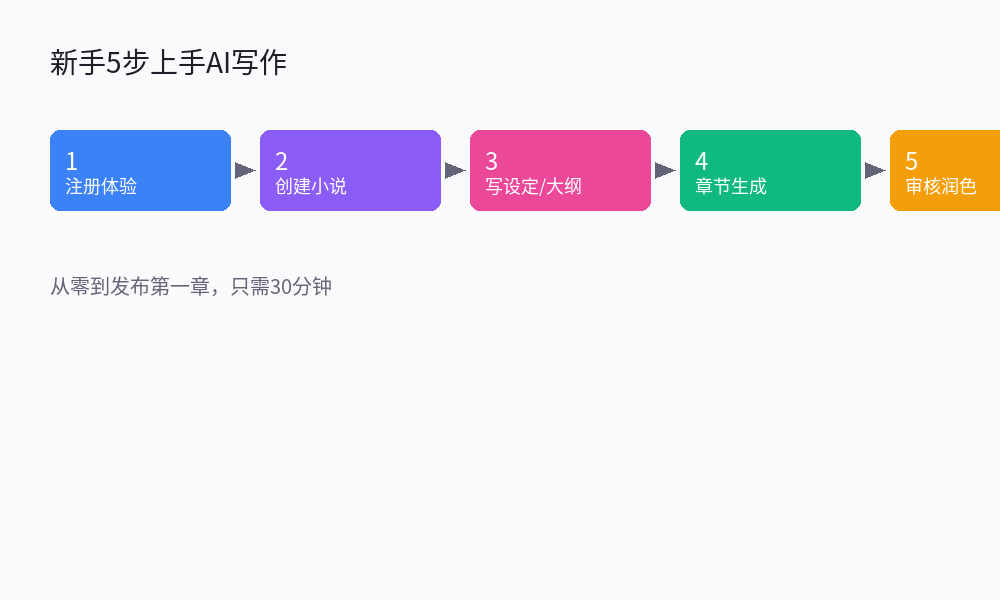
Minute 1: Sign Up and Create a Novel
Open Maliang Writer (maliangwriter.com) and register an account. Once inside, click “New Novel” and fill in:
- Novel title: pick anything, you can change it later
- Genre: beginners are recommended to choose “Urban” or “Romance” (simple worlds that AI writes well)
- Synopsis: one or two sentences summarizing the story you want to write
That’s all. 3 fields, done in 30 seconds.
Minutes 2–3: Write a Minimal Setting
Once inside the novel, open the “Story Bible” and add the two most basic things:
Protagonist setting (50 characters is enough):
Lin Mo, 28, a programmer at an internet company. Socially anxious on the surface, secretly passionate underneath. Has had a crush on a coworker for three years without daring to confess.
Female lead setting (50 characters is enough):
Su Qing, 26, a product manager at the same company. Cheerful and straightforward, says things plainly. Thinks Lin Mo dislikes her.
See, it’s that simple. Two characters, one misunderstanding, one potential romance line. That’s enough.
Minutes 4–5: Write a Chapter Blueprint
No need to write the full outline; just tell AI what this chapter is about. Open “Chapter blueprint” and write:
Chapter 1: Company team-building. Lin Mo and Su Qing are put in the same group for a game. The game forces the two into physical contact (holding hands to cross a balance beam). Lin Mo is so nervous his palms sweat, and Su Qing thinks he is unwilling to cooperate. Ending: Su Qing complains to her best friend, “That Lin Mo is really annoying.”
A blueprint of 100 characters. Five minutes is more than enough to write this.
Minutes 6–9: One-Click Generation
Click the “AI Generate” button. Maliang Writer’s 7 specialized agents start collaborating:
- The structure agent makes sure the plot follows your blueprint
- The generation agent outputs 2,000 characters of body text
- The consistency agent checks that characters’ behavior fits their settings
Wait 30–60 seconds, and a complete chapter of the novel appears.
You will see: the detail of Lin Mo’s sweaty palms, the scene of Su Qing cheerfully dragging him onto the balance beam, both people’s mixed inner thoughts during the physical contact, and the closing dialogue between Su Qing and her best friend.
All of it generated from the 50-character settings and the 100-character blueprint you wrote.
Minute 10: Read Through and Fine-Tune
Skim through the generated content quickly. You might feel:
- A line of dialogue doesn’t sound like what you imagine the character would say → just change it
- A description is too wordy → delete it
- You want to add a detail (such as Lin Mo stealing a glance at Su Qing) → write two lines yourself and insert them
This “fine-tuning” takes about 3–5 minutes. When it’s done, your first chapter is born.

What Next? From One Chapter to a Whole Book
You’ve now experienced the most basic flow. If you want to write a book seriously from here, we suggest adding the following:
Step 2: Write a master outline
Describe the main line of the whole book in a hundred or two hundred characters. For example: “Lin Mo and Su Qing start from a misunderstanding and go through coworkers → mutual crush → rejected confession → six months apart → together after reuniting. Interwoven with workplace threads and each one’s own growth thread.” With a master outline, no chapter AI generates will go off track. See the Three-Level Outline System for details.
Step 3: Enrich your characters
Add more setting details for the male and female leads: family background, past experiences, catchphrases, small habits. The richer the settings, the more three-dimensional the characters AI generates.
Step 4: Use the knowledge graph
After about 10 chapters, turn on the knowledge graph feature. It automatically tracks your characters’ states and events that have happened, preventing AI “continuity errors”. See Knowledge Graph Prevents Continuity Errors for details.
Step 5: Batch daily updates
Once you’re practiced, you can write the blueprints for 5–10 chapters at once, then have AI generate them in batches. After human review, queue them for publication. Updating 10,000 characters a day is no longer a dream. See Multi-Agent Long-Form Writing for details.
The 3 Mistakes Beginners Make Most
Mistake 1: Letting AI generate without writing a blueprint
AI is not a mind reader. Without direction, it will write a pile of bland, plodding play-by-play. Even writing just one line, “this chapter is an argument”, is ten times better than writing nothing.
Mistake 2: Accepting generated content wholesale
About 70–80% of an AI first draft is usable, but the other 20% needs your edits. If you don’t edit, what you publish carries an “AI flavor”. Just fix those “a hint of xxx showed in his eyes” sentences.
Mistake 3: Starting right away on a million-character xuanhuan epic
Please practice first on a 30,000–50,000-character short novel. Run the whole flow through (setting → outline → generation → revision → finished draft) before taking on a long novel. Beginners who jump straight into a million-character epic abandon it 99% of the time.
FAQ
Q: Can someone who has never written a novel write with AI?
Yes. AI lowers the technical barrier (prose and descriptive ability), but you still need “the ability to tell a story”: knowing what is interesting and what moves people. That ability comes from reading a lot, not from writing practice.
Q: What’s the quality of a chapter written in 10 minutes?
It reaches the mid-range of web-novel platforms, and can serve as the basic quality for serialized daily updates. If you spend 20 more minutes polishing, the quality goes up another notch.
Q: How much can free users generate per day?
The free version has a basic daily AI generation quota. Writing 3–5 chapters (6,000–10,000 characters) a day is no problem.