
Web Novel Outline Templates: 5 Ready-to-Use Structures
Five proven web-novel outlines—three-act, hero's journey, level-up, ensemble, and infinite-flow—with examples, best-fit genres, and three-level setup.
In this article 8 sections
An Outline Is a Map; Without It You Will Get Lost
“I just like to write wherever it takes me”: nine out of ten authors who say this end up abandoning the book.
Not writing an outline is not “free creation”; it is “gambling on luck”. By 200,000 characters you will certainly run into these problems: foreshadowing forgotten, the main line drifting with no idea how to pull it back, supporting-character threads scattering more and more.
An outline is not a shackle that limits you; it is a map that keeps you from getting lost. Especially when writing with AI: AI has no “inspiration”, and if you don’t give it a map, it runs blindly.
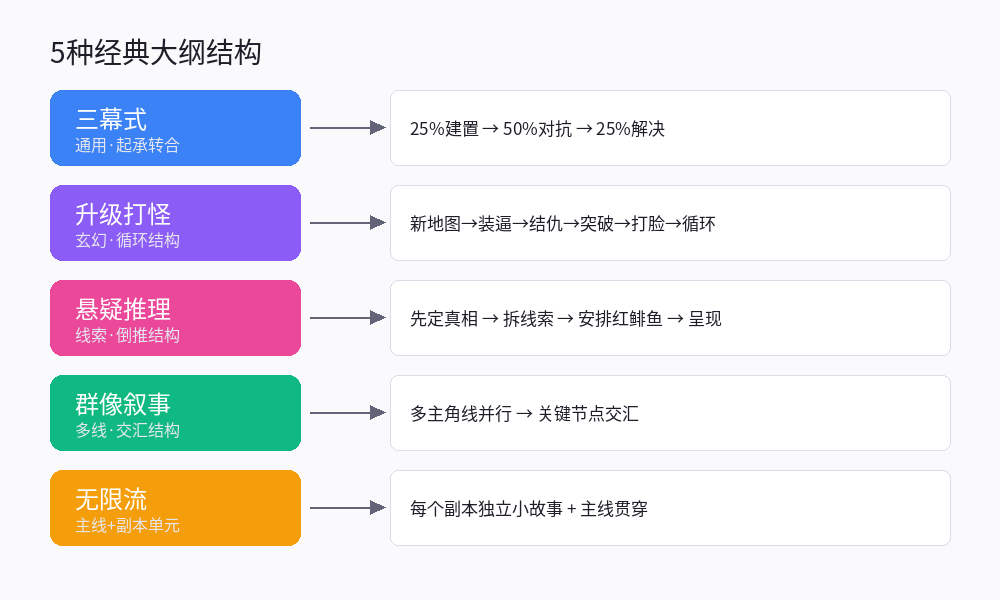
Template 1: Three-Act Structure (the Most General)
Suits: short stories, novellas, and long novels with a clear beginning, development, turn and ending
The three-act structure is a story structure Hollywood has used for 100 years: simple and blunt, but effective:
Act One (25%): Setup
Introduce the characters and the world, create an event that “breaks the routine” (the inciting incident), and force the character onto a journey.
Act Two (50%): Confrontation
The character advances toward the goal and meets ever bigger obstacles. The midpoint is a big turn (usually a “false victory” or “false defeat”). In the second half the obstacles double, and the character falls to the “lowest point”.
Act Three (25%): Resolution
The character resolves the final crisis as their grown self, and the story wraps up.
Outline example (xuanhuan):
Act One: The good-for-nothing protagonist has his engagement broken off → by chance obtains a legacy → decides to grow stronger
Midpoint: Shines at the sect tournament → but is found to have used a forbidden technique → expelled from the sect
Lowest point: Wanders alone → hunted → badly wounded and near death → grasps true power
Act Three: Returns to the sect → exposes the villain’s plot → final battle → becomes a power in his own right
Enter this outline into Maliang Writer’s three-level outline system, then break it down into each volume and each chapter.
Template 2: Level-Up and Fight (the Web Novel Staple)
Suits: xuanhuan, xiuxian (cultivation), system novels
This is not a traditional “story structure” but the web novel’s own “loop structure”: every arc is a round of “meet a stronger opponent → train and grow stronger → defeat the opponent → enter a new map”.
Core loop:
New map / new faction → low-key flexing → make enemies → cultivation breakthrough → face-slapping → get rewards → bigger stage
Outline framework:
Volume 1 (Cultivation Basics): Starting map → Level: Qi Refining stage → Villain level: local bully
Volume 2 (Sect Struggles): The sect → Level: Foundation Establishment stage → Villain level: inner-sect elder
Volume 3 (Venturing Out): Secret realm / outer lands → Level: Golden Core stage → Villain level: geniuses of other sects
...each volume doubles the level and doubles the stage
Key: every loop needs one “beyond expectations” element; it can’t be pure formula. For example, the villain of Volume 3 turns out to be the protagonist’s long-lost brother. AI is good at executing a loop structure, but you need to mark each loop’s “differentiating element” in the blueprint.
Template 3: Mystery and Detection (Clue-Driven)
Suits: mystery, detection, thriller
The outline logic of mystery is completely different from the two above: it works backward from the ending.
The order of writing the outline:
- First fix the truth (who the killer is, the motive, the method)
- Break the key clues into 5–10 items
- Decide when each clue appears
- Arrange 2–3 red herrings (misleading clues)
- Only last, write “the protagonist’s perspective” and present it in order
Outline example:
Truth: The butler did it; the motive was the inheritance; the method was slow-acting poison in the coffee
Clue 1 (chapter 3): The deceased drank only coffee brewed by the butler every day
Clue 2 (chapter 5): The butler has a pharmacology background
Red herring (chapter 4): The deceased’s lover has large debts
Reveal (chapter 10): The protagonist finds a medicine bottle in the butler’s room
See the Urban Mystery AI Writing Guide for more on foreshadowing management.
Template 4: Ensemble Narrative (Multiple Protagonists)
Suits: political scheming, palace intrigue, multi-faction conflict
Ensemble is the hardest structure to write, because you have to advance 3–5 protagonist threads at once and also make them converge at key nodes.
Outline framework:
Main thread A (the prince’s revenge): ch. 1 → ch. 3 → ch. 6 → ch. 9 → ch. 12
Main thread B (the princess’s hidden move): ch. 2 → ch. 4 → ch. 7 → ch. 10 → ch. 12
Main thread C (the assassin’s awakening): ch. 3 → ch. 5 → ch. 8 → ch. 11 → ch. 12
Convergence points: ch. 6 (A and C meet for the first time), ch. 9 (B and A join forces), ch. 12 (the three threads merge for the final battle)
In Maliang Writer, use the storyline system to create the three threads A/B/C separately and mark the convergence nodes. When AI generates each chapter, it automatically checks which thread should advance now.
Practical advice: an ensemble outline must have a timeline drawn up, to make sure the three threads’ times are in sync. Otherwise you get the bug of “thread A has passed three days while thread B is still on the same day”.
Template 5: Infinite-Flow / Instance-Based (Episodic)
Suits: infinite-flow, instance-based novels, rules horror
This is a “main line + episodes” structure: each instance/world is an independent small story, and the main line runs through all the instances.
Outline framework:
Main line: The protagonist is chosen to enter the game → each instance cleared yields a clue → finally the truth behind the game is pieced together
Instance 1 (survival type): Desert island survival → 3 chapters
Instance 2 (detection type): Locked-room murder → 4 chapters
Instance 3 (combat type): Otherworld war → 5 chapters
Interludes: 1 chapter of main-line progress between instances
Key: each instance can have a different tone (horror, comedy, hot-blooded), but the protagonist’s growth arc must run through all of them. In the master outline, mark what growth the protagonist gains after each instance (on two levels: ability and psychology).
Managing the Outline in Maliang Writer
Maliang Writer’s three-level outline system naturally fits all the templates above:
Master outline: corresponds to the “template framework” above, the main line of the whole book
Volume outline: corresponds to the detailed plan for each volume / each big arc
Chapter blueprint: corresponds to the specific content instructions for each chapter
Recommended workflow:
- Choose a template and spend 1–2 hours writing the master outline (1,000–2,000 characters)
- Break the master outline into 5–10 volumes, writing a 200–500-character volume outline for each
- Before you start writing, write the chapter blueprints for the current volume (50–200 characters per chapter)
- AI generates according to the blueprints, and you handle review
This way your “creation” is concentrated at the planning level (the most valuable part), and “execution” is left to AI.
FAQ
Q: How detailed should an outline be?
Master outline 1,000–2,000 characters, volume outlines 200–500 characters per volume, chapter blueprints 50–200 characters per chapter. Too rough and AI has too much room and easily goes off track; too detailed and you spend more time on the outline than on the body text.
Q: What if I want to change the outline as I write?
Completely normal; an outline was never fixed. Maliang Writer supports editing at any time: after you change the outline, later generated chapters automatically follow the new one.
Q: Which template should someone who has never written a novel use?
We recommend starting with “Level-Up and Fight”. Its structure is the simplest, it has the highest reader acceptance, and AI executes it best. Try more complex structures after you finish your first book.