Folio №07 · vs Jasper AI · 2026-10-11
General chat AI, coding agents and overseas writing tools

Is Jasper AI Right for Writing Novels? Marketing Writing Platform vs Long-Form Fiction Tool

Jasper is a marketing AI platform (Brand Voice, agents, 30+ languages). What to know when using it for a novel, vs. Maliang for long Chinese fiction.

❦ · Verdict · ❦
Bottom line

The short answer

Jasper was never a tool for writing novels: it describes itself as “an agent workspace built for modern marketing teams”, good at keeping a whole team’s marketing content in one brand voice and producing it in bulk in many languages. Official material shows no features aimed at long novels (setting library, chapter structure, version history and so on). For long Chinese fiction, Maliang offers a volume-and-chapter table of contents, character cards, story archives organized after each chapter is written and revision comparison in the editor.
Who should pick Maliang WriterAuthors writing long Chinese fiction who need chapter, character and foreshadowing management and revision comparison.
Who should pick Jasper AITeams producing marketing content: users who need a consistent brand voice, collaboration among several people, multilingual output and marketing workflows.
Scenario

A concrete writing scenario

An author who writes event copy with Jasper in a company marketing department is writing a long urban novel in their spare time and wants to use the same tool. They find that Jasper’s Brand Voice keeps the whole team’s copy in one tone, and the translation agent can turn copy into Traditional Chinese and Cantonese, which works well for the job. But for a novel they need something different: every chapter has to pick up from the earlier text, characters must not drift late in the book, revised paragraphs should show what changed, and when starting a book they want to consult the pacing of popular books in the same genre. They decide to keep work in Jasper and move the novel to a dedicated tool.

❦ · Matrix · ❦
Comparison table

11 dimensions compared one by one

On narrow screens, scroll sideways to see all columns.

Maliang Writer vs Jasper AI: key dimensions compared
DimensionMaliang WriterJasper AINotes
Product positioning✅ A human-AI collaborative writing tool for long Chinese fiction✅ An AI work platform for marketing teams (its own description)
Novel chapters and volume-and-chapter structure✅ Volumes, chapters and chapter outlines are in the left-hand table of contents, and new chapters AI writes appear there directly⚠️ No official material found describing a chapter structure for long novels
Characters and settings✅ Characters, settings, foreshadowing and storylines are cards; AI reads them as needed when writing and can also edit them as you ask⚠️ Has knowledge assets (5 included in Pro), described officially for brand, product and marketing material; no description of novel character settings found
Settings changing with the plot✅ After a chapter is written and this stretch of writing ends, story archives are organized: character states, relationships, locations, foreshadowing; anything that doesn’t match is listed as pending confirmation; can be turned off⚠️ No official material found
Consistent tone and style✅ When starting a book, passages from benchmark works are taken as style samples, and the writer agent checks against them for each chapter; style preferences can also be saved in the AI settings✅ Brand Voice sets a brand’s tone and style, and flags content that drifts from the brand voice with suggested edits
Editor and revision comparison✅ AI changes appear on the original in the editor as red deletions and green additions, each of which can be kept or restored; you can undo the current round, branch, or edit and resend⚠️ Has a document editor for writing, editing and formatting; no official material found on comparing changes one by one
Multiple languages✅ Chinese interface, for writing in Chinese✅ Can create or rewrite content in 30+ languages; the translation agent supports 27 languages including Simplified Chinese, Traditional Chinese and Cantonese; the website interface is in English
Team collaboration⚠️ Built for individual authors writing books✅ Canvas collaborative workspace; the Business tier has no user limit
Models✅ A choice of several models; the model that writes the body text can be chosen separately, see the in-product list for specifics✅ Several providers’ models routed by task (OpenAI, Google, Anthropic, Meta); no consistent official description of whether you can choose a model manually
Genre reference for Chinese web novels✅ When starting a book, consult the character and structure breakdowns of more than 1,500 popular serials in the public book library; the chapter-ending check is benchmarked against more than 2,000 popular web novels and about 56,000 chapter endings⚠️ No official material found
Price and trial✅ Free sign-up to try, then credits are deducted by usage✅ Pro $69/month billed monthly, $59/month billed annually, with a 7-day free trial; Business is custom-quoted (checked 2026-10-11)

✅ Confirmed in official material or in the product   ⚠️ Partly supported, or not stated in official material   ❌ Officially not supported · Competitor information comes from their public material.

How Maliang Writer approaches it

How Maliang Writer handles these problems

№01 Maliang Writer

Structure prepared for long fiction

Volumes, chapters, chapter outlines, character cards, setting cards, foreshadowing and storylines each have a place, the master outline is stored separately, and style samples are documents. New chapters and settings written by AI appear directly in the table of contents and the sidebar.

№02 Maliang Writer

Story archives organized after each chapter

After a chapter is written and this stretch of writing ends, the background organizes character states, relationships, locations and foreshadowing, and anything that conflicts with existing settings is listed as pending confirmation for you to confirm. It can be turned off.

№03 Maliang Writer

A body-text writer agent and chapter-ending checks

The body text goes to a dedicated writer agent, drawing on this book’s earlier text and style samples; each chapter comes with a chapter-ending check, benchmarked against more than 2,000 popular web novels and about 56,000 chapter endings.

  1. Revisions you can see: When AI edits the body text, red deletions and green additions are marked, and each can be kept or restored; if you are unhappy with a whole round, you can undo the current round, branch from before it, or edit and resend.
  2. Genre reference from popular books in the same genre: When starting a book, it consults the breakdowns of character setups and pacing of more than 1,500 popular serials in the public book library, learning methods rather than copying.
What you fill in yourself

What the author has to do when writing a long novel directly with Jasper AI

  1. Not designed for novels: It is officially positioned as a work platform for marketing teams, and no official material shows features aimed at long novels (setting library, chapter structure, version history and so on). When writing a novel, the author has to organize chapter order and character material themselves.
  2. You supply the story so far yourself: Which earlier text and which characters to bring along when writing a new chapter is not described for novel scenarios in official material, so the author may have to supply them by hand each time.
  3. Brand voice is not novel style: Brand Voice is for brand tone and style guides; no official material describes using it to keep each character’s way of speaking and the narrative style consistent in a novel.
  4. Pricing is designed for marketing teams: The Pro tier starts at $59–69/month, billed in US dollars, and does not accept PayPal or prepaid cards (checked 2026-10-11). An individual author who only uses it to write novels has to weigh the cost.
Where they are strong

What Jasper AI does well

Jasper’s strengths in marketing content are clear: Brand Voice and style guides keep a whole team’s content in one tone and warn when it drifts; the Canvas workspace, marketing agents, bulk generation and custom workflows suit team processes; it can create content in 30+ languages, and the translation agent covers Simplified Chinese, Traditional Chinese and Cantonese; under the hood, it routes tasks to models from several providers, and it also offers an API and a browser extension. For teams doing brand and marketing content, it is well worth considering. This page discusses only one thing: writing long novels.

Every product suits some scenarios; the advice here covers only one: serialized long-form fiction in Chinese.

Real interface

Maliang Writer's real interface

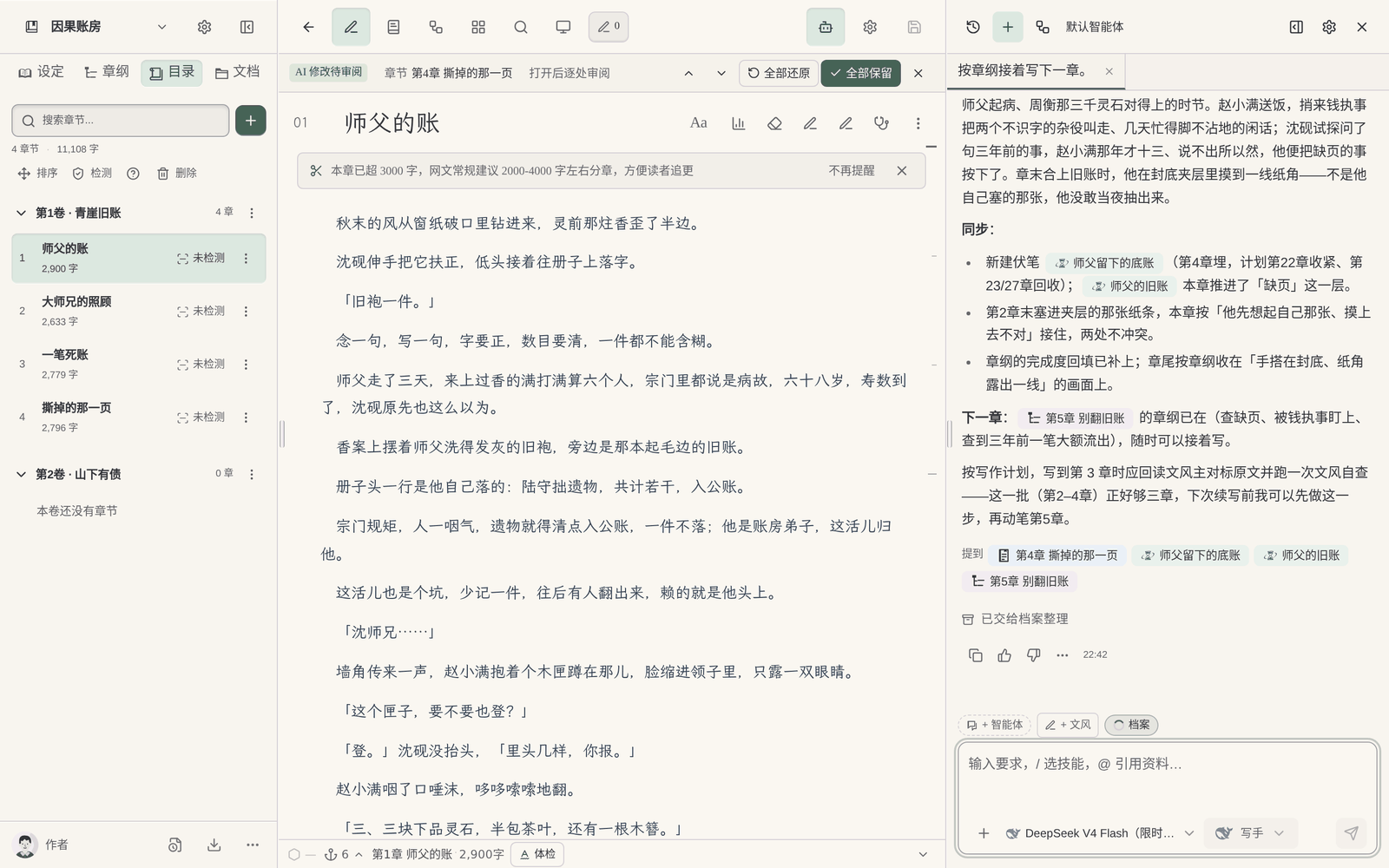
Asking Maliang in chat to keep writing, with a new chapter appearing in the left-hand table of contents and the text
The author says “keep writing” in chat, and the new chapter goes straight into the table of contents.
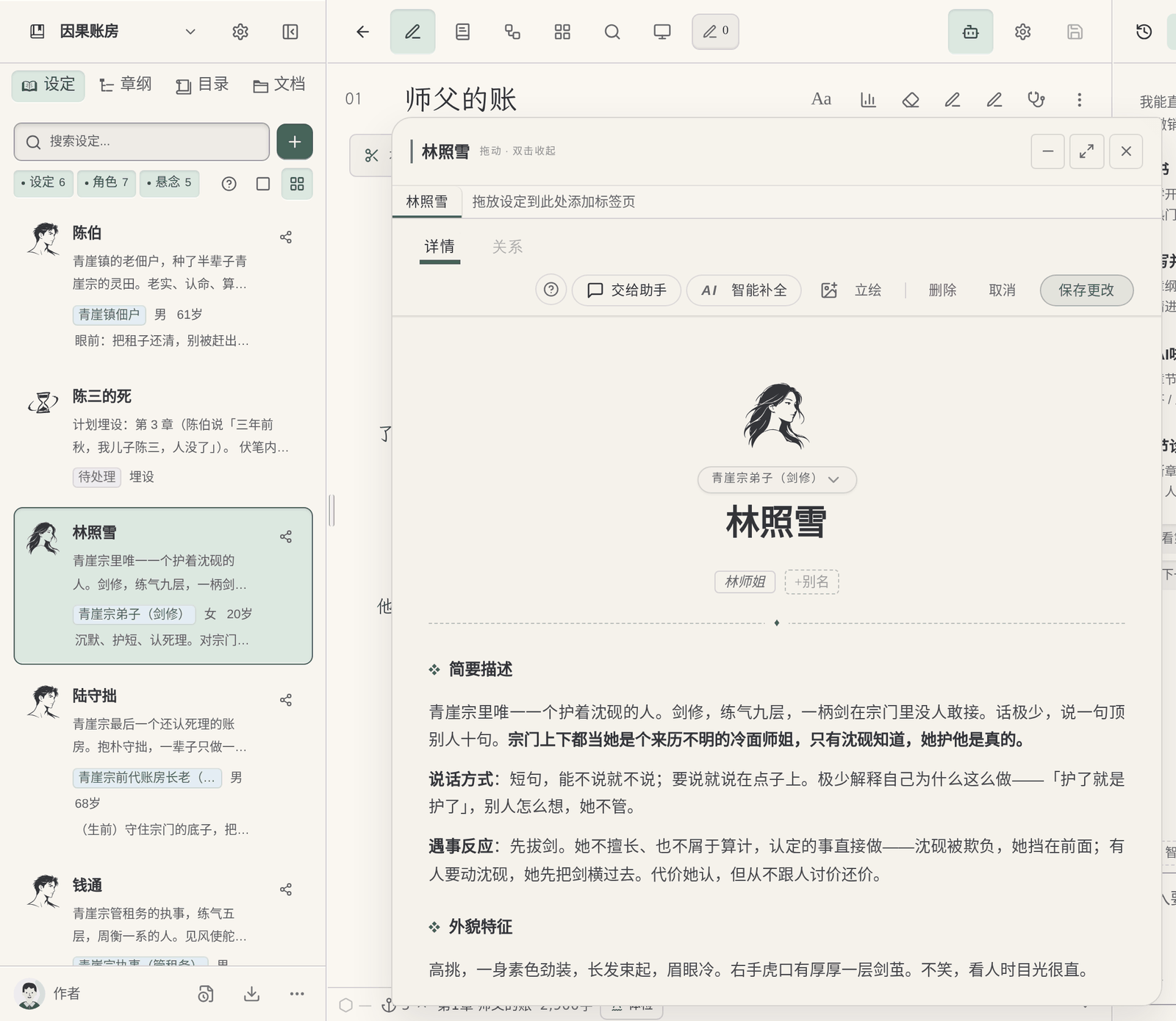
Maliang’s floating character card showing a character’s settings
The author opens a character card to view the character’s settings.
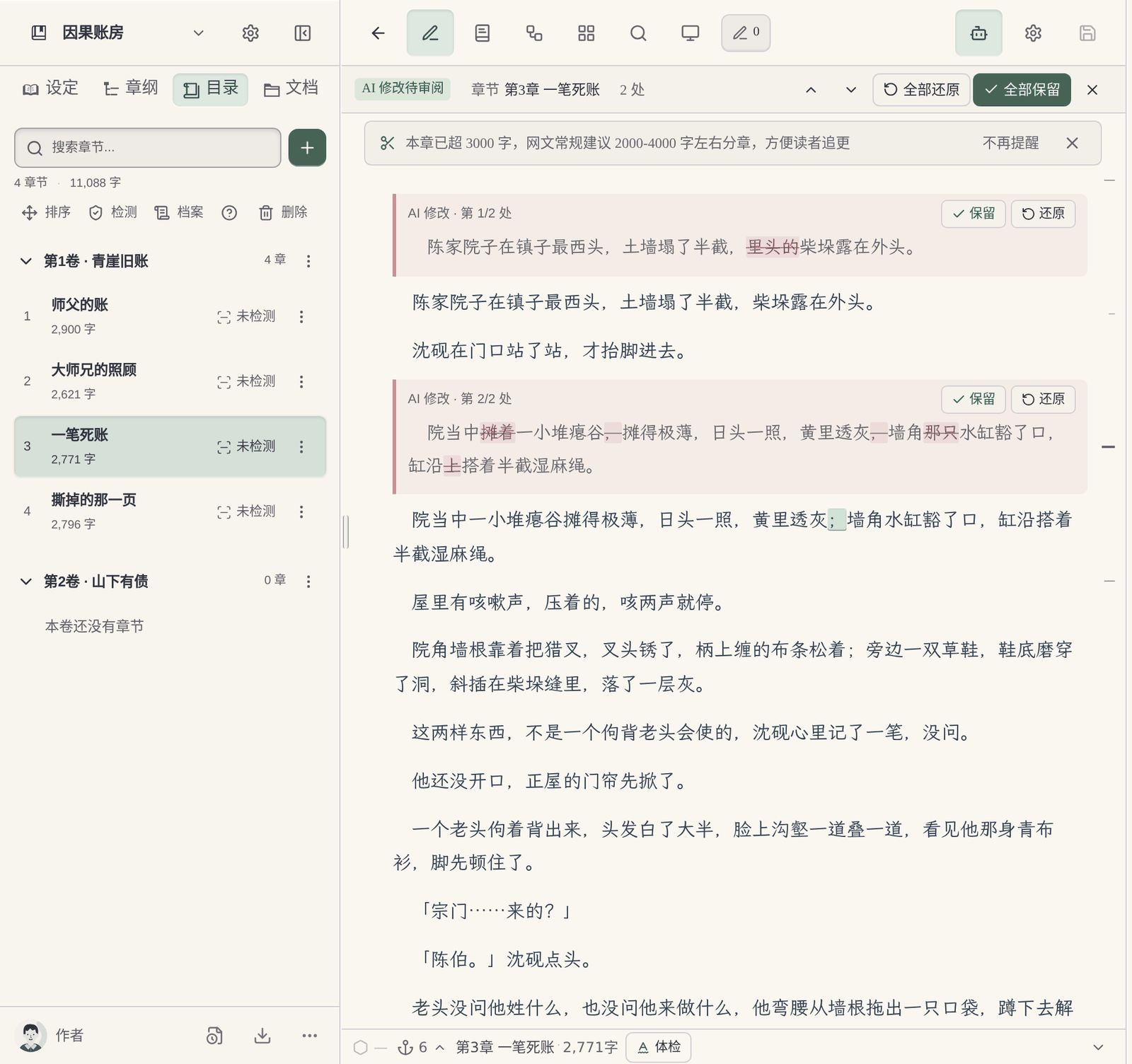
Red deletions and green additions for AI changes in the Maliang editor, each of which can be kept or restored
The author goes through AI’s changes one by one and decides whether to keep or restore each.
❦ · Evidence · ❦
Data and sources

Sources and check dates

Try four real writing tasks before you decide

When trying Jasper AI and Maliang Writer, start with the same original material and record the whole process: preparing materials, editing the text and taking the work with you when you leave the tool. Actual use decides the result; no side is assumed to win.

Below is a same-task trial checklist, not a finished comparison experiment. You can use the original teaching material “Jiehuo City” or a manuscript you have the right to handle; record the preparation, the output and the author’s edits for each tool.

Start a new book

Give both tools the same protagonist, core rules and reading preferences; compare the opening directions first, then organize the master outline, the first volume outline and the outlines for the first three chapters.

Check: Can it tell the roles of the three outline levels apart? Can the author confirm a plan before it continues? Were settings that hadn't been settled yet quietly written in as fact?

Use the same book-opening kit

Continue an existing twenty chapters

Use the same old manuscript you have the right to handle, specify how the last chapter ends and the goal of the next chapter; try writing one scene first, without changing the previous twenty chapters.

Check: What material did you prepare? Did character positions, items and open threads carry over? How are candidate drafts told apart from adopted ones?

See the import-and-continue task checklist

Change a setting that has already appeared

Pick a real rule that affects earlier chapters; first ask it to list the affected chapters and the evidence, then let the author choose the scope of the change.

Check: Does it say which parts it did not check? Can you review the changes first? Did it wrongly edit text outside the task or write an unadopted plan into the material?

See how to change a setting

Take your work and material with you

Actually try keeping the text, the order of volumes and chapters, character profiles and world rules, and check whether the output is suitable for further editing; list what cannot be taken along.

Check: Are the format and order recognizable? What material is inside the platform account, what is in local files, and what is in the export? Do not infer usability from a marketing page alone.

Copy the task and result record card

Record the models, plans or account conditions you actually used, and the time spent preparing materials and editing the text. Leave blank anything you have not tried or cannot confirm; do not let a feature name or a single generation stand in for the full experience.

How to choose

Choose by your situation

FAQ

FAQ

Can Jasper AI write novels?

It is officially positioned as a work platform for marketing teams, and no official material shows features aimed at long novels (story bible, chapter structure, version history and so on). When writing a long novel, the author has to manage chapters, characters and the story so far themselves.

Does Jasper AI support Chinese?

The official pricing page says content can be created in 30+ languages, and the translation agent lists Simplified Chinese, Traditional Chinese and Cantonese; the website interface is in English. No official material found on how well it writes Chinese fiction.

How much does Jasper AI cost?

Official pricing page (checked 2026-10-11): Pro is $69/month billed monthly and $59/month billed annually; Business is custom-quoted with a minimum 12-month term. Refer to the official site for current prices.

Does Jasper AI have a free version?

The official site offers a 7-day free trial of the Pro tier, which requires a credit or debit card and does not accept PayPal or prepaid cards. Maliang Writer is free to sign up and try.

Can Jasper’s Brand Voice be used to keep a novel’s style consistent?

Brand Voice is for a brand’s tone and style guides, and no official material found on using it for novels. Maliang’s approach is to take passages from benchmark works as style samples when starting a book, and the writer agent checks against them as it writes each chapter’s body text.

Can Jasper AI be used in China?

Jasper’s terms of service do not list available countries, are subject to US export controls and price in US dollars. Whether you can access and pay smoothly depends on your actual situation.

What’s the difference between a marketing writing tool and a novel tool for writing novels?

Marketing writing tools center on individual pieces and brand consistency; a novel tool has to manage the structure of dozens or hundreds of chapters: the volume-and-chapter table of contents, character states, foreshadowing progress and revision versions. Maliang turns these into a table of contents, cards and story archives.

Which Jasper alternatives suit writing novels?

For long Chinese fiction, look at Maliang Writer; for English-language fiction, look at novel tools such as Sudowrite and Novelcrafter; you can also use a general-purpose large model, but you manage the story so far and settings yourself.

Can Maliang’s AI-flavor removal guarantee passing detection?

No. AI-flavor removal reduces common AI-sounding sentence patterns, but whether the text passes a given detection tool depends on the detector.

❦ · Continued · ❦
Related comparisons

Related comparisons

Writing Novels with ChatGPT vs Maliang Writer: How Projects and a Novel Editor Divide the Work in a Long Serial

vs ChatGPT · updated 2026-10-11

ChatGPT suits brainstorming, drafting passages and polishing sentences. Projects keeps story files and instructions together, and Memory remembers preferences. In a long serial, how chapters are ordered, where to edit when a setting changes and what this draft changed are still for the author to arrange. Maliang puts volumes and chapters, character cards, story archives and revision comparison in one editor.

Read the comparison →

How Good Is Sudowrite for Chinese Writing? Sudowrite vs Maliang Writer for Long Fiction

vs Sudowrite · updated 2026-10-11

Sudowrite is designed around a complete workflow for English-language fiction: the Story Bible runs from a brain dump all the way to prose, the Muse model is built for fiction, and there is a planning canvas and a mobile app. Chinese authors writing web-novel serials should note the officially mentioned “some output falls back to English”, and setting changes after a chapter is written are also mostly for the author to maintain. Maliang is built for long Chinese fiction: cards, story archives, revision comparison in the editor and genre reference for Chinese web novels.

Read the comparison →

Does NovelAI Work in Chinese? NovelAI vs Maliang Writer: How to Choose

vs NovelAI · updated 2026-10-11

NovelAI is a mature AI story-writing tool for English and Japanese: the Lorebook is brought in automatically by keyword, Memory and the Author’s Note stay in place, every generation is recorded in a traceable branching history, and there are in-house fine-tuned models and anime image generation. But its interface is only in English and Japanese, and official material does not describe product-level support for writing in Chinese. For long Chinese web-novel serials, Maliang offers a Chinese volume-and-chapter table of contents, character cards, story archives organized after each chapter is written, revision comparison in the editor and Chinese genre reference.

Read the comparison →
Get started

Try one chapter of the book you're writing

After signing up, create a book or import existing chapters, tell the AI which chapter to continue, then look at what it wrote, what it changed and what it recorded in the archive, and decide whether to move your long novel over.