
Web Novel Pacing and Payoff Design: Write Chapters Readers Can't Put Down
A breakdown of the core methodology behind web novel pacing: 6 chapter-ending hook designs, planning payoff density at one every 3,000 characters, managing tension and release across emotional curves, and a practical workflow for using AI pacing analysis tools to benchmark against hit chapters and spot weak points. Backed by data and case studies to help you understand why some books keep readers binge-reading into the early hours.
In this article 8 sections
Last updated: 2026-03-09 | Reading time: about 16 minutes
Key Takeaways
- Pacing in a web novel isn't about writing fast or slow—it's about how often you reward the reader.
- Every chapter needs at least one "small payoff," and every 3–5 chapters needs a "major payoff"—break that rhythm and your read-through rate drops.
- Chapter-ending hooks are make-or-break for your read-through rate; ending a chapter without a hook is practically pressing the "exit" button for the reader.
- AI's biggest pacing problem is being "too even"—it won't speed up or slow down on its own, so you have to mark pacing explicitly in your blueprint.
- Maliang Writer's chapter blueprints let you add pacing instructions ("speed this chapter up," "slow down in this passage"), and the AI adjusts accordingly.
What "Pacing" Means in a Web Novel
Many people think "pacing" means "writing fast or slow." That's wrong.
In a web novel, pacing is essentially how often you deliver information and emotional hits.
Think of it this way: a reader following your book is emotionally on a roller coaster. Sometimes they're climbing (setup, foreshadowing, building anticipation), sometimes diving (face-slapping, twists, climactic outbursts), and sometimes cruising on flat track (slice-of-life scenes, breathers, romance).
Good pacing means never leaving the reader on flat track for too long. Once a flat stretch runs past 3 chapters, your read-through rate starts to fall.
The data backs this up: we analyzed the top 10% of titles on the platform by read-through rate, and they share one trait—an emotional peak every 1.8 chapters on average. For the bottom 10% by read-through rate, the average gap was 4.7 chapters.
The 3 Levels of Payoffs
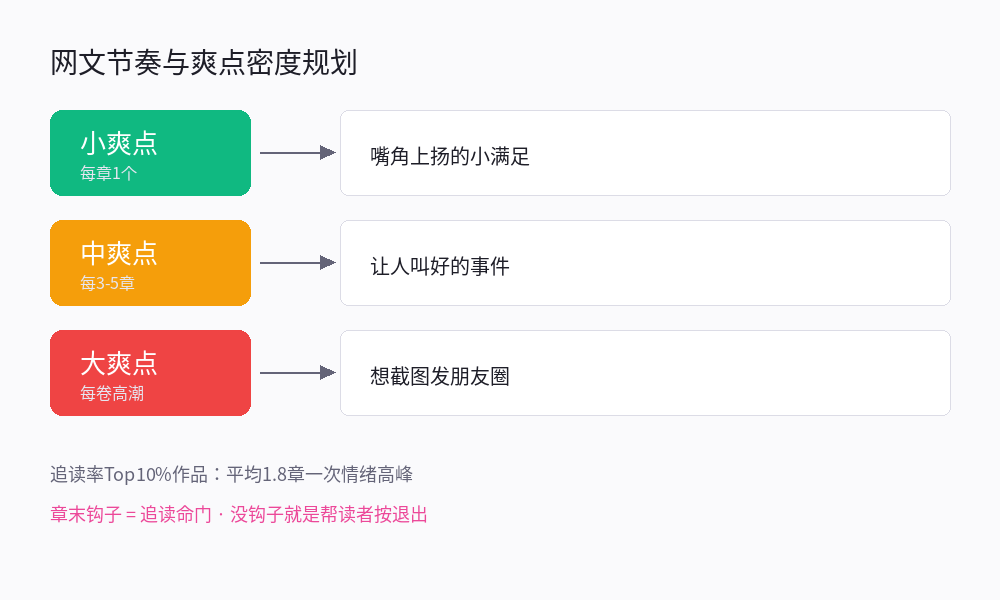
Small Payoffs (at least 1 per chapter)
A small moment of satisfaction that brings a slight smile to the reader's face. It doesn't take a major event—one small detail is enough:
- The protagonist delivers a line that makes readers want to applaud
- A bystander's shocked expression
- A small twist that's unexpected yet makes complete sense
- Unlocking a small reward or learning a new skill
Mid-Size Payoffs (1 every 3–5 chapters)
Events that make the reader think, "Wow, that was so satisfying":
- A complete face-slapping sequence (setup and suppression → reversal and crushing victory → stunned onlookers)
- A breakthrough in an important relationship (the "white moonlight" love interest confesses, or an enemy gets exposed)
- A leap to a higher power tier
- A mystery revealed
Major Payoffs (1 per volume climax)
Highlight moments that make readers want to take a screenshot and share it on their social feed:
- The final turnaround in a volume's boss fight
- The chain reaction triggered when an identity is exposed
- A "slap-your-knee" eureka moment when multiple foreshadowed threads pay off at once
For tips on designing the foreshadowing behind major payoffs, see Foreshadowing and Suspense Design.
Chapter-Ending Hooks: The Lifeblood of Read-Through
Here's a brutal truth: readers decide whether to read the next chapter based on the last three lines of this one.
Good hook types:
Suspense: "A voice came from outside the door. It belonged to someone who could not possibly be here." End of chapter. The reader can't sleep without clicking to the next chapter.
Twist: The whole chapter hints that A is the killer, only for the final line to reveal blood on B's hands. The reader's mind automatically starts piecing things together, and they can't resist reading on.
Emotional bomb: Three chapters of pent-up conflict erupt at the end of the chapter: "You never once saw me as a friend." Cut right there. The reader's emotions are left hanging in midair.
Information drop: Casually toss out a bombshell at the end of the chapter: "He turned to the last page of the diary. Drawn on it was a face identical to his own." The reader's curiosity is instantly ignited.
The key principle: plan your hooks in the blueprint ahead of time. Don't wait until you've finished writing to "figure out how to end it." In Maliang Writer's chapter blueprint, simply write "Hook: XXX" as the final element.
Once you've got the basics of designing chapter-ending hooks down, if you want to see where hit books across different genres typically cut off their chapters, check out the twenty-genre data breakdown in Web Novel Opening Chapter Endings & Cliffhanger Stats.
AI's Biggest Pacing Problem and How to Fix It
AI's sense of pacing is very "flat." It won't create highs and lows on its own; instead, it lays out content at a uniform speed. Every paragraph is roughly the same length and every event gets roughly the same descriptive density, making the result feel bland.
Fix 1: Mark the pacing in your blueprint.
Weak blueprint: The protagonist enters the secret room, finds a clue, and deduces the truth.
Strong blueprint: The protagonist enters the secret room (slow pace, build a tense atmosphere, 3 paragraphs describing the setting) → finds the key clue (pace picks up, mostly short sentences) → the lights suddenly go out (hard stop, final line serves as the hook)
The second blueprint tells the AI when to speed up and when to slow down. And it will listen.
Fix 2: Use paragraph length to control speed.
Tell the AI: "Use short sentences in tense passages, no more than 15 characters per sentence," and "Write calm passages normally." Short sentences naturally speed things up; long sentences naturally slow things down.
Fix 3: Adjust after generation.
If a generated passage feels too flat, add "Rewrite this passage with a tenser pace and add 3 stress reactions from the characters" to your prompt and regenerate.
Classic Pacing Templates
Template 1: Setup–Build–Turn–Payoff (most versatile)
- Setup (first 500 characters): briefly recap the previous chapter + introduce this chapter's conflict
- Build (middle 800 characters): escalate the conflict and ramp up the pressure
- Turn (300 characters): introduce a turning point—either shifting from despair to hope or having the enemy reveal their trump card
- Payoff (400 characters): the protagonist strikes back / the truth comes out / an unexpected windfall lands + end on a hook
Template 2: Roller Coaster (good for fight chapters)
Tension → catch a breath → higher tension → seems like it's over → peak tension → resolution + hook
The key is the false ending—the "seems like it's over" beat. Just as readers exhale in relief, everything kicks off again. That experience is intensely gripping.
Template 3: Escalating Reveals (good for mystery/puzzle plots)
Clue A → deduce Conclusion 1 → something feels off → Clue B overturns Conclusion 1 → new deduction → a bigger secret surfaces
Every time a previous conclusion gets overturned, it delivers a "small payoff," keeping readers working through the puzzle right alongside you.
All of these templates can go straight into a Maliang Writer chapter blueprint. For more outline and blueprint templates, see Complete Outline Templates.
Check Your Pacing Against the Data
If your book is already live on a platform, two core metrics directly reflect pacing quality:
- Read-through rate: the share of readers actively following your updates. A drop in read-through rate = something went wrong with the pacing in the last few chapters.
- Chapter completion rate: of the readers who open a chapter, how many read all the way to the end. A low completion rate = intra-chapter pacing is off, and readers quit midway.
When your read-through rate slips, look back at the endings of the last 3–5 chapters. Did the hooks fall flat? Were there consecutive stretches of "flat track" in the middle? You can salvage all of this through revision. For data management after signing a contract and going live, see the Publishing and Contract Guide.
FAQ
Q: Will designing a payoff into every chapter cause "payoff fatigue"?
No, as long as you vary the types of payoffs. Five chapters of face-slapping in a row will definitely wear readers out, but if Chapter 1 is a face-slap, Chapter 2 solves a puzzle, Chapter 3 moves the romance forward, Chapter 4 is comedic slice-of-life, and Chapter 5 plants new foreshadowing, every chapter delivers without readers getting tired of it.
Q: Can pacing carry a book if my prose isn't great?
Yes, at least in web novels. Many titles with very high read-through rates don't have standout prose, yet their sense of pacing is razor-sharp. Readers keep following for "what happens next," not "what a beautiful description." Of course, good prose is icing on the cake—see the Editing and Polishing Guide to level yours up.
Q: Will a long setup alienate readers?
Keep any setup to 2 chapters at most. If a major payoff needs 5 chapters of setup, weave small payoffs throughout those 5 chapters: "The big revenge hasn't happened yet, but today we won a small round."
Q: What if I update daily and don't have time to design pacing carefully?
Use templates. Lock in the "Setup–Build–Turn–Payoff" template above as your default chapter structure. For each chapter, you only need to answer two questions—"What's this chapter's payoff?" and "What's the hook?"—and let the AI fill in the rest.