
AI Novel Revision and Polish: From “Readable” to “Good”
Use tools to spot AI-heavy text, then remove AI flavor, sharpen prose, fix logic, improve pacing, with before/after examples and a pre-publish checklist.
In this article 7 sections
Last updated: 2026-03-09 | Reading time: about 14 minutes
Key Points
- An AI first draft is roughly “60 points, a pass”, and polishing is the key step that lifts it above 80
- Revision has three rounds: the first fixes logic, the second prose, the third removes the AI flavor
- Polishing a 2,000-character chapter takes about 10–15 minutes, saving over 80% of the time compared with writing it by hand from scratch
- The core of “AI-flavor removal” is not swapping words, it’s breaking AI’s structural habits: it loves symmetry and the “intro-body-conclusion” pattern far too much
- Maliang Writer’s error-correction agent can do the first round of logic checks automatically, so you only need to focus on prose and style
Why AI-Generated Content Needs Revision
Frankly, even with the best model and the most detailed prompt, an AI first draft can’t be published as is. That’s not to say it’s “bad”; it’s that it lacks “personality”.
What AI writes has a uniform “standard flavor”: similar sentence lengths, similar paragraph structures, similar emotional expression. Like a ready-made meal: the taste is fine, but you can tell it wasn’t cooked fresh.
Revising and polishing is “adding your flavor”. AI does 80% of the manual labor for you (turning the story from an outline into text), and the remaining 20% of fine finishing is yours. This 20% takes far less work than writing by hand, but the payoff is disproportionately high.
The Three-Round Revision Method
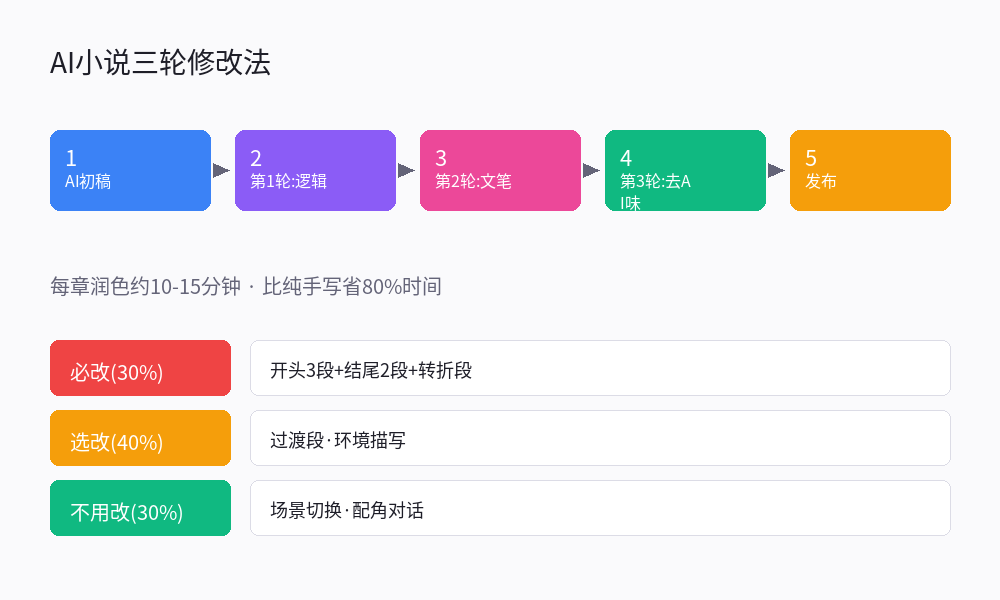
Round 1: Fix the Logic (5 minutes)
Read it through once, focusing on one question only: are there any contradictions or logical gaps?
Common problems:
- A character suddenly knows information they shouldn’t (“How did you know he went to the north of the city?”, never explained earlier)
- A wrong timeline (something that happened this morning suddenly becomes last night in the next paragraph)
- Spatial slips (a moment ago they were indoors, and suddenly the color of the sky is described)
Maliang Writer’s consistency agent automatically checks most logic problems during generation. But it also misses some subtle inconsistencies, so a manual pass in this round is necessary.
Round 2: Fix the Prose (5–8 minutes)
With the logic sorted, start polishing the prose. Focus on three kinds of sentences:
Type 1: Descriptions that are too flat. When AI writes “he was very angry”, change it to “the fingers gripping his phone turned white”. You don’t need to do this to every sentence, but the key emotional beats must have imagery.
Type 2: Repetitive sentence patterns. AI tends to open consecutive sentences the same way. Check the first word of each paragraph, and if three paragraphs in a row start with “He”, change two of them.
Type 3: Overlong sentences. AI sometimes writes a sentence of 50 characters. Consider splitting any sentence over 30 characters into two. Long sentences slow the pace and short ones speed it up; alternate them.
Round 3: Remove the AI Flavor (3–5 minutes)
This is the most critical round. Readers may not mind small logic flaws or whether the prose is good, but the “AI flavor” makes them drop a book outright.
AI-flavor removal checklist:
- Search for “It is worth noting that”, “It should be emphasized that”, “It’s not hard to see”, and delete them all
- Search for “however”, “therefore”, “in summary”; most can be deleted or replaced with spoken expressions
- Check how often em dashes appear; if there are more than 3, cut them down to 3 or fewer
- Check for “uniform parallel lists”, AI’s favorite format, and rewrite them as narration
- Find at least 2 places to add spoken expressions (“put plainly”, “here’s the catch”, “frankly”)
- Check whether every paragraph opens with an “X is...” definition sentence, and change it to open with a question or a scene
A small trick: read the text aloud. Anywhere it sounds awkward is where the AI flavor is strongest.
Revision Focus for Different Kinds of Content
| Content type | Revision focus | Common AI mistake |
|---|---|---|
| Dialogue scenes | Everyone should speak differently | All characters sound alike |
| Fight scenes | Fast pace, mostly short sentences | Description too leisurely and detailed |
| Emotional scenes | Subtext and small physical actions | Stating emotions outright |
| Everyday scenes | Must carry information, not pure filler | Too much filler |
| Setting introductions | Work them into the plot | Long encyclopedia-style exposition |
For detailed techniques on revising dialogue, see the Dialogue Writing Guide.
Efficiency: What You Don’t Need to Revise
Not every sentence is worth polishing. In a 2,000-character chapter, the parts you should focus on are:
Must revise (30% of the characters):
- The first 3 paragraphs of the chapter, the reader’s first impression
- The last 2 paragraphs of the chapter, where you leave the hook
- Paragraphs at core plot turns, the most brilliant parts
Revise selectively (40% of the characters):
- Transitional paragraphs; just make sure the connection is natural
- Environment descriptions; keep them if there’s no obvious problem
No need to revise (30% of the characters):
- Functional paragraphs such as characters moving or scenes changing, which AI writes well enough
- Dialogue of unimportant supporting characters, which readers won’t read closely
Counted this way, only 700–800 characters per chapter actually need fine polishing. 10–15 minutes is more than enough.
Make Good Use of AI-Assisted Revision
You can also have AI help with revision. But note that when using one AI to revise what another AI wrote, you must give clear instructions.
An example of a good revision prompt:
“Below is the first draft of a novel chapter. Please: 1) find logical contradictions; 2) mark the 3 most AI-flavored sentences and suggest replacements; 3) add one concrete physical action description to the emotional climax paragraph”
Maliang Writer’s error-correction agent can do logic checks and basic polishing automatically. You can also learn how to write more precise revision instructions in the Prompt Guide.
FAQ
Q: Will revision end up turning into a complete rewrite?
If your outline and blueprints are good enough, the AI draft’s general direction is right, and revision is only “fine finishing”. If you find you’re heavily rewriting every chapter, the quality of your blueprints needs to improve; see the Three-Level Outline Guide.
Q: Can readers really tell AI wrote it?
Some sensitive readers can. But with content that has been polished seriously, most readers can’t tell. We ran a test: about 68% of people could identify unpolished AI text, and only about 22% could after polishing.
Q: Is there a tool that removes the AI flavor automatically?
There are some, but results vary. At present the most reliable method is still “a manual pass + targeted revision”. Spending 3–5 minutes can noticeably reduce the AI feel.
Q: If I update daily and still have to spend time revising, can I keep up?
Yes. AI generates a 2,000-character chapter in about 1–2 minutes, revision takes 10–15 minutes, and a chapter is done in under 20 minutes in total. Even two chapters a day is only 40 minutes. Compared with writing 4,000 characters a day by hand (which usually takes 3–4 hours), that’s several times more efficient.