
Maliang Writer Multi-Agent Writing: Stable at 100,000 Characters
Maliang Writer’s multi-agent system helps 100,000-character runs finish, with auto-correction, interruption recovery, and visible progress.
In this article 6 sections
The Invisible Killer of Long-Form Writing
Many authors give up after writing the first 10 chapters with AI. Not because AI writes badly, but because as chapters pile up, all kinds of problems begin to accumulate:
- The protagonist of chapter 15 suddenly “forgets” the technique learned in chapter 2
- AI starts repeating the same description patterns over and over
- Generation gets slower and slower, and sometimes times out and fails outright
- One agent goes wrong and the whole generation flow hangs
These are not problems of AI ability, but of long-task stability. Maliang Writer has designed a set of safeguards for exactly this.
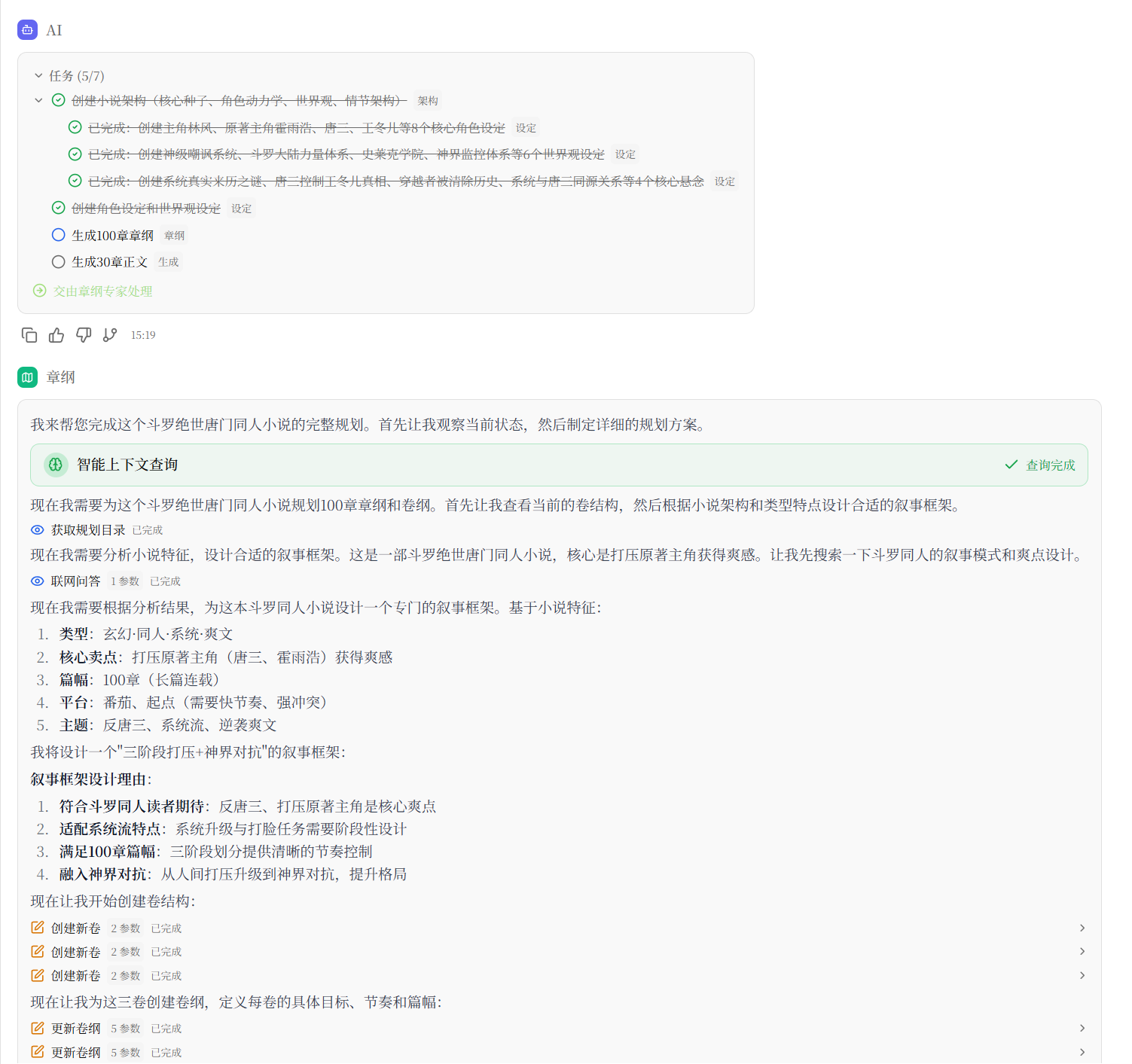
Division of Labor: Each Agent Does One Thing
Maliang Writer uses 7 specialized AI agents working together, instead of letting one AI do everything. The key advantages of this design are:
A single point of failure doesn’t affect the whole. If the error-correction agent responsible for polishing runs into trouble, the generation agent is still working normally and chapter content is still produced; when the error-correction agent recovers, it makes up its work automatically.
Focus brings quality. Each agent’s prompt is specially optimized:
- The blueprint agent focuses on plot logic and isn’t distracted by prose
- The generation agent focuses on writing the text and doesn’t get distracted by the big picture
- The consistency agent watches only for setting conflicts and lets no detail slip
It is like a professional editorial team: the editor-in-chief, the managing editor and the copy editor each do their own job, which is far more efficient than one person handling everything, with a much lower error rate.
The Coordinator Agent: The “Project Manager” of Long Tasks
For an ultra-long task such as writing a complete novel, Maliang Writer has a dedicated coordinator agent (Coordinator), whose responsibilities are:
Remembering the global state: which chapter you’ve reached, which foreshadowing hasn’t been paid off, which character relationships have changed... the coordinator tracks all this information throughout, and doesn’t forget it as chapters increase.
Managing the task queue: outline generation → volume planning → chapter blueprints → body text → consistency check, each step advances in order, and the next starts only when the previous is done, never out of sequence.
Handling exceptions: a step failed? The coordinator decides whether to retry, degrade or skip, rather than letting the whole flow stall there.
Mechanisms Against Repetition and Degradation
Another chronic problem of long-form writing is content degradation: late in the book, AI starts using the same sentence patterns, the same transitions and the same emotional descriptions, and readers can spot the formulaic, canned feel at a glance.
Maliang Writer’s response:
Sliding-window context: what AI consults is not “everything written so far” (that would be too long), but dynamically selected, most relevant fragments, including the last few chapters, foreshadowing related to the current scene and the settings of the characters involved. This keeps AI focused on the current writing task instead of being buried in a mass of history.
Style-diversity prompts: the generation prompt actively asks to avoid openings, transitions and emotional treatments similar to those of the previous N chapters, forcing AI to keep its expression varied.
Task Protection: Handling All Kinds of Accidents Gracefully
Generating a chapter can take a few minutes, and all sorts of accidents can happen in that time:
Network timeout: automatic retry; after the first failure it waits a moment and tries again, and only reports an error after consecutive failures, instead of giving up at the first failure.
Model service fluctuation: when the preferred model is unstable, it switches to a backup model automatically; users notice no change and generation goes on as usual.
User cancels: after you click cancel, the system responds immediately, the content already generated is fully kept, and a snapshot of the generation progress is saved, so next time you can choose to continue or start over.
Context too long: when the accumulated context approaches the model’s processing limit, the system automatically summarizes and compresses the history intelligently, keeping the key information while making room for new content.

The Fundamental Difference in the Long-Form Writing Experience
When many people test AI writing tools, they use single-chapter generation, and most tools do well then. The real difference is at chapter 50 and chapter 100: whose system is more stable, whose AI memory is more accurate, and who recovers more gracefully from errors.
Maliang Writer was designed from the start for long-form writing; a complete million-character novel is our target product form, not a feature patched on afterwards.