
Maliang Writer vs ChatGPT for Novels: How Big Is the Gap?
Maliang Writer vs ChatGPT for novels: knowledge graph, multi-agent writing, outlines, and memory, head-to-head past 100,000 characters.
In this article 8 sections
A Common Question: “Can’t I Just Use ChatGPT?”
You can. ChatGPT really can write novels.
But if you have actually tried writing a long web novel of over 100,000 characters with ChatGPT, you have probably been through these breakdown moments:
- By chapter 20, AI forgot what the protagonist’s weapon is called
- You want it to continue from yesterday’s content, but it has “amnesia”
- Foreshadowing you planted earlier is completely forgotten when it’s time to pay it off
- Every new conversation, you have to tell it all the settings again
This is not a ChatGPT bug: it was never designed for novel writing. It is a general-purpose chat tool that happens to write some text too.
Maliang Writer, by contrast, was built from the first line of code for writing million-character long novels.
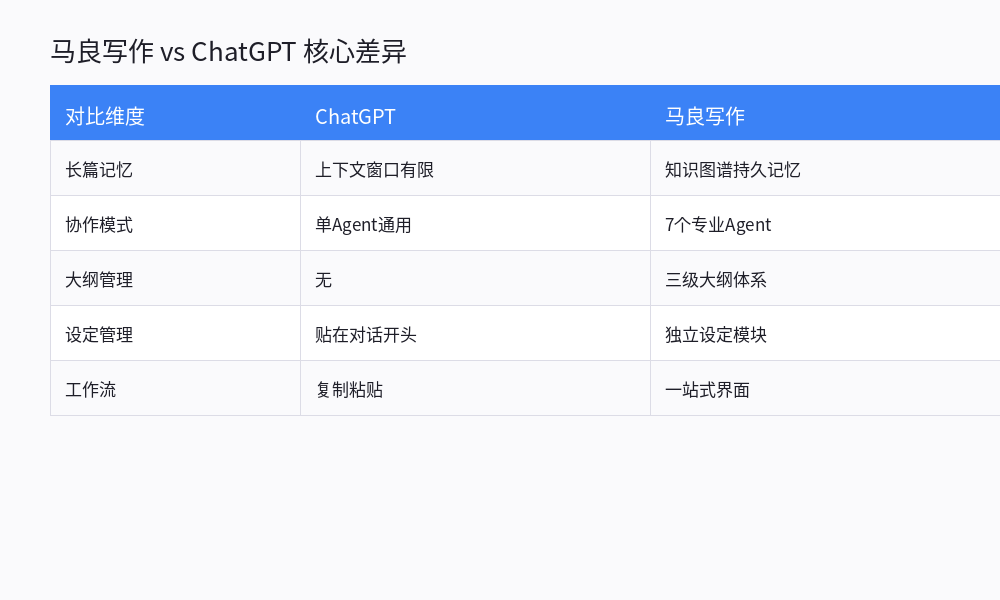
Comparison 1: Long-Form Memory
ChatGPT: the context window of a single conversation is about 20,000–30,000 characters. Beyond that length, earlier content is “squeezed out”. By the time you reach chapter 30, it no longer remembers what chapter 1 said. You can open a new conversation and paste the settings again, but it has to be done by hand each time, which is very inefficient.
Maliang Writer: a dual mechanism of knowledge graph + smart summaries. After each chapter is generated, the system automatically extracts key information (character state changes, newly appearing items, plot progress) and stores it in the knowledge graph. At the next generation, AI automatically retrieves the relevant information. When you reach chapter 100, it still “remembers” the sword the protagonist picked up in chapter 1.
Measured gap: we ran a test: at 300,000 characters, ChatGPT’s setting-contradiction rate is 4.7 per 100,000 characters, and Maliang Writer’s is 1.3. A 3.6× difference. See the data report for details.
Comparison 2: Multi-Agent Collaboration vs Single-Agent Generation
ChatGPT: one model does everything from start to finish. It has to plan the plot structure, write the body text and check consistency, which is like one person serving as screenwriter, author and editor at once. Quality is naturally uneven.
Maliang Writer: 7 specialized agents, each with its own job. The structure agent makes sure the plot is sound, the generation agent writes the body text, the consistency agent checks for contradictions, and the error-correction agent polishes the prose. Each agent does only what it does best. See Multi-Agent Writing Explained for details.
An analogy: ChatGPT is a full-stack writer, and Maliang Writer is a professional writing team. However strong one person is, they can’t beat a team that divides the work.
Comparison 3: Outline and Structure Management
ChatGPT: no outline management feature. You can tell it the outline in the conversation, but it won’t maintain and track it for you. Later on, the outline and the actual content have long since come apart, and you don’t remember which plot points are written and which aren’t.
Maliang Writer: the three-level outline system: master outline → volume outline → chapter blueprint, refined layer by layer. Every chapter is checked against its blueprint when generated, so it doesn’t go off track. You can view the progress of the whole book at any time: which outlines have been turned into body text and which are still being planned.
Comparison 4: Settings and Character Management
ChatGPT: your character settings can only be pasted at the start of the conversation. With many characters (protagonist + female lead + 5 supporting characters + 3 villains), that block of settings takes up several thousand characters of context space, squeezing out the window that could have held earlier content.
Maliang Writer: a dedicated story bible module supporting 30+ types of worldbuilding entities. Every character, every item and every faction is a separate card. When generating, AI calls up only the relevant settings (for example, the characters appearing in this chapter) and doesn’t take up irrelevant context space. See Immersive Writing: Worldbuilding for details.
Comparison 5: Writing Workflow
ChatGPT’s workflow: open a conversation → paste settings → paste previous text → write the instruction → wait for generation → copy and paste into a document → repeat all of the above for the next chapter. The prep work for each chapter is 10–15 minutes.
Maliang Writer’s workflow: open the novel → write the chapter blueprint (2 minutes) → click generate (1 minute) → read through and revise (10 minutes) → automatically saved to the chapter. It all happens in one interface, with no copy-pasting.
The time saved looks like only a few minutes per chapter, but multiplied by 100 chapters it is a dozen-plus hours.
When to Use ChatGPT and When to Use Maliang Writer
It’s not that ChatGPT can’t be used; it depends on the scenario:
ChatGPT suits better:
- Short pieces (within 5,000 characters)
- Brainstorming and discussing ideas
- Quickly trying out whether an idea works
- One-off content that needs no long-term maintenance
Maliang Writer suits better:
- Serialized long novels over 100,000 characters
- Contracted authors who need steady daily updates
- Genre fiction with many characters and a complex world
- Works that need foreshadowing management and setting consistency
The two don’t conflict. You can perfectly well use ChatGPT for early creative discussion, then switch to Maliang Writer for formal writing once the direction is settled.
FAQ
Q: Does Maliang Writer also call ChatGPT’s models underneath?
Maliang Writer supports multiple models (Claude, GPT, Gemini, DeepSeek and others), but the core difference isn’t the models themselves; it’s the surrounding engineering capabilities: the knowledge graph, multi-agent collaboration and outline management. ChatGPT doesn’t have these.
Q: What about ChatGPT Plus (the paid version) compared with Maliang Writer?
ChatGPT Plus offers a larger context window and faster responses, but still has no knowledge graph, no multi-agent system and no outline management. It is only a “stronger general-purpose chat tool”, not a novel-writing tool.
Q: How about the price comparison?
ChatGPT Plus costs $20 per month (about ¥140), and Maliang Writer membership costs about ¥100 per month. Maliang Writer is cheaper, and also provides a full set of features designed specifically for novel writing.