
Immersive Writing: Build Your Novel World with Character Cards
Maliang Writer’s immersive setting cards: borderless double-click editing, dynamic images, 30+ entity types, and instant detail lookup at 500,000 words.
In this article 6 sections
What Is “Immersive Editing”?
Setting management in ordinary writing tools works like this: open the sidebar → click the edit button → a form pops up → fill it in → save. Every time you view or change a setting you go through a tedious sequence of interactions that completely breaks your creative flow.
Maliang Writer’s setting system follows one core design philosophy: borderless, double-click, immersive editing.
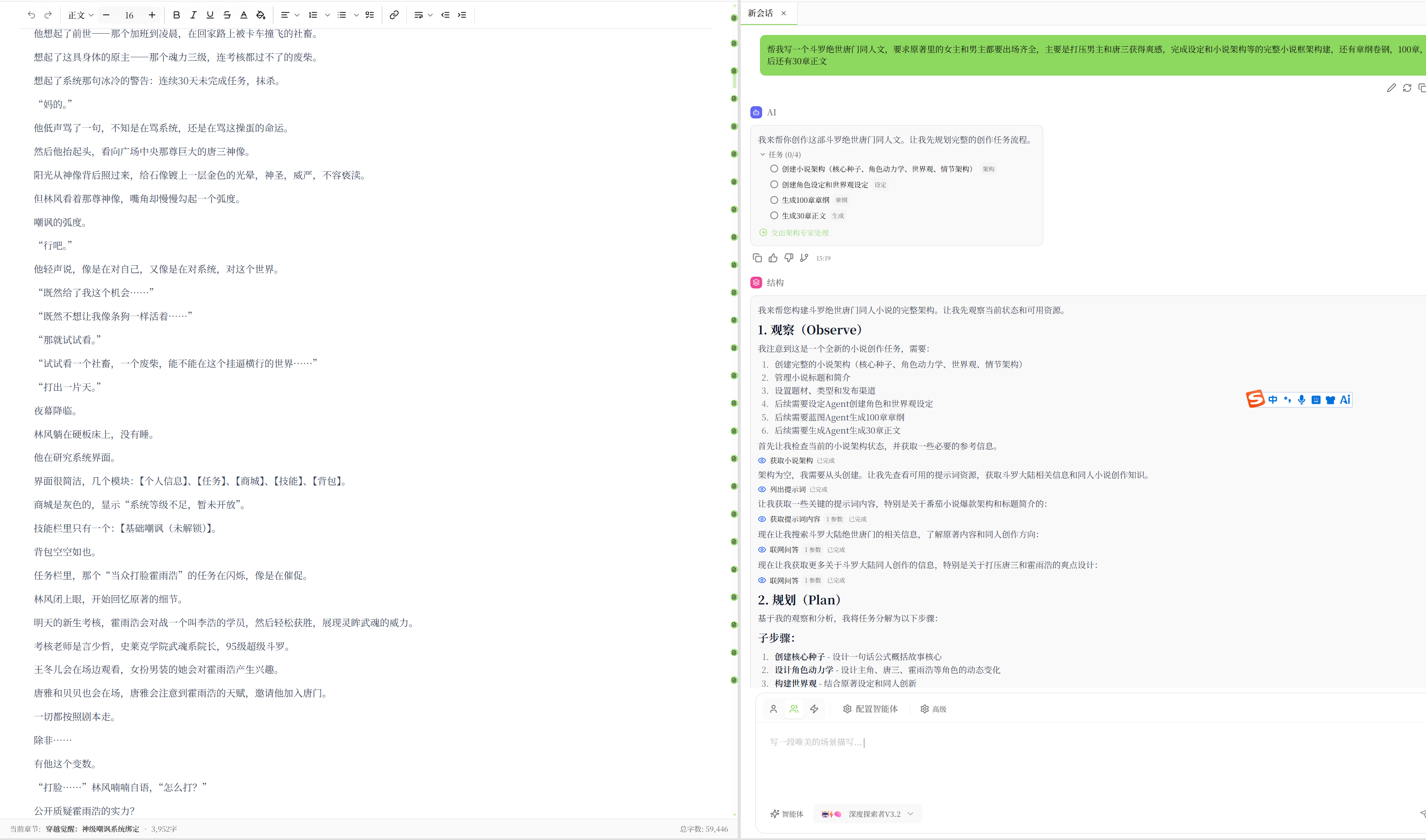
A setting card has two states:
- Browse mode: a clean card display, with a faint ✎ icon appearing when the mouse hovers, without disturbing reading
- Edit mode: double-click any field to edit it in place; the input has only a dotted line at the bottom, with no background color and no border, so the text looks written straight onto paper
It is smarter on mobile: the system detects touch devices automatically, and a single tap activates editing, with no double tap needed.
Dynamic Image Layout System
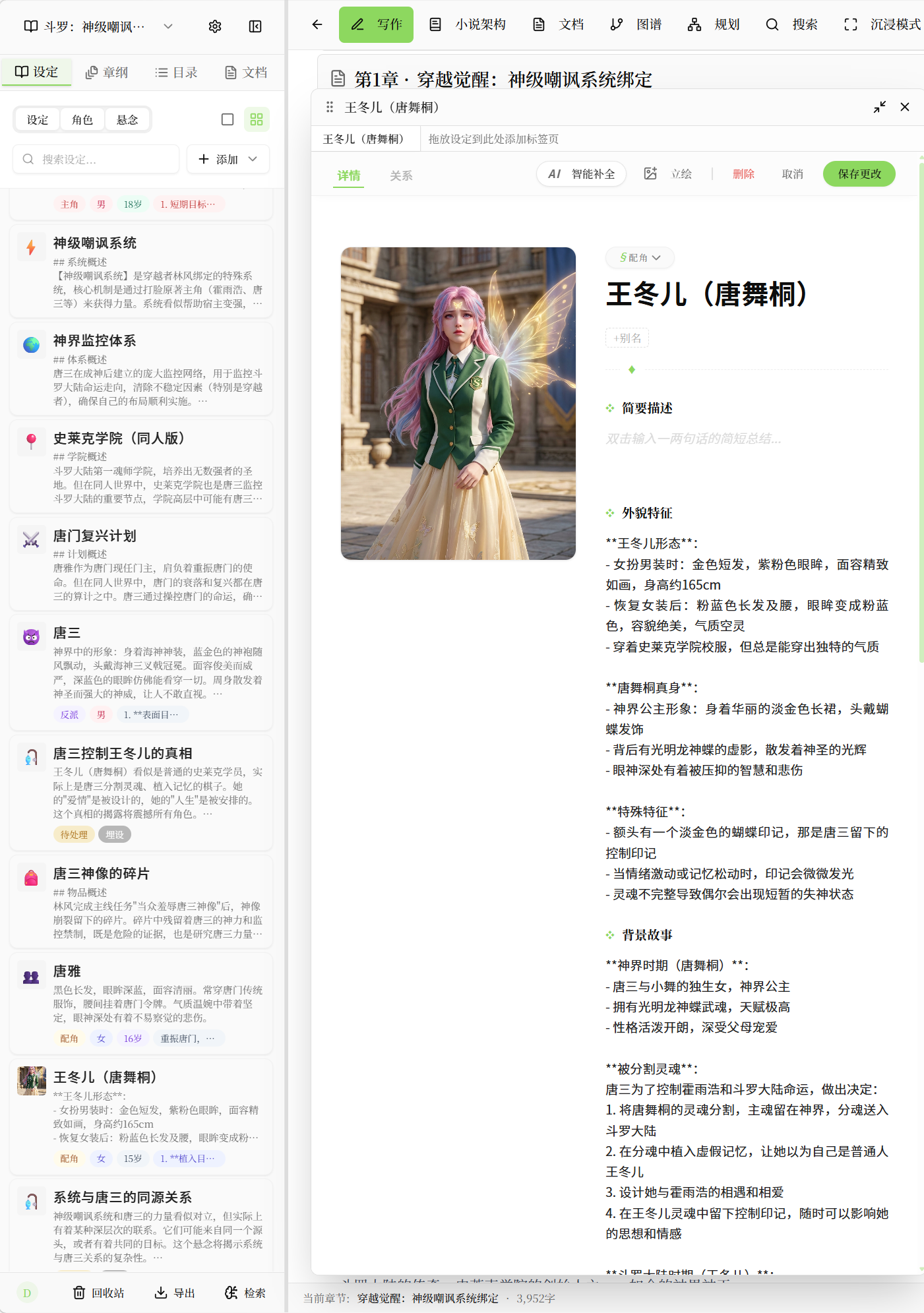
Character setting cards support uploading character illustrations, and the system detects the image’s aspect ratio automatically and chooses the best layout:
| Image ratio | Layout mode | Effect |
|---|---|---|
| Wide > 1.3 | Top banner | A full-width banner, with a grand feel |
| Square 0.8–1.3 | Centered circle | Avatar centered, clean and clear |
| Portrait < 0.8 | Left column + right text | Full-body portrait on the left, attributes on the right |
Character cards use a 3:4 portrait layout by default, which is exactly the standard ratio of light-novel and game character art. The character image is sticky on the left and stays visible as the content scrolls; there is a gradient fade at the bottom, and these details reflect the product’s devotion to aesthetics.
30+ Worldbuilding Entity Types
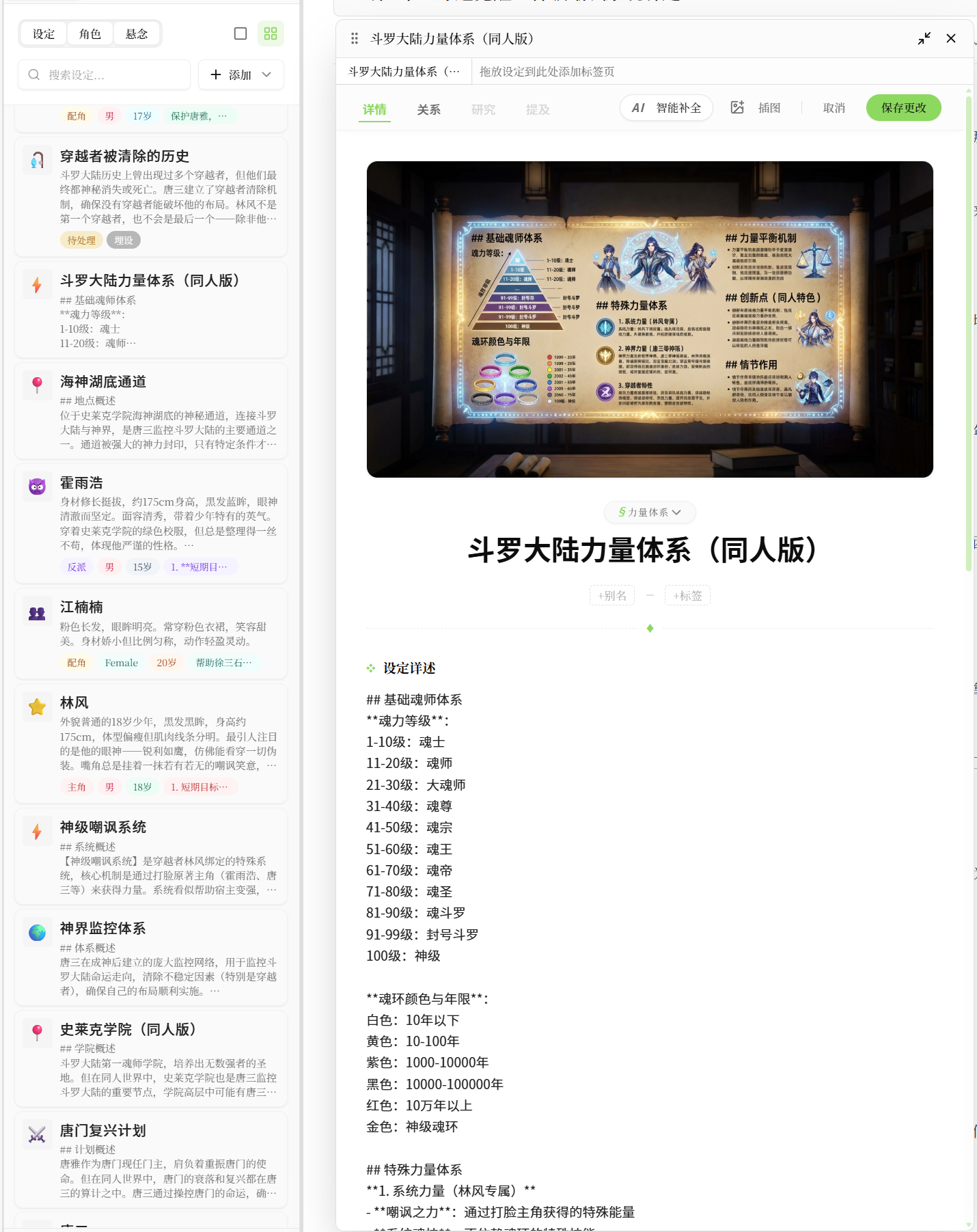
Maliang Writer’s setting system supports entity types covering the whole range of web-novel writing, including:
Characters: protagonist, supporting character, villain, mentor, companion...
Worldbuilding:
MAGIC_SYSTEM— magic systemPOWER_SYSTEM— power system (cultivation levels, techniques)GOLDEN_FINGER— golden finger (the protagonist’s special ability / cheat)TIMELINE— timeline
Plot:
FORESHADOWING— foreshadowingPLEASURE_POINT— payoff pointANTICIPATION_HOOK— anticipation hook
Geography: places, maps, spheres of influence...
Relationships can be built between these entities to form a visual knowledge graph. When you change a setting, the system highlights all related entities to help you assess the scope of the impact.
The Field System of a Character Card
Taking a character setting as an example, the fields Maliang Writer manages include:
Basics: name, list of aliases, role, age, gender
Appearance: appearance (long text, AI completion supported)
Backstory: background (long text)
Personality: list of personality tags (can be added/removed)
Goals and conflicts: list of goals, lists of internal and external conflicts
Hidden information: list of secrets, list of weaknesses
Relationship network: relationships with other characters/settings
Custom attributes: key-value pairs (such as “Combat power: S-rank”)
All fields support AI smart completion: click the AI button beside a field, and the system generates reasonable content suggestions based on existing settings.
The Floating Outline Card
Besides setting cards, there is another distinctive feature: the floating novel architecture card (FloatingNovelArchitectureCard).
This card can:
- Float anywhere without covering the editing area
- Be moved by dragging and have its width adjusted by dragging an edge (700px–1400px)
- Fill the screen automatically on mobile
- Edit the four core architecture fields in real time:
- Core seed (coreSeed): the novel’s core concept and conflict
- Character dynamics (characterDynamics): character relationships and growth arcs
- Worldbuilding (worldBuilding): world rules and background
- Plot architecture (plotArchitecture): the overall plot structure
These four fields are the “creative constitution” from which AI agents generate everything, and they are injected into the prompt every time a chapter is generated.
Why Is Immersive Editing So Important for Writers?
Research shows that building creative flow takes about 20 minutes, and a single interruption can take you 23 minutes to get back into it.
Maliang Writer’s principles of immersive design:
- Edit in place, without jumping to another page
- Minimal visual noise, letting the content be the star
- Keyboard shortcuts first (Enter to save, Escape to cancel)
- Autosave, removing the anxiety of “forgetting to save”
“A good tool should disappear into the creative process, so that you feel only the story itself.”
Maliang Writer’s setting system is designed on exactly this idea: it is not a database management interface, but a creative environment that lets you truly “live in” your own novel’s world.