
Too Many Characters by Volume 3? Archive Exits & Returns
By volume three, characters, places, and foreshadowing pile up. Tier characters, record exits, archive cards, and return them cleanly in Maliang Writer.
In this article 8 sections
The Conclusion First: Take Stock by Volume, Archive Exits, Review Before a Return
By volume three of a long novel, the common situation is this: the settings sidebar already holds over a hundred characters, half of whom appeared only in volume one; the map has changed twice and old places are still piled there; the foreshadowing list keeps growing, and you can’t tell which threads have been paid off.
The problem that arises then is often not “forgetting” but “remembering too much”:
- If you give the AI all the character settings when continuing, it will have volume-one extras show up in volume three for no reason;
- Characters who have already died get written as “standing to one side nodding”;
- Places that changed hands long ago are still described as the old owner left them;
- When an old character returns, he knows nothing of the protagonist’s changes over these years, yet says things he shouldn’t know.
The fix is management by volume: after finishing each volume, take stock once, move the characters, places and foreshadowing you no longer need into the archive, and bring them back when needed. Archiving isn’t deleting; it means “not looked at in normal times, but findable when needed”.
Step 1: Tier Your Characters
After finishing a volume, sort the characters into four categories:
- Core: the protagonist’s group and the main opponents, who appear in every volume;
- This volume: characters who serve only this volume’s plot, such as the elders of the sect this volume takes place in, or the opponents in this one dungeon;
- Retired: dead, gone for good, or their function is complete;
- Dormant: temporarily gone, but still carrying foreshadowing and will be back later.
The “dormant” category needs special marking: who he is, when he left, which foreshadowing he carries, and in which volume you plan for him to return.
Places and factions are sorted the same way: still in use, destroyed or changed hands, and to be revisited later. Sort foreshadowing into paid off, not yet paid off, and abandoned; note down the abandoned ones too, so you don’t later mistake them for forgotten.
Why Problems Only Show Up by Volume Three
In volume one there are few characters, the author remembers them, and there isn’t much material to give the AI. From volume two the map changes and new people are added, and the old characters haven’t been dealt with yet. By volume three, the material holds three maps and three batches of supporting characters at once, all tangled up with each other. Whether the author is flipping through settings or the AI is reading the material, the useful information is drowned in old information. So we suggest starting volume management as soon as volume one is finished; the later you catch up, the bigger the stocktaking workload.
Step 2: Take Stock at Volume End and Write Exit Records
For each retired or dormant character, write a short exit record:
- How he left (died, left, imprisoned, missing);
- His state when he left: injuries, strength, identity;
- Where his relationship with the protagonist was frozen: owing a favor, or having become enemies;
- What he left behind: items, promises, unfinished words;
- What he knows and doesn’t know.
An exit record doesn’t need to be long, for example:
Old Zhou, left the Azure Cloud Sect in volume 1, chapter 32.
How he left: to take the blame for the protagonist, he asked to be expelled from the sect and his whereabouts are unknown.
State on leaving: meridians damaged, cultivation dropped by one realm.
Relationship with the protagonist: the protagonist owes him a life, and at parting said “When you become an elder, come and take me out for a drink.”
What he left behind: a wooden tag engraved with the character “Zhou”, which the protagonist carries.
He knows: the protagonist has a strange fire inside him. He doesn’t know: the protagonist later joined Heavenly Sword Peak.
Plan: return mid-volume three and make good on the “drink” promise.
The last item matters especially for a return. What happens after a character leaves is, in principle, unknown to him, unless you’ve arranged a way for him to find out.
Step 3: Archive, Don’t Delete
After the stocktaking, move the retired and dormant characters’ cards, old places and paid-off foreshadowing into an “archive” area:
- When writing a new volume, normally look only at the core and this-volume material;
- Give the AI only that material too, and don’t paste in all the character settings;
- The archived content is still kept, and can be found when you need to check.
The benefit is direct: with less material, neither you nor the AI is easily distracted by old information, and the characters appearing in the continuation are more focused.
Step 4: When an Old Character Returns, Review Before Writing
When a dormant character is coming back, prepare in this order:
- Read his archive card and exit record.
- Reread the chapter or two where he last appeared, to recover his way of speaking and his tone with the protagonist.
- State the “time gap” clearly: what he has experienced during his absence; what has changed for the protagonist in that time; where his understanding of the protagonist stopped.
- Decide what he knows. He shouldn’t know about things that happened after he left, unless someone tells him. The knowledge gap is itself the highlight of a return scene: he still treats the protagonist as the junior apprentice brother of those days, while the protagonist has become master of a region.
- Put him back into active use. After the return, he becomes a character of this volume again, the card is moved back, and his state is updated to the latest.
Places and foreshadowing need the same treatment. When the protagonist returns to the small town of volume one, first check how the town looked in the archive at the time: who was in charge, which shops were still open, what trouble the protagonist left behind when he left. Then think through what changes the town should have undergone over these years. Foreshadowing is the same: the foreshadowing carried by a returning character must be dug out of the archive before the return, and you decide whether to pay it off this time and how.
Much of the weight of a return scene comes from what was planted earlier: promises from back then, favors not repaid, unfinished words. The more concrete the exit record, the easier the return is to write. For how to arrange foreshadowing and payoff in a character line, see How to Write Novel Characters.
How to Do It in Maliang Writer
In Maliang Writer, characters, places, factions and foreshadowing are all cards in the story bible panel on the left, and after a chapter of body text is written, the archivist organizes that chapter’s character states, relationships, locations and foreshadowing. Volume management builds on this:
-
When you reach a new volume, old settings are moved into the archive. Characters, places and foreshadowing that appeared only in earlier volumes are moved into the archive, and the AI no longer references them when writing new chapters; they are still kept, and can be looked up and edited when needed.
-
Returning characters are still brought along. An old character the chapter outline names as coming back has his settings brought along when that chapter is written. After a character formally returns, he is put back into active use.
-
You can say it directly in the chat. For example, “Volume two is done, Liu Sanniang is still needed next volume, and archive the other supporting characters who only appeared in volume two for now”, or “In chapter 85 have Old Zhou return; first tell me how he exited and the situation at his last appearance”.
-
The archives help you remember “where is he now”. Each character’s state, relationships and location are recorded in the story archives, and the “Archive” tab on the character card shows that character’s change record. Looking through it before a return is much faster than rereading dozens of chapters.
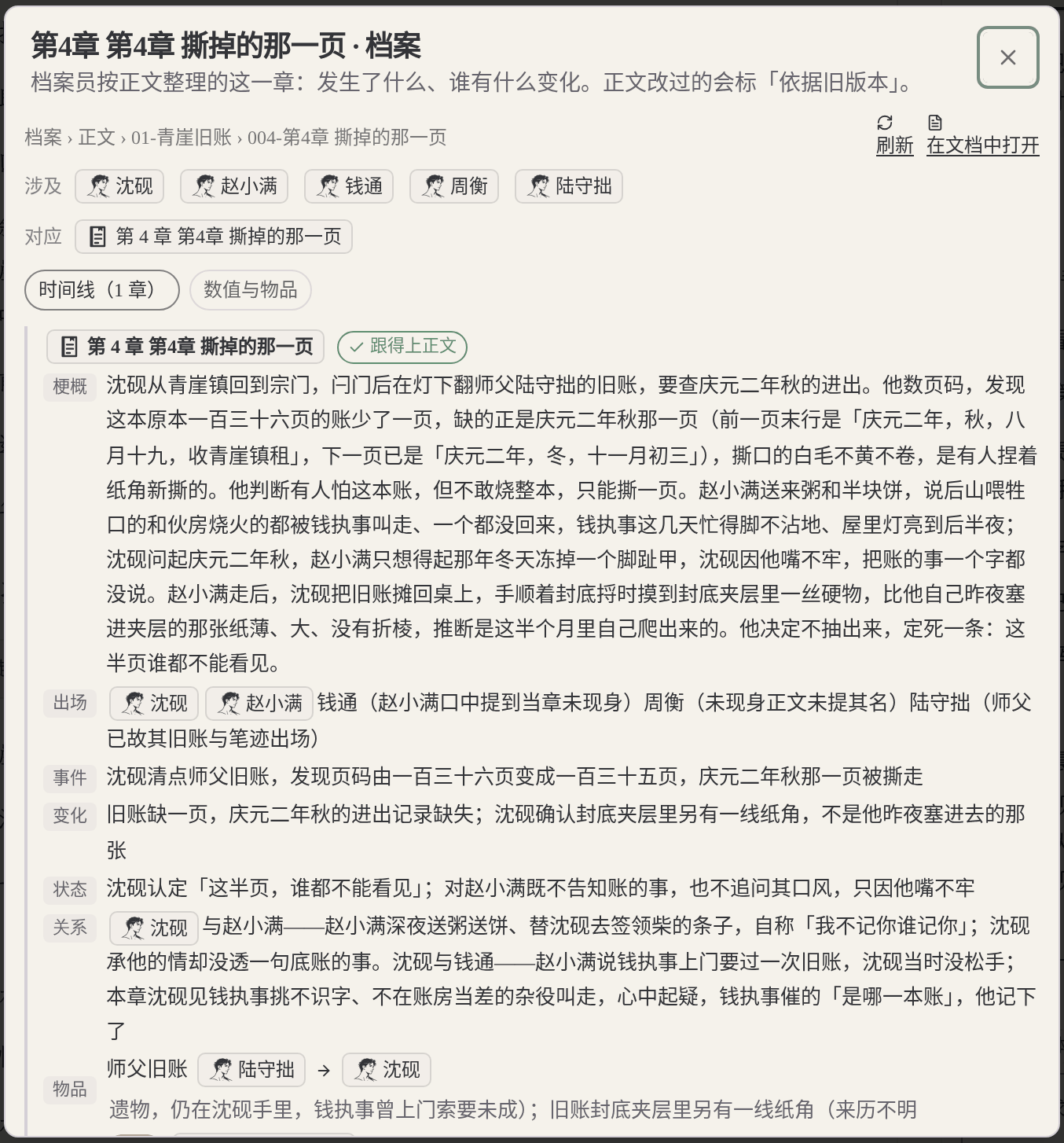
To be clear, archiving only lets the AI see less irrelevant material when writing new chapters; it is not a guarantee against errors. After a return chapter is written, we still suggest you read it against the exit record. When the archivist finds places that don’t match existing settings while organizing, it lists them under “Pending Confirmation” for you to confirm. For more see Story Archives.
FAQ
Q: What should I do when a long novel has too many characters to remember?
Tier them by volume: core, this volume, retired, dormant. When writing a new volume, look only at the core and this-volume characters, move the retired and dormant into the archive, and look them up when needed. Record each character’s current state separately and update it every chapter.
Q: How should I handle a character after he exits the story?
Write an exit record: how he left, his state on leaving, his relationship with the protagonist, what he left behind, and what he knows. Then move the card into the archive, without deleting it.
Q: How do I write an old character’s return so it doesn’t feel off?
First read his exit record and the chapter of his last appearance, then state the “time gap” clearly: what he has experienced in this time, what has changed for the protagonist, and where his understanding of the protagonist stopped. The knowledge gap is itself the highlight of a return scene.
Q: What if AI continuations keep writing in characters who have already exited?
Most likely those characters are still in the material you give it. When writing a new volume, give it only the settings of core and this-volume characters, and move exited characters into the archive; in the chapter outline, state clearly which characters appear in this chapter.
Q: When I reach a new volume, do I need to redo the settings?
No need to redo them; one stocktaking is enough: tier the characters, update the places, and sort foreshadowing into paid off, not yet paid off and abandoned. Newly added characters and places in the new volume get cards as usual.
Q: In Maliang Writer, can archived characters still be edited?
Yes. Archived characters, places and foreshadowing are still kept and can be viewed and edited; it’s just that the AI doesn’t reference them by default when writing new chapters. When a character returns, he is put back into active use.