
AI Writing Prompt Guide: Help AI Understand Your Creative Intent
Prompt techniques for novel writing: feeding character cards, scene elements and style constraints, plus 10 copy-ready chapter-generation prompt templates so AI fits your settings first time.
In this article 7 sections
Why the Same AI Produces Wildly Different Quality for Different People
The answer is two words: instruction quality.
AI is not a mind reader. If you say “write chapter ten for me”, it can only guess what you want. If you say “write chapter ten: in the arena match, the protagonist uses his newly grasped sword technique to defeat the opponent who mocked him earlier, the whole crowd is stunned, and his master smiles with relief”, it can hand you a decent piece of work.
This article teaches you how to write high-quality creative instructions. You don’t need any programming knowledge, just the ability to speak plainly.
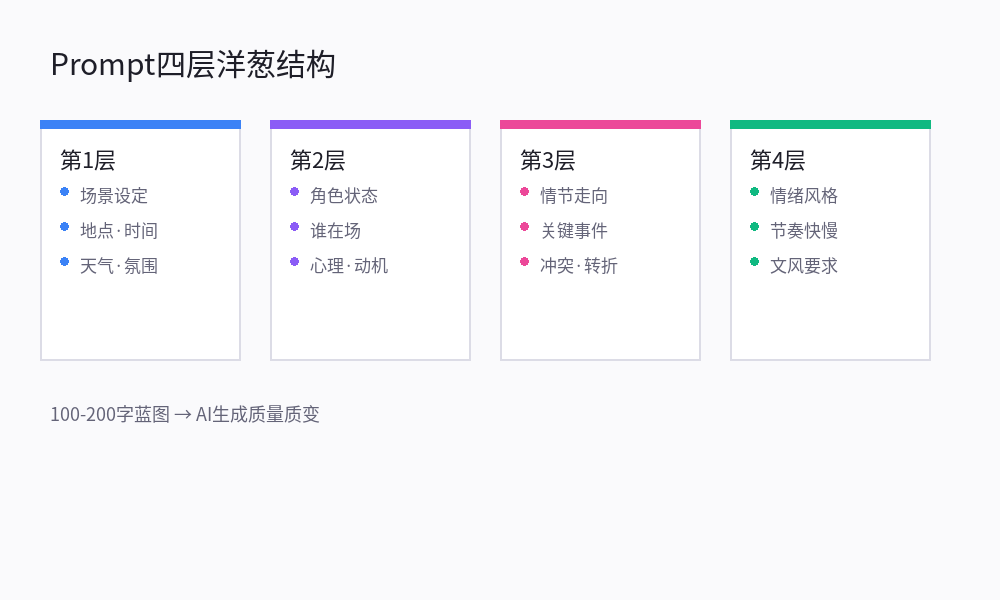
The Golden Structure of a Prompt: A 4-Layer Onion
A good novel-writing prompt should be layered like an onion. From the outside in:
Layer 1: Scene setting (where, when, what atmosphere)
“Late at night, an abandoned old factory. A rainstorm is falling.”
Layer 2: Character state (who is present, their current state and mindset)
“Lin Mo stands alone in the factory, soaked through. He has just found a clue to Su Qing’s kidnapping.”
Layer 3: Plot direction (what happens in this passage)
“Lin Mo follows the clue to the kidnappers’ hideout but is discovered. After a chase, he finds the injured Su Qing in a corner.”
Layer 4: Emotion and style (what you want readers to feel)
“Tense pacing, with the sound of rain building atmosphere. The moment he finds Su Qing turns from tension to heartache. Dialogue short and forceful.”
Together these 4 layers come to roughly 100–200 characters. Two minutes of writing buys a qualitative change in AI’s output.
Good Prompt vs Bad Prompt
Bad: “Write a chapter where Lin Mo rescues Su Qing.”
→ AI will write a bland, plodding “hero saves the girl” play-by-play.
Good: “In a rainstorm late at night, Lin Mo follows the clue to the abandoned factory. He hears a faint groan behind the iron door, kicks it open, and sees Su Qing tied to a chair with blood at the corner of her mouth. The moment their eyes meet, Su Qing doesn’t cry, but says hoarsely, ‘What took you so long?’ Without a word, Lin Mo unties the rope and sweeps her up in a princess carry. On the way out they meet the returning kidnappers; Lin Mo puts Su Qing down, tells her to hide in a corner, and goes to meet them himself. Keep the fight under 300 characters, fast-paced. At the end Su Qing, on Lin Mo’s back, whispers ‘Thank you’. Pacing: tension → heartache → brief warmth.”
See the difference? The good prompt gives AI a script to “act out”, while the bad prompt gives only a title.
In Practice in Maliang Writer
Maliang Writer’s “chapter blueprint” is essentially a structured prompt input. What you write in the blueprint is assembled automatically into the full instruction sent to AI, together with character settings, previous-chapter summaries and knowledge graph information.
So your job is just to write the blueprint well, with no need to worry about the underlying prompt assembly. But the quality of the blueprint directly determines the quality of generation.
Suggested blueprint template:
Scene: [place, time, weather]
Characters present: [who is there, in what state]
Chapter events: [what exactly happens]
Emotional rhythm: [tense / warm / funny / heart-wrenching]
End-of-chapter hook: [what suspense to leave at the end]
Fill in the blanks of this template, 2 minutes per chapter, and the improvement in generation quality is immediate.
5 Small Tips for Making AI Write Better
Tip 1: Use “forbid” to rule out AI’s bad habits
AI has a few common faults: it loves writing “a hint of ... showed in his eyes”, loves em dashes, and loves opening every paragraph with scenery. Just write in the settings “forbidden to use sentence patterns like ‘a hint of ... showed in his eyes’”, and AI will stop using them.
Tip 2: Give dialogue samples
If you want a character to speak in a particular way, give one or two samples. For example: “Su Qing’s speaking style: short sentences + rhetorical questions. Samples: ‘What do you think?’ ‘Fine, suit yourself.’ ‘Do I look like I’m joking?’”
Tip 3: Control content with “proportions”
“Dialogue takes 60% of this chapter, action description 20%, inner description 20%.” AI carries out numerical requirements very well.
Tip 4: Mark the pacing turning points
“First 1,000 characters at a gentle pace → clue found at character 1,000 → last 1,000 characters speed up → sudden reversal in the last 200 characters.”
Tip 5: Give negative examples
“Don’t write it like this: ‘Lin Mo clenched his fists, his heart filled with anger.’ Write it like this: ‘Lin Mo’s fingernails dug into his palms.’” A concrete contrast of right and wrong is the most direct thing for AI to understand.
Advanced Prompting: Style Control
If you want AI to imitate a particular writing style, Maliang Writer’s imitation writing feature works best. But you can also control it with simple descriptions in the blueprint:
- “Prose leaning toward plain description, few adjectives, in the style of Yu Hua”
- “Dense dialogue, with the rhythm of an American TV series and fast scene changes”
- “Stream-of-consciousness, alternating the protagonist’s inner monologue with outside scenes”
- “Cyberpunk style, lots of technical terms interspersed with everyday dialogue”
FAQ
Q: What if I can’t write prompts?
You don’t need to “know how to write prompts”. Maliang Writer’s chapter blueprint is a simplified prompt: you only need to describe in your own words “what happens in this chapter”. The system turns it into instructions AI can understand.
Q: If the prompt is too long, will AI ignore what comes later?
Yes. We suggest keeping the chapter blueprint within 200 characters. Put key information first and supplementary information later.
Q: Do I need to write a blueprint for every chapter?
Strongly recommended. Even one sentence (such as “everyday interaction in this chapter, slightly sweet”) is far better than nothing. For chapters without a blueprint, AI’s generation quality drops noticeably.