
AI Novel Dialogue Writing Guide: Make Your Characters Sound Human
Where AI dialogue sounds plastic: five techniques, from voice profiles to subtext, with rewrite examples in xuanhuan, urban, and romance novels.
In this article 7 sections
Last updated: 2026-03-09 | Reading time: about 15 minutes
Key Points
- Dialogue has three jobs: advancing the plot, showing character and conveying information; failing at any one of them pulls readers out of the story
- Good dialogue is not about “beautiful prose”, but about “this person saying this line feels right”
- The biggest pitfall of AI dialogue is “all the characters sound like the same person”, and the fix is to build a language profile for each character
- Maliang Writer’s character management system can bind a speaking style to each character and tell their tones apart automatically when generating
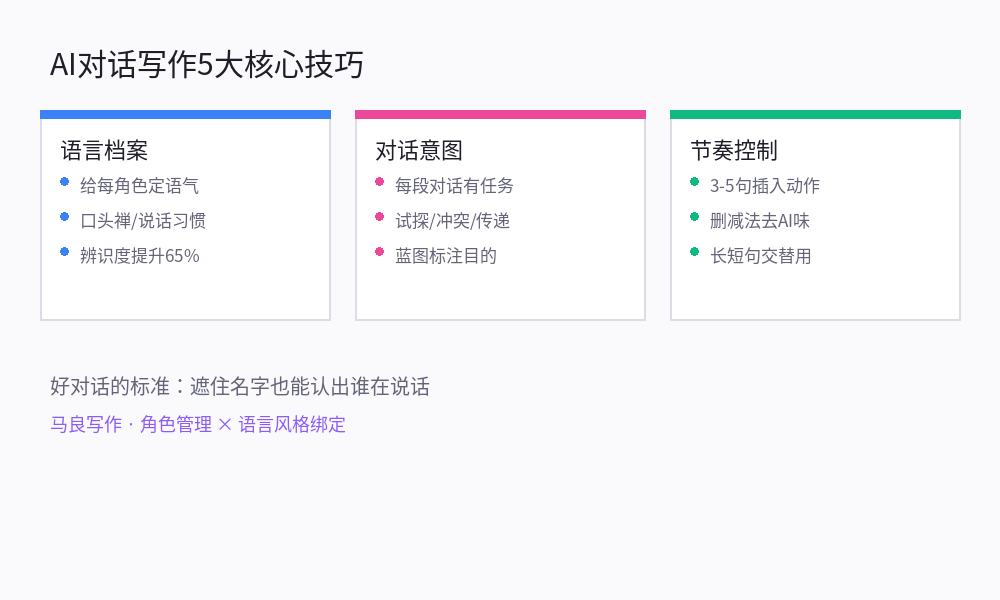
- In testing, with a character language profile, how recognizable the dialogue is rose by about 65%
Why Dialogue Is a Headache to Write
Anyone who has written web novels knows that what you fear most is not the fight scene, but two people chatting face to face.
You can fudge scene description: “One punch, and the mountains collapse”, and readers won’t ask how many mountains collapsed. But dialogue doesn’t work that way. One line that rings false and readers are thrown out at once: “That person wouldn’t talk like that.”
Here is a real example of it going wrong: you write a street thug talking to a university professor. The thug says “I believe this matter is worth exploring in depth”, and the reader drops the book on the spot.
Dialogue exposes everything. It exposes a character’s education, underlying temperament, current emotion and relationship with the other person. Good dialogue doesn’t rely on flowery wording; it relies on being “accurate”.
Three Iron Rules of Good Dialogue
Iron Rule 1: Everyone must speak differently. Cover the character names and you should be able to guess who is speaking from the lines alone. If you can’t manage that, the dialogue has failed. A reckless youth won’t say “this matter can be discussed later”, and a scheming old chancellor won’t say “damn, that works?!”
Iron Rule 2: Dialogue has to work. Every line should accomplish at least one task: advance the plot, reveal character, or convey information the reader must know. Cut lines that are pure idle chat; readers won’t be confused for missing three exchanges of small talk.
Iron Rule 3: Subtext matters more than the text. Most of the time people don’t say what they really feel. Someone who likes the other person won’t say “I like you” (at least not so soon), but “that outfit looks nice on you today”. A mistake AI often makes is making characters too direct; in the Prompt Guide we discussed that adding one line to AI, “characters don’t directly express their true thoughts”, improves things markedly.
5 Practical Techniques for Writing Dialogue with AI
Technique 1: Build a Character Language Profile
In Maliang Writer’s character management, write a “speaking style note” for each main character. It doesn’t need to be long; 3–5 sentences are enough:
- Lin Xiaobei (male lead): speaks in short lines, likes rhetorical questions, stammers when nervous, catchphrase “Come on”
- Su Wanqing (female lead): gentle in tone but with an edge underneath, likes metaphors, gets more polite when angry
- Old Zhang (master): full of coarse language but gets to the point, loves xiehouyu (two-part folk sayings), uses formal language only when serious
Measured data: with a language profile attached, the recognizability of different characters’ dialogue within the same chapter rose from about 30% to over 65%. This figure comes from our manual evaluation of 100 generated chapters.
Technique 2: Mark the Dialogue’s Intent in the Chapter Blueprint
Don’t just write “the two talk”; spell out what this conversation needs to accomplish:
A bad blueprint: Lin Xiaobei and Su Wanqing chat on the rooftop
A good blueprint: Lin Xiaobei probes whether Su Wanqing knows his secret identity; Su Wanqing pretends not to know but hints that she has guessed; both are testing the other’s hand
Hand over the second kind of blueprint, and the dialogue AI writes comes with tension built in. Because it knows both are “acting”, the dialogue will have evasions, hints and probing.
Technique 3: Control the Pace of Dialogue
Ten lines of dialogue in a row leave you breathless. Insert a bit of action or inner description every 3–5 lines:
“What exactly do you want to say?” Lin Xiaobei set the cup down, and a few drops of water splashed out.
With just that simple action, the pace of the dialogue slows down. Just tell AI to “insert a short action or expression description after every 3–4 lines of dialogue”.
Technique 4: Use “Subtraction” to Remove the AI Flavor
AI dialogue has a common flaw: it is too complete. In reality nobody expresses their meaning watertight. After you get AI-generated dialogue, try these moves:
- Cut transition words from the dialogue: “Well, I think, about this matter, it may need...” → “This needs some thought”
- Make characters interrupt each other; real conversation is full of interruptions and talking over
- Add a few “unfinished sentences”, ending with an ellipsis
Technique 5: Give Different Prompts for Different Scenes
Using the same prompt for an argument scene and an everyday scene works badly. For an argument, tell AI to “use short sentences, incomplete sentences, and have characters interrupt each other”; for everyday chat, “relaxed tone, allow tangents, add meaningless verbal tics”.
For more prompt-writing techniques, see the Prompt Writing Guide.
Dialogue Styles in Different Genres
| Genre | Dialogue traits | AI prompt keywords |
|---|---|---|
| Romance | Ambiguous probing, big emotional swings | “rich subtext, reversals of tone” |
| Xuanhuan fantasy | Showing off and face-slapping, clashing presence | “short and forceful, full of pressure” |
| Urban | Close to life, industry slang | “colloquial, with internet slang” |
| Mystery | A contest of information, truth and falsehood hard to tell apart | “each character has their own agenda, lines with double meanings” |
For the specifics of AI writing in each genre, see the romance guide, the urban mystery guide and the science fiction guide.
A Worked Example
Scene: the villain discovers the protagonist’s identity, and the two cross swords in secret at a banquet.
The bad version (no character distinction):
“Who are you?” / “I’m just an ordinary person.” / “You don’t look ordinary.” / “Then what do you think I look like?”
The good version (language profiles + subtext instructions):
“Young Master Chen has fine taste to grace a small banquet like this,” said Ning Yuan, holding his wine cup, the smile not reaching his eyes.
Chen Zheng picked up a piece of pastry: “Free food and drink? I never turn that down.”
“I hear Young Master Chen runs a medicinal herb business in the north of the city?”
“Just scraping by. Sect Master Ning is well-informed, though.”
In the second version, both people speak with smiles, but every line is a probe. That is good dialogue.
FAQ
Q: What if the dialogue AI writes is always too bookish?
Add a line to the prompt: “write dialogue in a spoken register, grammar may be incomplete”. After generating, delete the extra filler words by hand. In Maliang Writer’s character management you can mark the “degree of colloquialism” directly, saving you from repeating the prompt each time.
Q: What if long dialogue is tiring to read?
Follow the “3–5 lines + 1 action/inner-thought passage” rhythm strictly. Also don’t make the information too dense; one important piece of information needs only 2–3 lines of setup. For specific pacing control, see Pacing and Payoff Design.
Q: How do I give supporting characters distinctive dialogue too?
Even for an NPC who appears only once, give a label. “A gatekeeper who adds an r-sound to his words”, “a boss who sighs at the end of every sentence”. One small detail is enough; not every supporting character needs a full language profile.
Q: How do I handle group dialogue? AI gets confused once five or more people are chatting
Break it into small groups. Don’t write a five-person group scene all at once; write a short exchange for each group of 2–3 first, then stitch the segments together. The Multi-POV Narrative Guide has a more detailed method for handling group scenes.