
Multi-POV & AI Writing: Ensemble Fiction Secrets
Rules for switching POV, allocating information and converging storylines, plus AI character-state tracking to manage ensemble stories with 30+ characters.
In this article 7 sections
Last updated: 2026-03-09 | Reading time: about 16 minutes
Key Points
- The greatest value of multi-POV narrative is the “information gap”: different characters know different things, and the reader knows more than any one of them
- Every POV thread must stand on its own: pulled out alone, it should still be an interesting story, not a footnote to the main plot
- Don’t run more than 3 POV threads at once; beyond 3, readers get confused
- The key to AI writing multi-POV is “switch the prompt every time you switch POV”, so AI forgets the previous character’s mind
- Maliang Writer’s multi-character management and storyline features naturally support multi-POV writing
When to Use Multiple POVs
Not every novel suits multiple POVs. Before using them, ask yourself three questions:
-
Do at least 2 characters each have their own compelling storyline? If a supporting character’s POV only fills in information the protagonist can’t see, it’s better handled by “someone else relaying it”, with no need to switch POV.
-
Is the information gap your core selling point? The greatest value of multi-POV is this: the reader learns the truth through POV A, then, when watching POV B, knows B is being kept in the dark. The tension of this “omniscient view” can only come from multi-POV.
-
Can your readers accept their rhythm being interrupted? Switching POV means interrupting the current reading rhythm. If you write fast-paced payoff stories, switching POV frequently may backfire.
Genres that suit multi-POV: palace intrigue, political scheming, mystery and detection, group transmigration, apocalypse survival, war. Genres that suit it less: level-up-and-fight, sweet romance, system-flow.
Supporting data: on our platform, multi-POV works have an average bookmark conversion rate about 18% higher than single-POV ones, but a completion rate about 12% lower. This suggests multi-POV more easily “gets people to click in”, but also tests your execution more.
3 Iron Rules for Switching POV
Iron Rule 1: A switch must be marked. Every time you switch POV, use an obvious chapter title or divider to show whose POV it is. Don’t switch back and forth frequently within a chapter; web-novel readers are used to “scrolling straight through”, and switching POV forcibly interrupts that.
Iron Rule 2: Switch at a “suspense point”. POV A is at a tense moment, and you suddenly cut to POV B. Readers anxiously wait for A’s continuation while having to follow B’s plot as well. This is the “double-thread hook”. Never cut away from POV A at a “flat moment”; readers then lose interest in A’s plot completely.
Iron Rule 3: Every POV chapter must have its own draw. Readers have to read B to see A’s continuation, but if B’s chapters are dull, readers skim past them quickly or even drop the book. Every chapter of every POV needs its own payoff points and hooks, and can’t be a “tool chapter that just feeds information to the main plot”.
The Core Difficulty of AI Writing Multi-POV
AI writing multi-POV has one fatal problem: it can’t truly “forget” what another character knows.
You ask AI to write a chapter from B’s POV, but AI “knows” all of POV A’s information. As a result, B inadvertently reveals in dialogue something only A knows, and the POV collapses.
Technically this is called “information leakage”. Solutions:
Solution 1: Reset the Context on Every POV Switch
In Maliang Writer, build an independent “POV setting” for each POV character, stating:
- What this character currently knows
- What this character doesn’t know (a red line!)
- This character’s impressions of other characters (which may be wrong)
When switching POV, explicitly reference that character’s “POV setting” in the chapter blueprint, and add one line: “This chapter is narrated strictly from [character name]’s POV, and must not include information this character doesn’t know.”
Solution 2: Generate Separately, Then Merge
A safer approach: generate several chapters of each POV thread independently, and interleave them along the timeline once finished. That way each thread is generated completely unaffected by the others.
Solution 3: Let AI Self-Check
After generating a chapter, use a prompt to have AI check: “Please check the following content and confirm that [character name] doesn’t use or imply any information he/she couldn’t possibly know. The information this character currently knows is: [list]”.
Converging Threads: The Highlight Moment
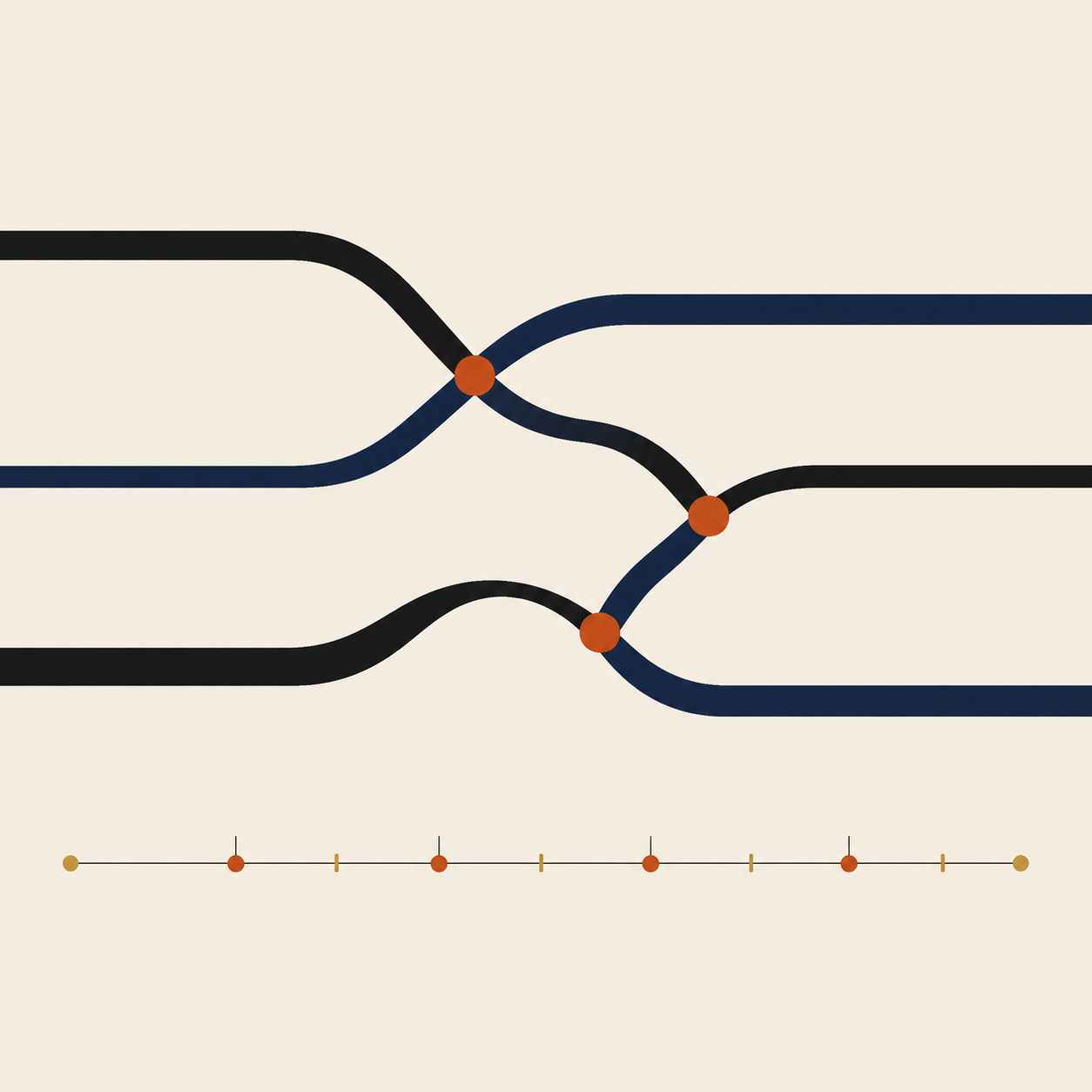
The most brilliant moment in multi-POV narrative is the “merge”, when storylines that have each been running their own course meet at a certain node.
Classic convergence patterns:
Collision: A and B have each been acting on their own, then suddenly face to face. All of both people’s accumulation collides at this moment, and the reader, having followed both sides, knows each person’s stakes and hidden cards, more than the people involved do. The tension is at its maximum.
Jigsaw: Thread A reveals half of the puzzle and thread B the other half. When the two threads merge, the reader finally sees the whole picture: “So that’s how it is!”
Misalignment: A thinks B is an enemy, and B thinks A is an enemy. The reader knows the two should actually be allies, and waits to see when they discover the truth.
Mark the “convergence points” already at the outline-planning stage. In Maliang Writer’s storyline feature, each storyline can be managed independently and marked with crossing nodes. See Storylines and Plot Nodes for details.
Managing an Ensemble Cast in Practice
Multi-POV fiction usually involves 5 or more important characters. Managing so many characters isn’t easy.
Practical advice:
-
Give every character a “core label”. One word is enough: “avenger”, “guardian”, “rebel”, “bystander”. This label determines the character’s default reaction tendency in each event.
-
A character relationship table. A simple matrix: A’s attitude toward B, B’s attitude toward A, C’s attitude toward A and B. Update it as the plot goes on. Save it in Maliang Writer’s character management.
-
Control the appearance rhythm. If there are 5 POV characters, don’t develop the 5 threads with equal weight. Usually 1–2 “main POVs” take 60% of the space, and the other 2–3 “secondary POVs” take 40%. Secondary POVs only need to appear at key nodes.
-
Distinguish language styles. Multi-POV fiction demands more in distinguishing characters’ speaking styles. Each POV character’s narrative voice should also differ: use a restrained style for a calm character’s POV and a hurried one for an impulsive character’s POV. Write these into the character settings and AI will follow them.
For more character management methods, see the Character Development Guide. For distinguishing dialogue styles, see the Dialogue Writing Guide.
FAQ
Q: Will readers skip POVs they don’t like?
Yes. That’s why every POV must have its own draw. If you find readers generally skip a certain thread, that thread isn’t attractive enough; either strengthen its dramatic conflict or reduce its length.
Q: Will a multi-POV work be much longer than a single-POV one?
By our statistics, multi-POV works average about 35% more characters than single-POV works in the same genre, because you need to cover each thread’s progress separately. For AI-assisted writing this isn’t a problem: use Maliang Writer to generate chapters of different POVs in batches. For more long-form management tips, see Long-Novel Consistency.
Q: First-person multi-POV or third-person?
Third-person is recommended for web novels. First-person multi-POV has stronger immersion, but switching among several “I”s easily confuses readers. If you do use first person, the start of every chapter must use the largest heading to state “whose POV this is”.
Q: How do I manage the timeline? What if the threads’ times aren’t in sync?
There are two ways: one is to advance all threads in sync (alternating A’s Monday and B’s Monday); the other is for the threads to progress at different paces in time but align at the convergence points. The latter is more flexible but harder to manage. We suggest drawing a timeline in the outline and marking the actual time of each chapter, to avoid the awkward case of “one day passes in thread A and a week in thread B”. Maliang Writer’s knowledge graph can help track timeline consistency.