
How to Write Characters: Profile Cards, Character Threads, Storylines
How to write character profiles: goals, weaknesses, threads and storylines, plus a full exercise, copyable examples, hit-book breakdowns, and a starter kit.
In this article 13 sections
The Short Answer: A Character Profile Is How a Character Chooses
A character profile isn't a string of adjectives. "Cold, scheming, cold outside but warm inside" on a card could be reused in any other book, and readers won't remember it.
A profile you can actually use answers five questions:
- What does he want? (surface pursuit)
- What is he really missing? (deep need)
- What is he afraid to lose, and where can people get leverage on him? (weakness)
- How does he talk?
- What is his first reaction when something goes wrong?
Once these five are clear, how the character should choose and speak in any scene is mostly settled. Below, we go in this order: character profile → supporting characters → character threads → storylines → keeping a long novel consistent.
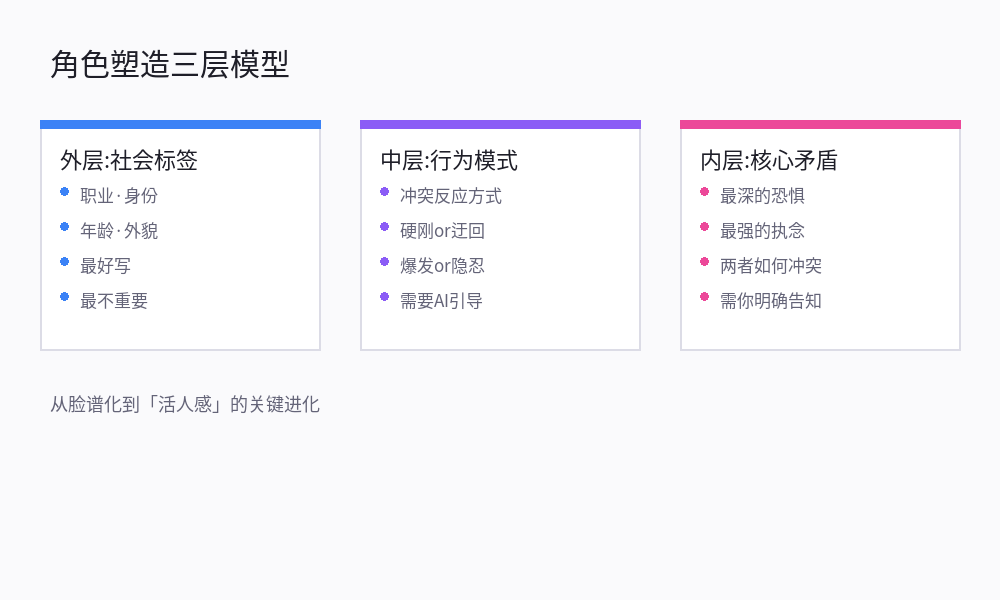
A Character Card That Works: How to Fill In the 8 Fields
Write your protagonist in detail and hit the key points for supporting characters. These 8 fields are the character card structure we actually use in long-form projects:
- Summary: one sentence on who he is and what he does in the story.
- Appearance: three sentences at most, covering only the traits readers will see again and again.
- Background: only the part of his past that affects the choices he makes now.
- Personality: write it as behavior, not adjectives. "Stubborn" is weaker than "when praised, he points out his own mistakes first."
- Goal: what he needs to get in this volume.
- Conflict: who or what stands between him and his goal.
- Secret: what he doesn't want someone to find out, and what happens when it comes out.
- Weakness: who can get leverage on him, and with what.
At the top of the card, also write a short passage on how he talks: sentence length, catchphrases, how his tone differs with superiors and with friends, ideally with two or three sample lines. Speech style is what the AI loses most easily when continuing a story, and putting it up front makes it least likely to be ignored.
Surface Pursuit and Deep Need: The Engine of a Character
The surface pursuit is the goal the character states aloud: get into the inner sect, earn enough money, find out how his father died. The deep need is something he may not even admit to himself: to be acknowledged, to be favored, to never be left behind again.
A character gets interesting when the two don't line up. Take a bookkeeper who saves every coin. His surface pursuit is buying back the family's old house, and his deep need is to prove he's not "the one who dragged the whole family down." So when someone says in public that he's useless, he makes a choice that goes beyond his own calculations. Readers tend to remember exactly those moments.
Weakness and Secret: Give Conflict Something to Grab
A character with no weakness can only be pushed along by outside forces. A usable weakness has two traits:
- Specific: "soft-hearted" is too broad. "Can't stand seeing a child go hungry" can become a scene.
- Exploitable: once a villain, rival, or even an ally knows the weakness, they have a way to apply pressure.
The same goes for secrets: spell out "if this comes out, whose attitude changes?" That directly decides how the relationship thread gets arranged later.
Speech Style: Recognizable Even with the Name Covered
When readers can't tell characters apart, it's usually because everyone talks in the same voice. You can separate them in three ways:
- Sentence length: some people only say half a sentence, others love to reason things out and use analogies.
- Catchphrases or habitual words: few and precise, and best when called back once at a key moment.
- Tone toward different people: polite to elders and sharp-tongued with brothers is far more useful than "outgoing."
You don't have to avoid interior thoughts. At a key point, one line of the character's own thinking is often more precise than a long stretch of action. What to avoid is the stock phrase "a surge of XX rose in his heart."
Supporting Characters: Role, Memory Hook, Anchor, and Their Own Goal
More supporting characters isn't better, but every important one needs four things spelled out:
- Role: what he gives the reader in the story. Common roles include the character who piles on the pressure (leaving readers frustrated, so the later release lands harder), the onlooker (amplifies the satisfaction), the validator, the defender, the mouthpiece (says what readers are thinking), the partner, the mirror foil, the nemesis, and the sacrifice. Don't stack three characters in the same role within one volume.
- One-line memory hook: recognizable even with the name covered, for example "the bookkeeper who keeps everyone's accounts but never his own."
- Anchor: a catchphrase, an object, or a habitual gesture, called back at key moments.
- Their own goal: a desire that doesn't depend on the protagonist. If a supporting character exists only to serve the protagonist, readers won't feel for him.
A supporting character's big moments should be on the protagonist's side. A protagonist who is suppressed by supporting characters for long stretches, or whose key choices get taken over by them, is a common reason readers drop a book.
Once you've mapped out these eight core elements and are ready to build your files, download a genre-specific Xuanhuan Character Sheet, Xianxia Character Sheet, or Urban Fiction Character Template to fill in directly, or browse more categories on the Templates Hub (in Chinese).
Learning Characters from Hit Books: Study the Setup, Don't Copy Names or Plot
The most direct way to see how characters are usually set up in a genre is to take apart similar hit books: what the protagonist wants, why the villain is able to suppress him, what role each core supporting character plays, and how much space the romance thread and the brotherhood thread each get.
Maliang Writer's Public Library collects character and structure breakdowns of over 1,500 hit serials, and every book has a character overview page you can compare directly:
- Character Overview: Lord of the Mysteries (Guimi zhi Zhu)
- Character Overview: Notes of the Northern Tomb Raiders (Beipai Daomu Biji)
- Character Overview: Sword of Coming (Jian Lai)
- Character Overview: Tales of the Herding Gods (Mushen Ji)
While reading, watch for three things: what each major character wants, fears, and is stuck on; what role each supporting character beside the protagonist plays; and in which volume a relationship changes irreversibly. What you're learning is the method of setup. Don't copy names, settings, or plot.
Character Threads: Which Emotional Payoff Is the Reader Waiting For?
What draws readers into a character thread isn't just that the character "grew." It's the emotional payoff the reader is waiting for arriving on schedule: being acknowledged, being favored, being protected, an enemy getting settled with, a brother repaying a debt, a partner catching you at the critical moment. When we read the paragraph comments on hit serials, we found that the places where readers stop to comment are almost always a line, an action, or a reckoning between two people.
Three practical rules for arranging character threads:
- Pair setup with payoff. When someone sneers at the protagonist, brushes him off, or looks down on him, you've given the reader an IOU: pay a small installment within a chapter or two, and a big one dozens of chapters later. Setup without payoff leaves readers feeling strung along.
- Write strong payoffs in a concentrated stretch. A thread's climax written as one arc across several consecutive chapters hits harder than the same material spread evenly. Before heavy material like a sacrifice or a reveal about someone's origins, that character should appear early and plant a catchphrase or a promise that you call back at the right time.
- Set the density by genre. In female-oriented and mystery stories, character interaction is the foundation: relationship threads are dense, and every point that makes readers angry needs a reckoning. In male-oriented genres like system, rich-tycoon, and officialdom stories, character beats are fewer and weightier, and each one should be written as a scene worth a screenshot.
Character arcs fit into this same frame. A growth arc (cowardice to responsibility), a fall arc, and a flat arc (the character doesn't change but changes the people around him) all work. What matters is that the change happens in choices the reader can see, not in a narrator's line saying "he had changed."
How Character Threads Connect to Storylines
The storyline decides "what must happen and what readers are waiting for," the volume outline decides "which stage it goes in," and the chapter outline decides "which chapter, and how readers live through it." For each node in a character thread, we suggest writing four lines like this:
Planned for: Chapter 38
Function: major payoff (answers the setup in Chapter 6)
What the reader is waiting for right now: will she speak up for him in public?
The scene: in front of the elders of all three branches of the family, she gives up her own seat to him, at the cost of losing a vote.
Follow it with a short causal chain: the cause, who made what choice, what it cost, how the relationship differs before and after, and a final line on which other thread it moves.
Once you've laid it out, look back for three kinds of problems: which thread has been silent for many chapters in a row (gaps), which setup has never paid off, and whether the people the payoff scene needs are actually scheduled to appear in that chapter. The earlier you catch these three, the less rework you'll do. For more outline methods, see novel outline templates.
Why Characters Drift Late in a Long Novel
Characters rarely break all at once. Most of the time they slide a little at a time: an injury from earlier is forgotten, a relationship that fell apart acts as if nothing happened in the next chapter, a supporting character's catchphrase ends up in someone else's mouth. The cause is that after dozens of chapters there's too much backstory, and neither the author nor the AI can hold it all.
The fix is to record "the characters as they are now" separately and update it every chapter:
- State: injuries, cultivation level, identity changes.
- Relationships: who they've made an enemy of, whose favor they owe.
- Location: where each person is.
- Experiences and items: what they've gained and lost.
- Foreshadowing: what this chapter planted and what it paid off.
Maliang Writer's Story Archives work this way. After a chapter is written, the character's state, relationships, location, and foreshadowing records are updated from the text. Anything that conflicts with the existing story bible gets flagged separately for the author to confirm, and the story bible is never changed without you. When continuing, the AI reads these archives and the preceding text first, then writes. See AI Novel Continuation.
A Full Exercise: From a Character Card to Relationships to the First Scene
Below is an exercise built on the original teaching story City of Borrowed Fire (Jie Huo Cheng). It is not an excerpt from a hit title or a test record. Shen Yan is a wall-repair apprentice who needs to borrow a cart to haul materials. A-He is the cart mechanic, and she wants the shop not to absorb the losses of a public task by itself.
| Layer | Shen Yan | A-He | Change that can enter the text |
|---|---|---|---|
| Character profile | Wants to prove he can handle things on his own, afraid of owing favors | Willing to help, but cares about old orders and wheel wear | She doesn't agree unconditionally the moment he asks |
| Relationship | Needs her cart and her route knowledge | Needs him to admit and take responsibility for the delay | From a verbal request to a conditional partnership |
| First scene | Promises first: "I'll return it before dark" | Presses: "Are you promising the cart, or wheels that still turn?" | He has to write the wear and the delay into his application |
| Later character thread | Learns to state the risk instead of taking it all on alone | Watches whether his promise is kept | The next collaboration depends on the consequences of the last |
Draft passage:
"Back before dark." Shen Yan took his hand off the handlebar.
A-He flicked a loose wheel pin. "Are you promising the cart, or wheels that still turn?"
Shen Yan looked at the delivery slip behind the door. "I'll put the wall-repair wear in the application. And the delayed shipment, too."
The scene never says directly who is kind and who is stubborn. The characters come across through conditions and choices. What you can confirm at the end of the scene is "Shen Yan promises to apply to take responsibility," not "the compensation has been approved," and certainly not "A-He will support him unconditionally from now on."
The exercise order can be: first set goals and weaknesses with the Character Profile tool, then spell out both sides' conditions in Character Relationships, then put them into a refusal or a negotiation in Character Scene Test. When you're actually preparing to write the novel, use the three-level outline system to place the scene in your chapter outline and confirm how it moves this volume's goal forward.
To get a full character biography and a blank template, read the Character Examples Library. To see how the characters in the same story connect to the master outline, volume outline, and first three chapters, read the Long Novel Starter Kit. To compare before-and-after revisions, read the Original Long Novel Case Study.
How to Do This in Maliang Writer
- Starting a new book: tell the AI what you want to write. It draws on the character setups and pacing of hit books in the same genre and works with you to set the protagonist, villain, and core supporting characters, then arranges the character threads and volume outline. You confirm every step. You learn the method, not copy plot or names.
- Just want a character card first: use the free Character Profile Generator, pick a genre and a character role, then revise the result using the 8 fields in this article.
- Already writing: have the AI go through your existing storylines and character threads to find gaps, setups that never paid off, and characters who can't make it onto the page. Manage worldbuilding and character settings together in Worldbuilding.
FAQ
Q: How do I write a character profile that isn't a stereotype?
Use fewer adjectives and write more choices. Give the character a surface pursuit and a deep need he may not even admit to himself, then a specific weakness people can use against him. When conflict hits, his choices will follow his own logic instead of a template.
Q: How long should a character profile be?
Write the protagonist in detail. For core supporting characters, spell out their goal, weakness, speech style, and relationship to the protagonist. For functional supporting characters, a one-line memory hook and one anchor are enough. Precise beats long, and speech style especially should go first.
Q: How do I write a villain who doesn't act stupid?
Give the villain his own interests, methods, and bottom line. He isn't bad just for the sake of being bad. He believes what he's doing is right. The smarter the villain, the more weight the protagonist's win carries.
Q: What if a supporting character has no presence?
First confirm his role, then give him a memory hook, an anchor, and a goal that doesn't depend on the protagonist. Supporting characters also need interactions that don't pass through the protagonist, or the ensemble won't feel alive.
Q: What's the difference between a character thread and a storyline?
The storyline covers "what must happen," and the character thread covers "which person or relationship the reader is waiting on for an emotional payoff." The nodes of a character thread should land on specific chapters and meet the main plot in some chapter.
Q: What if the characters fall apart late in a long novel?
First organize the characters' current state, relationships, locations, and planted foreshadowing into an archive, then compare it against the last few chapters to find the deviations. After that, update the archive after every chapter and read it before continuing. You'll have far fewer mismatches, and they'll be easier to find.
Q: Can I use character setups from popular novels as reference?
Yes, you can reference the setup and technique, such as which roles a genre usually needs and at what stage relationships turn. Don't copy names, settings, or specific plot.