
Maliang Writer drafts in your voice, avoids vague summaries and formulaic chapter endings, then checks typos, names and AI flavor with exact locations and fixes.
Why You Can Spot AI-Written Fiction at a Glance
When readers say it has “a strong AI flavor,” they usually mean these things:
- Characters have no judgment: small gestures like “he didn't look up” or “her eyes were calm” stand in for what the character is actually thinking in the moment
- Every book has the same tone: fantasy, romance and mystery all read in the same narrative voice
- Chapters end on uplift: every chapter closes with a golden line, a resolve monologue or an empty shot of scenery
- Odd punctuation: the narration uses so many em dashes that it doesn't feel like a real author
It's better to avoid these problems while writing than to fix them afterwards.
What the Writer Watches for While Drafting
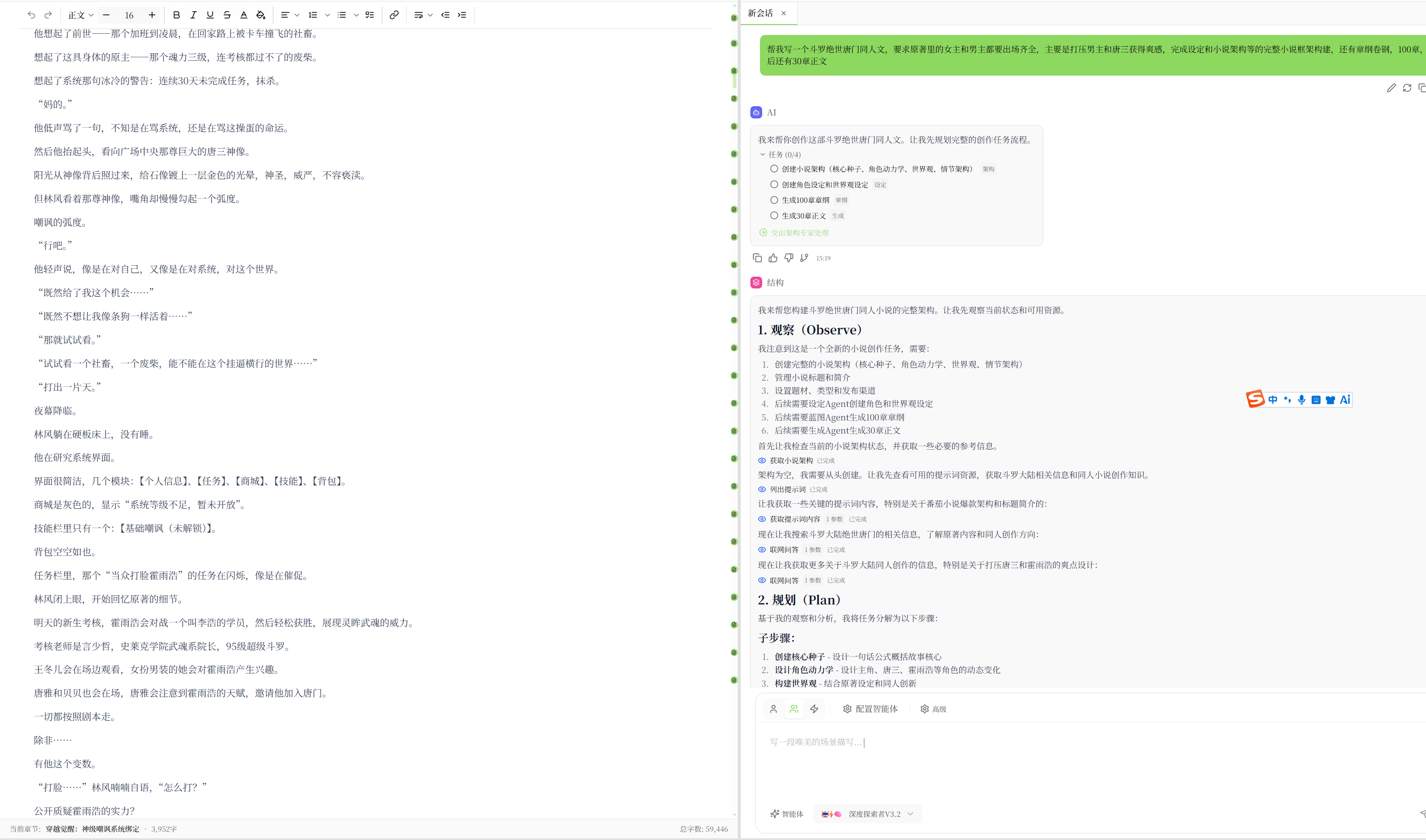
Before it writes a word, the writer agent in Maliang Writer has clear requirements:
- It reads your earlier text first: it identifies the voice of the book and works the protagonist's in-the-moment judgment into the narration
- It writes within a style range: it measures sentence length, share of long sentences, paragraph length and punctuation frequency from your earlier text and gives the writer a range, not adjectives like “beautiful prose”
- It tells light from heavy: in a light book, characters banter and joke; in a serious book, it doesn't force in gags
- It references the original text, not analysis: when imitating, it pulls original passages from the reference works by scene, such as a dialogue showdown or an emotional peak, so the writer sees how it's really done
- Fewer em dashes: extra em dashes in narration are changed back to colons or commas; those in dialogue are left alone, and so are ones the author habitually uses
What You Can Check After Writing
When needed, you can run checks on any chapter, and every issue comes with its location, cause and fix:
- Chapter diagnosis: scores from multiple dimensions and attaches evidence from the text
- Typos, repeated sentences and name spellings: finds wrong characters, repeated sentences and different spellings of the same character
- Chapter-ending diagnosis: identifies useless endings and, using chapter-ending statistics from popular works, suggests a better ending type for your genre
- Style comparison: compares paragraph length, sentence length, dialogue share and punctuation between your chapters and reference works, and points out where it drifts
- AI-flavor removal rewrite: clears odd punctuation and filler words and restructures symmetrical Q&A and summary uplift, only subtracting and never adding new plot; a polish-and-expand mode is also available
AI-rate detection connects to a third-party service and uses credits at the detection price.