
Write Prose or Organize Materials: Switch Between Two Views
Two mindsets: writing prose, organizing materials. Switch between immersive and document views, and know when to file new settings and foreshadowing.
In this article 7 sections
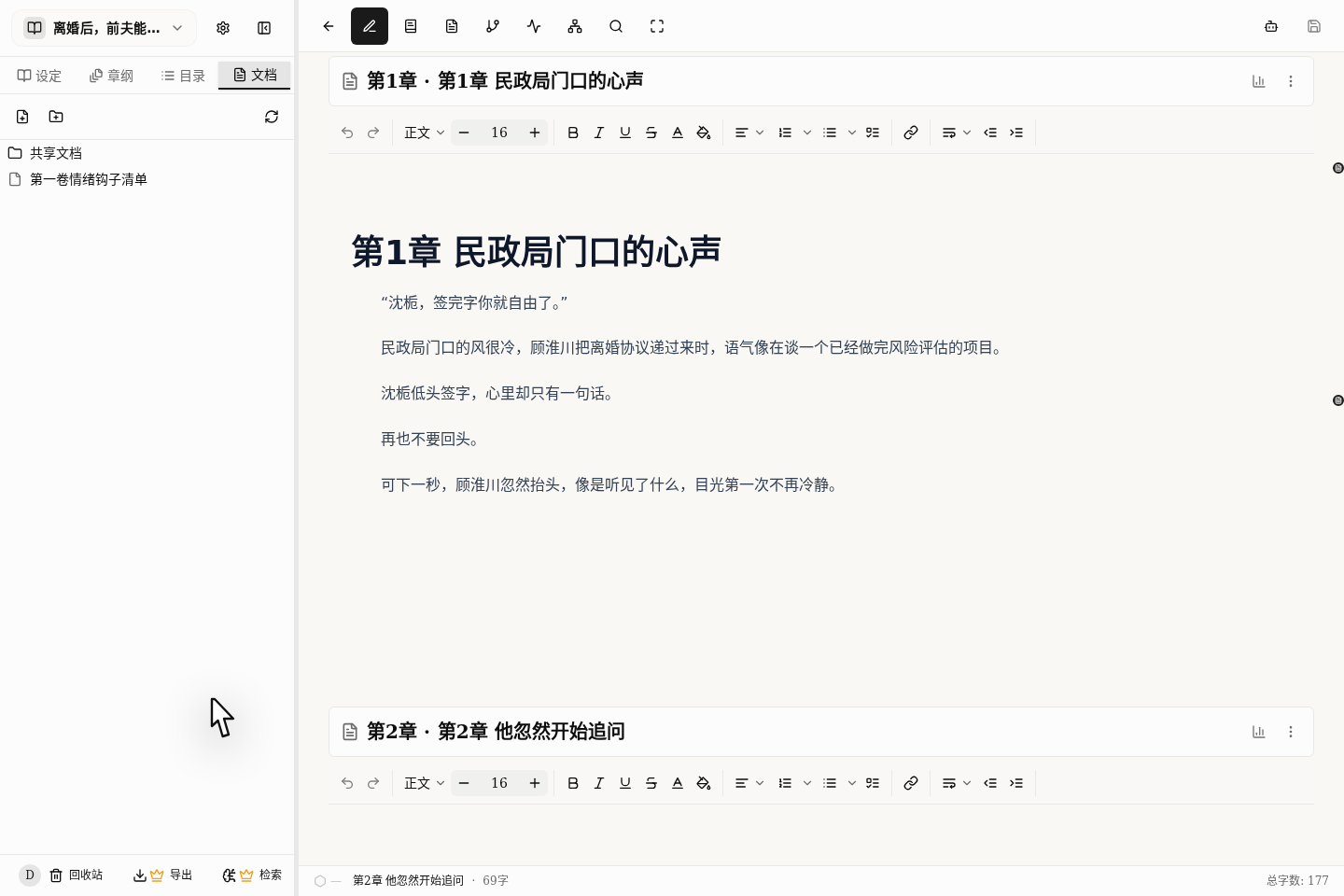
Many authors get stuck not because they can't write, but because they have piled the main text, blueprints and materials all together. For a novel like "After the Divorce, My Ex-Husband Can Hear My Thoughts", which has to maintain an emotion line and a foreshadowing line over the long term, the main text and the materials must be kept apart for the writing to feel light.
First, tell three kinds of content apart
Main text
This is the chapter content readers will actually see; the focus is fluency and immersion.
Blueprint
This is the plan written for you and for AI; the focus is clarity, not literary quality.
Material documents
This is where you keep character profiles, foreshadowing lists, emotional hooks, stage goals and supplementary notes.
What is best put in the documents area
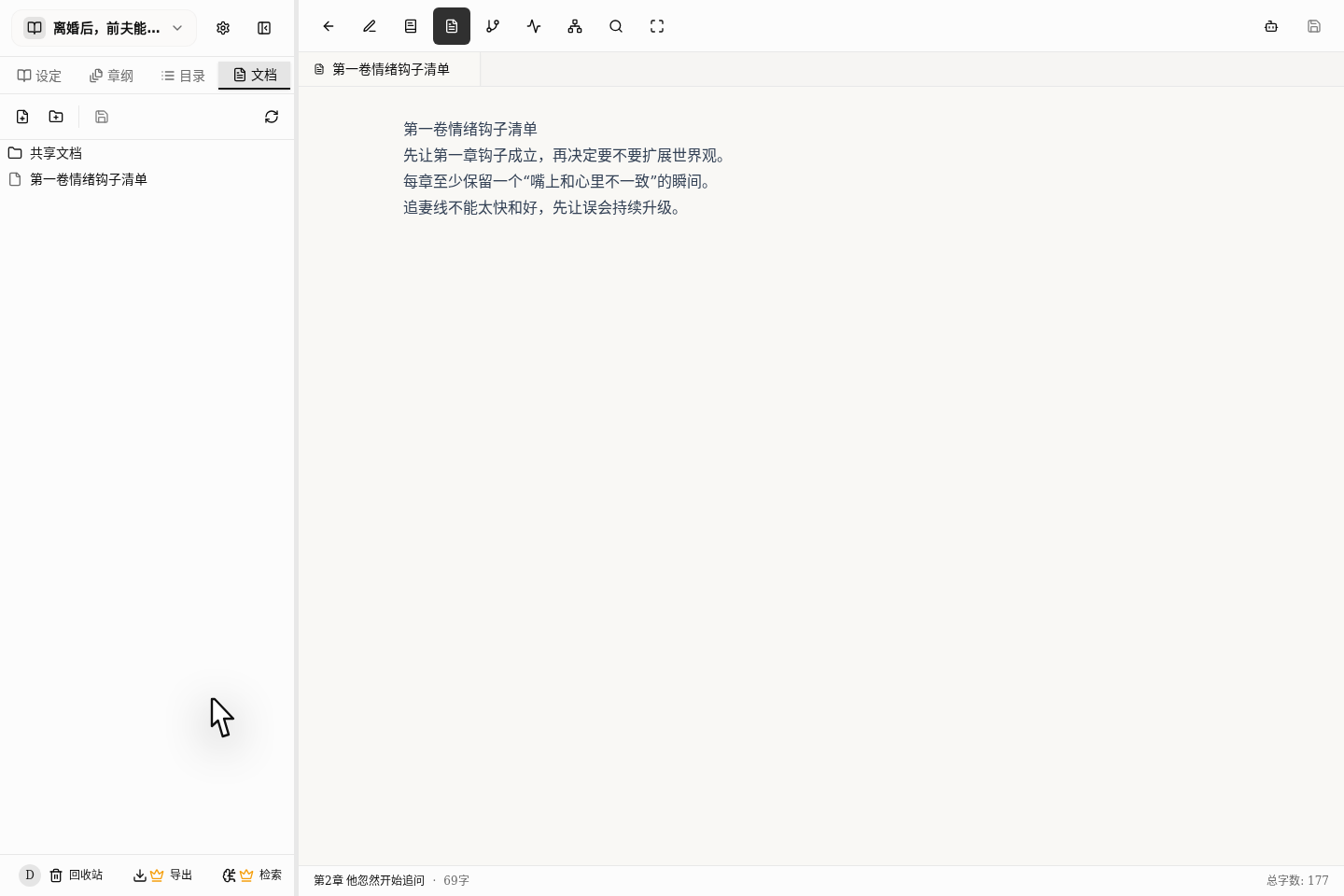
This demo created a dedicated document: "Volume 1 Emotional Hooks List". Content like this is especially suited to the documents area rather than being mixed into the main text:
- A list of the high-energy beats of a volume
- A table of what characters are hiding
- A foreshadowing and payoff plan
- Background explanations that don't belong in the main text
- To-do notes for yourself or collaborators
A very handy division of labor
We recommend dividing it like this:
- The main text area holds only what readers will see
- The blueprint area maintains only each chapter's goal and key actions
- The documents area maintains materials, lists, foreshadowing and stage summaries
That way, when you get stuck, you don't have to stare blankly at an empty main text; you first go back to the documents area to fill in information, then return to the main text and keep writing.
Why separating them actually makes it faster
Because the goals of the three kinds of content are fundamentally different:
- The main text should flow
- The blueprint should be workable
- The materials should be easy to look up
When they are mixed together, a change in any one place affects the other two.
The two most common mistakes
Writing creative notes directly into the main text draft
This makes them easy to forget to delete later, and inconvenient to search.
Creating documents without maintaining them
If material documents are never looked at again or updated, they lose their value quickly. It is best to update the documents area together with each volume.
How the documents area and material cards divide the work
The easiest thing to confuse here is that the documents area and the setting/character/suspense cards are not an either-or choice; they divide the work differently.
- Setting, character and suspense cards hold stable facts.
- The documents area holds volume-level lists, stage plans, rework to-dos and long notes.
- The main text area holds the narrative content readers will actually see.
What to connect next
Once the document system is set up, we suggest continuing with: