
Your First Chapter in 10 Minutes: The Fastest Path to Results
Want to see AI writing in action? Open a book from a one-line premise, let AI draft the chapter outline, then the prose. About 10 minutes, with screenshots.
In this article 7 sections
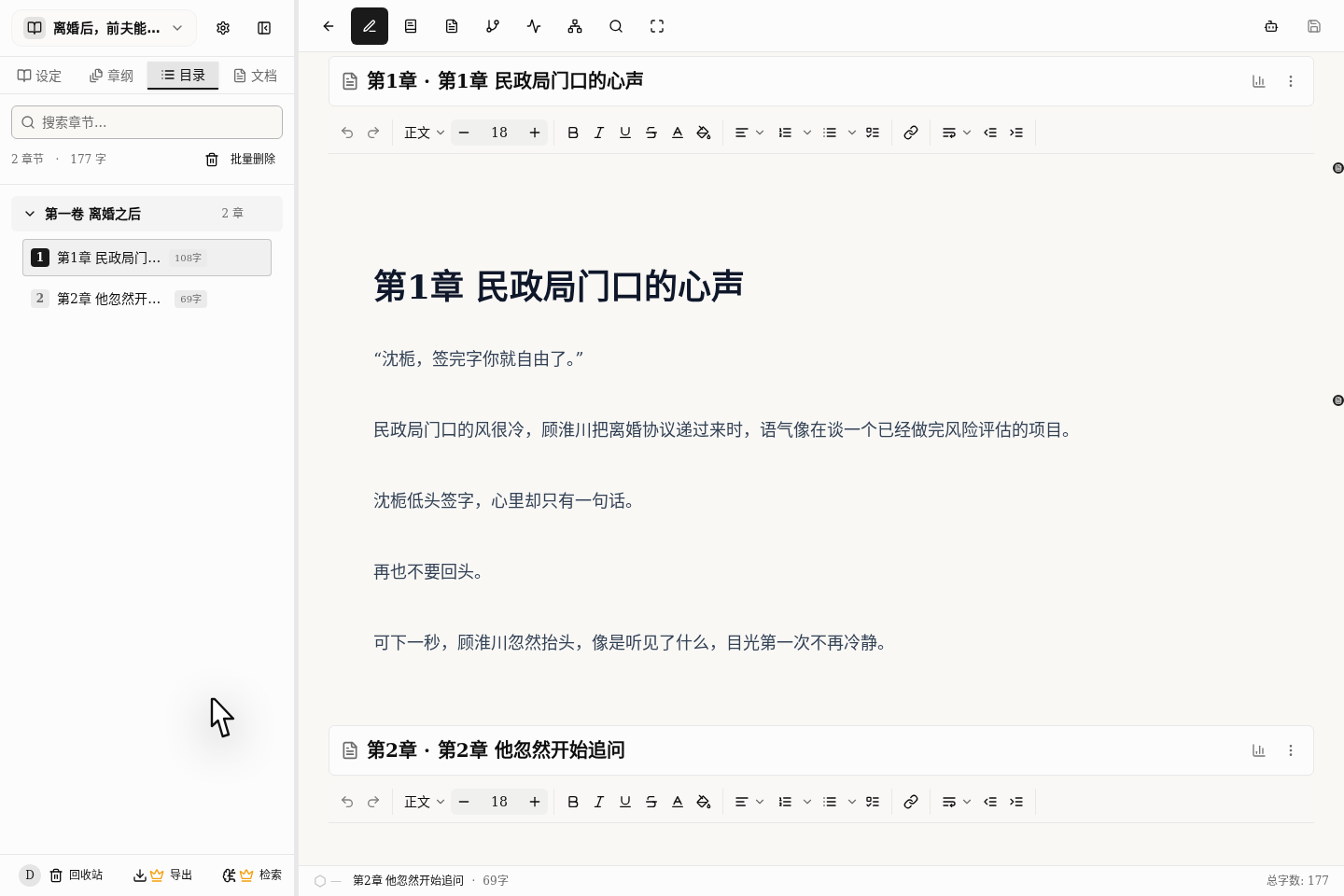
If what you most want to know right now is "can this premise produce a gripping opening immediately?", this page solves exactly that. The demo uses a women's-audience urban romance, "After the Divorce, My Ex-Husband Can Hear My Thoughts": our goal is not to finish all the worldbuilding first, but to write chapter one and see whether the hook, the emotion and the pull to keep reading are strong enough.
Who This Path Suits Best
This method suits these three situations best:
- You already have a selling point for the premise but haven't started writing
- You want to check whether the opening is strong before deciding on long-term serialization
- You need a readable sample chapter to show an editor, an operations colleague or a partner
If you are already planning a long novel of 500,000 characters or more, read Building a Three-Level Outline: Master Plan, Volumes, Chapters first.
Step 1: Come Up With a One-Line Idea
Don't write your request as a full page. Just make these 4 points clear:
- Genre and reader expectations
- The protagonist's current identity
- The conflict of chapter one
- What hook the ending should leave
Take this demo's premise as an example:
Women's-audience urban romance. The heroine Shen Zhi has just divorced and thinks she is finally free of her ex-husband Gu Huaichuan, only to find that he can hear her thoughts. Chapter one has to deliver the "ability reveal" and the "relationship reversal".
That is already enough to generate chapter one; you don't need to complete a volume outline first.
Step 2: Lock Down the Chapter-One Blueprint, Then Expand the Prose
A steadier order is not "write 2,000 characters right away", but to first confirm these 3 key moves of the chapter:
- What the information gap at the opening is
- How the conflict escalates in the middle
- What makes readers want to click the next chapter at the end

If the blueprint already contains the opening, the reversal and the hook, the chance of the prose drifting off course when you ask the AI to expand it is much lower.
Step 3: Once the Prose Is Out, Check Only 3 Things
After the first draft of chapter one appears, don't rush on to chapter two. First check:
- Whether the protagonist is the kind of person you wanted
- Whether the conflict keeps heating up instead of staying flat
- Whether the ending leaves a suspense that keeps readers following
This step is mainly about "is the direction right"; don't fuss over every phrase. If the direction is wrong, the more you write afterwards, the bigger the rework.
Step 4: Save the Information Chapter One Has Confirmed
Once chapter one passes, immediately save the reusable content into the project:
- Identity details for the protagonist and key supporting characters
- World rules the prose has already confirmed
- The key foreshadowing left at the end of chapter one
This directly affects how stable later AI writing is. You can continue with Managing Characters, Worldbuilding and Suspense: The Left Sidebar and Character and Setting Cards: What to Write, What to Let AI Fill In.
The Two Most Common Problems
Asking the AI to Do the Outline, Settings and Prose All at Once From the Start
When the task is too big, the AI tends to wander. For chapter one, only solve "does the opening work".
Not Organizing the Material After Finishing Chapter One
By chapter three or five, characters and rules start to drift. Chapter one is really the starting point of your later material library.
How to Continue From Here
If chapter one is running smoothly, we recommend continuing in this order: